Our free open access paper can be read via the link below.
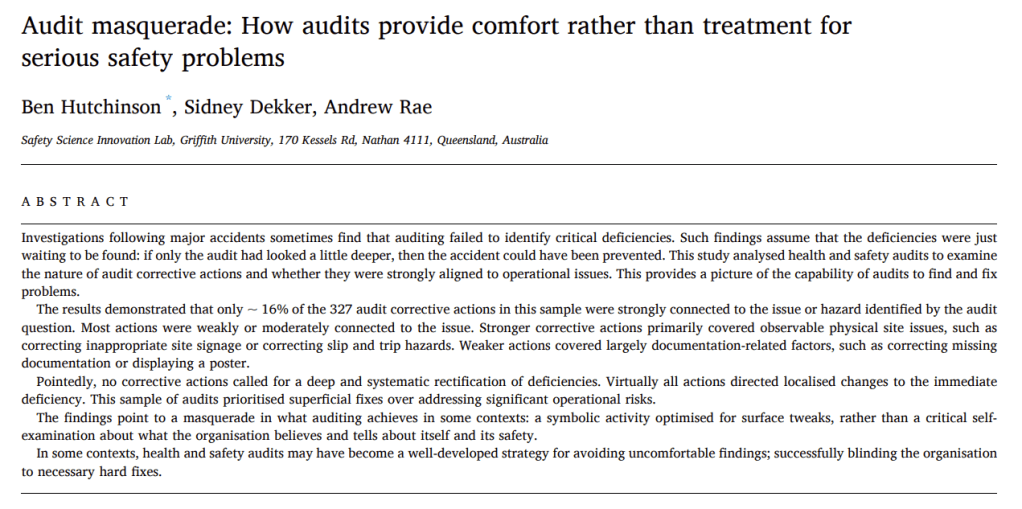
Some of the key findings in this sample were:
· What are the characteristics of assigned actions?
o A spread of audit findings involving the rectification of administrative defects and physical actions to rectify hazard-related defects.
o The most frequently assigned actions targeting administrative aspects involved rectification of incomplete or missing documents, and regarding physical defects the most numerous actions targeted the resolution of missing signage or the inspection, placement, or review of emergency equipment.
o There is an apparent over-representation of corrective actions involving communication (e.g., toolbox talks) even when the underlying hazard is not communication related.
o Audits that ostensibly had a focus on site communication practices focused almost exclusively on outputs of communication and not on communication practices per se.
· What is the strength of alignment between specific audit questions and actions?
o Weak and moderate strength actions were approximately equal at 39%. Most of these actions were administrative in nature (e.g., incomplete, or missing documents) and, for the weak actions at least, a substantial proportion had little discernible connection to a specific hazard or issue.
o 16% of actions had a strong connection to a physical hazard or issue and virtually all of these fell under the physical category. Just one example of design or engineering improvement actions was observed. No action directed attention to the systematic investigation and resolution of a class of issues.
o Most stronger actions still related to rather trivial and superficial physical hazards, such as inadequate signage or emergency equipment (first aid kits and fire extinguishers) and slip and trip hazards.
We found positive things about audits, too.
Of course, there were limitations in this sample. We hope this paper helps further the body of evidence around WHS auditing, which compared to other practices in safety, has comparatively less evidence.
In all, we don’t argue to abandon auditing, nor could our data substantiate this claim. This isn’t smoking barrel evidence against auditing.
We do however suggest a critical reflection on what auditing is believed to be achieving, and whether it’s actually achieving those goals.
Our next study (under peer review) evaluated the functioning of audits based on major accident reports, coronial inquiries, royal commission etc.
With that data, we were able to delineate some general trends in how investigators and accident panels believed auditing approaches to have failed. So watch this space.
Study link: https://doi.org/10.1016/j.ssci.2023.106348

 SafetyInsights.org
One thought on “The audit masquerade and the focus on paperwork over operational risk”