This study explored the adverse impacts that project complexity have on safety performance and the moderating role played by a resilient safety culture in the construction sector.
Structural equation modelling was performed based on interviews.
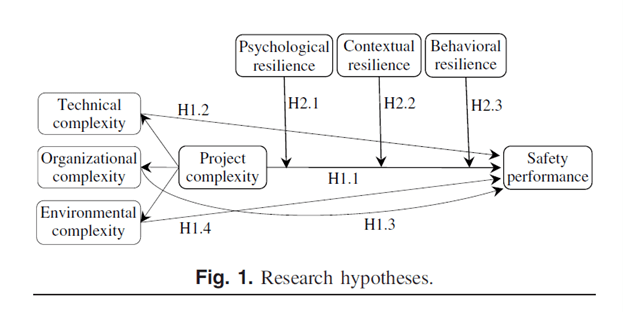
A conceptual mapping of their hypotheses are shown below:
Providing background:
· The authors discuss research about resilience engineering and the adaptive concepts. For one, they argue that these approaches can help build in more adaptability to emerging and unforeseen risks and disruptions
· Based on the authors’ prior work, they developed a reframing of safety culture based on a resilience engineering approach, “resilient safety culture’ (RSC)
· RSC is defined as “an organizational culture that fosters safe practices for improved safety in an ultrasafe organization striving for cost-effective safety management by stressing resilience engineering, organizational learning, and continuous improvements”
· More specifically, RSC draws on an organisation’s psychological, behavioural and contextual capabilities to “anticipate, monitor, respond and learn in order to manage the safety risks and create an ultrasafe organization”
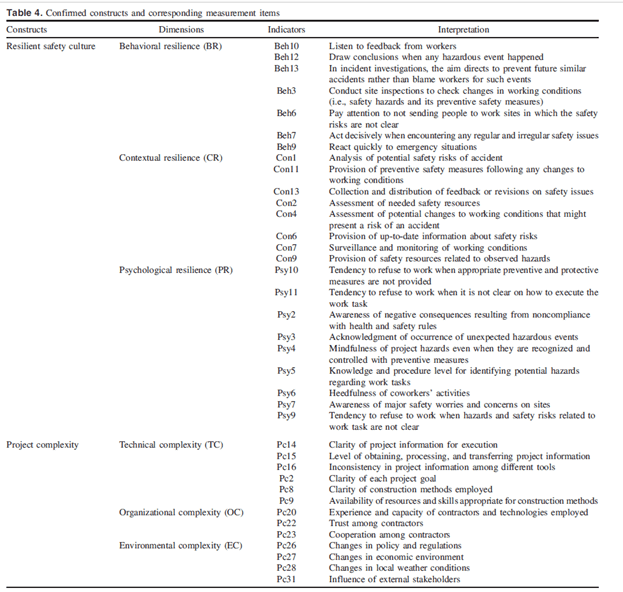
· Psychological resilience is characterised by the abilities of project employees to identify and respond to regular and irregular risks and disruptions
· Behavioural resilience is characterised by the competencies and patterns of the behaviour of project employees to recognise, understand, predict and react to hazardous situations
· Contextual resilience is characterised by the organisation’s or contractor’s capabilities to “provide the backdrop for responses to identified and changing shapes of safety risks”
· Project complexity is also prevalent in modern construction environments, resulting from an interaction between various factors with dynamic and uncertain properties
· Lots of different frameworks and approaches exist with complexity. One perspective divided project complexity into technical, organisational and environmental groups
· Drawing on Normal Accident Theory (NAT), it’s stated that “accidents involve the unanticipated interaction of a multitude of events in a complex system rather than as a result of a few or a number of component failures”
· Moreover, drawing on NAT interactions can be seen as linear or complex. Linear interactions are “expected and familiar, visible, and understandable”
· In comparison, complex interactions “are those of unfamiliar sequences or unplanned and unexpected sequences and neither visible nor immediately comprehensible”
Their RSC construct is shown below:
Results
Overall:
· Technical and environmental project complexities have negative impacts on project safety performance
· The negative impact of project complexity on safety performance “becomes less significant when a higher level of resilient safety culture exists, but this impact might be not significant for a high resilient safety
Thus, uncertainties related to technical and environmental aspects of construction can increase the occurrence of incidents. It’s argued that technical and environmental complexities “fall into the distal factors of accident causation produced by preconstruction project participants”. As a result, these unseen upstream risks are transferred to contractors during the construction stage.
By extension, the research “recognizes a set of project complexity indicators that have adverse impacts on safety performance”.
The impact of project complexity on safety performance is lessened in the context of a higher level of resilient safety culture performance. Thus, this finding “clarifies the value of resilient safety culture for the improvement of the organization’s capabilities to manage safety risks”.
Drawing on their findings and other work, it’s highlighted that a range of factors subsequently impact project performance. Including objectives (schedule, cost, quality), construction method change, resources, missing project information, inappropriateness of regulations and standards, economic pressures, and external stakeholders driving competitive tendering and the like.
Drilling down, the moderating effect of psychological resilience suggests that in projects with higher psychological resilience, emerging safety risks are ore likely to be effectively addressed.
Projects with higher contextual resilience, e.g. contractor abilities to provide the backdrop for responses to identified or changing risks, then emerging risks associated with project complexity are more likely to be effectively managed.
Finally, higher behavioural resilience also resulted in better management of emerging safety risks. They postulate that this may be, in part, a result of Situational Awareness [** remembering that SA isn’t just an individual phenomenon, but also organisational with distributed situational awareness].
Hence, “increasing project complexity levels did not automatically result in negative safety performance as measured by the [incident rate]”, but was offset to a degree by the performance of the project’s RSC.
Authors: Trinh, M. T., & Feng, Y. (2020). Journal of Construction Engineering and Management, 146(2), 04019103.
Study link: https://doi.org/10.1061/(ASCE)CO.1943-7862.0001758
LinkedIn post: https://www.linkedin.com/pulse/impact-project-complexity-construction-safety-role-ben-hutchinson

 SafetyInsights.org
One thought on “Impact of Project Complexity on Construction Safety Performance: Moderating Role of Resilient Safety Culture”