A very interesting study which compared the attributions of accidents to “human error” compared to three other non-error classes: “mechanical failure”, “technical failure” or “computer error”.
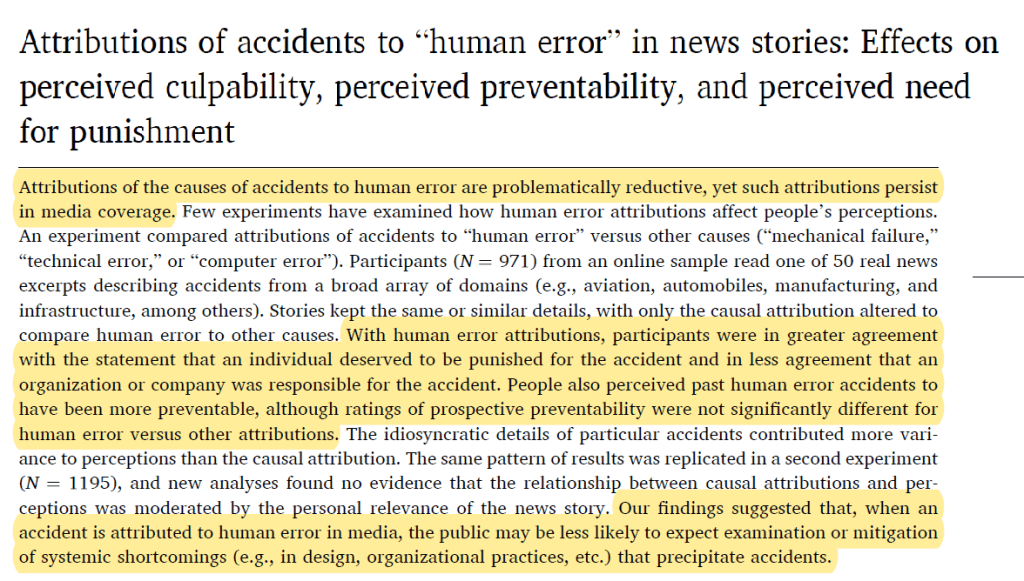
Two experiments utilising 971 online participants in study 1 and 1195 participants in study 2 read one of 50 real news excerpt stories which the authors had modified to align with the causal attribution classes as above; other details in the stories remained as per the actual article.
Authors highlight the problems with “human error” attributions, being that they can be internal attributions related to the person rather than the mitigating external factors and are “problematically reductive” (p1) which underplay the complex and interrelated sociotechnical factors and ways that context influences individual, team and system behaviour.
Based on anecdotal evidence, the authors suggest that the public is far more critical of accidents they perceive to be human-caused compared to other isolated mechanisms.
Results
When stories were manipulated to the human error category, participants were in greater agreement with the statement that an individual deserved to be punished for the accident and agreed less that an organisation was responsible for the accident compared to the non-error categories.
Compared to the non-error categories (mechanical or technical failure etc.), participants viewed past human error accidents to have been more preventable.
The idiosyncratic details of the particular story contributed more variance to perceptions of culpability and blame than did the causal attributions in the story.
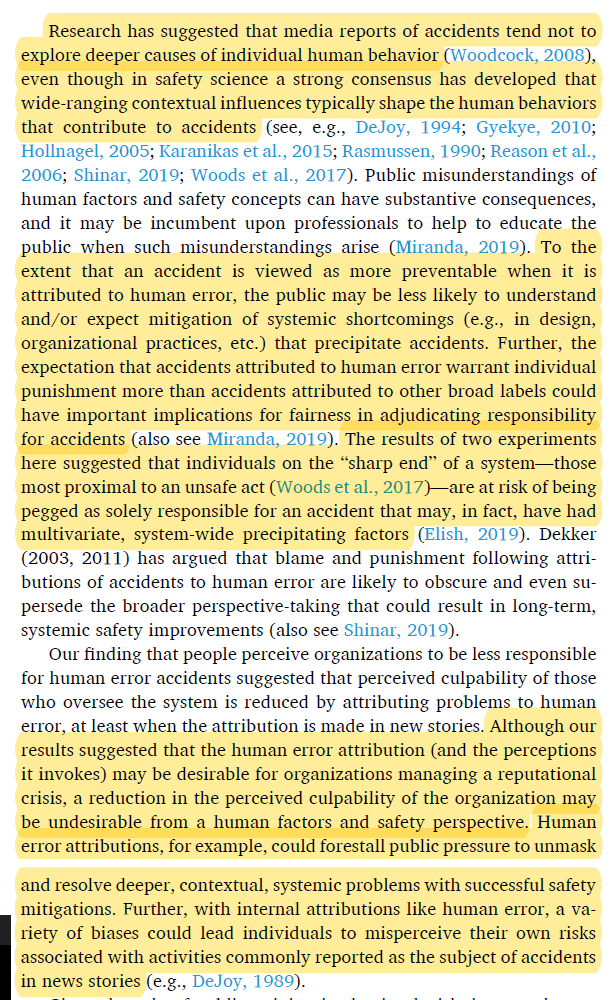
These findings suggested that “when an accident is attributed to human error in media, the public may be less likely to expect examination or mitigation of systemic shortcomings (e.g., in design, organizational practices, etc.) that precipitate accidents” (p7).
The authors argue that finding people were more likely to attribute accidents perceived to be precipitated by error as deserving more punishment than accidents related to technical or other factors “could have important implications for fairness in adjudicating responsibility for accidents” (p7) and seek to drive more culpability towards the sharp end where people may have the least ability to influence the precipitating factors.
Authors briefly explored reasons why greater culpability is placed on perceived error-related accidents. One is the idea of mutability, said to be how people use counterfactual thinking to generate plausible alternation actions which could have prevented the accident.
People can more readily imagine scenarios where “human error” could have been avoided whereas counterfactuals for organisational factors are more difficult to imagine.
As highlighted here, other research has shown that incidents involving human error were more often targeted when it came to corrective measures compared to deeper system-focused solutions, which may “further obscure effective recourse options that might arise from system-centered approaches” (p7).
Also discussed is the “value” that error attributions have for companies, being in a sense desirable for a company to find in order to manage reputational crises and reduce their own organisational culpability.
They say that “Human error attributions, for example, could forestall public pressure to unmask and resolve deeper, contextual, systemic problems with successful safety mitigations” (p7).
Finally, they argue that “From a human factors and safety perspective, systems-based approaches to understanding accidents are likely more productive for society than person-centered, blame-assigning approaches”.
Authors: Nees, M. A., Sharma, N., & Shore, A. (2020). Accident Analysis & Prevention, 148, 105792.

Study link: https://doi.org/10.1016/j.aap.2020.105792
LinkedIn post: https://www.linkedin.com/pulse/attributions-accidents-human-error-news-stories-need-ben-hutchinson

 SafetyInsights.org
2 thoughts on “Attributions of accidents to “human error” in news stories: Effects on perceived culpability, perceived preventability, and perceived need for punishment”