An interesting conference paper that explored how a permit-to-work process operated in practice in the oil & gas industry.
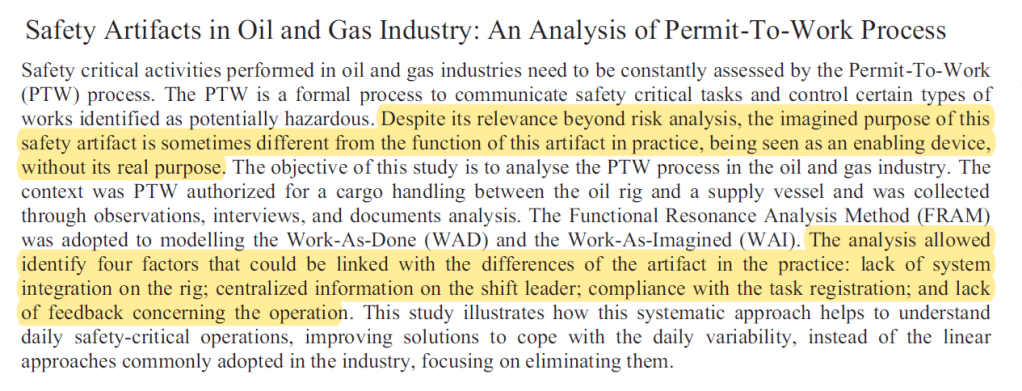
They drew on the distinction between WAI (work as imagined) and WAD (work as done), and also my own concept of artefacts acting as enabling devices (from my first Safety Science publication).
The study observed a cargo handling operation between the oil rig and supply vessel, and further observation, interviews and document analysis. Then they built models of the process using FRAM.
Providing background:
· O&G rigs are complex systems, representing activities with a high degree of uncertainty and with potential unwanted consequences to the entire system
· Organisations use, in part, safety management systems and associated practices to maintain constraints, where the PTW is one component
· Despite the espoused importance of PTW processes, it’s said “the imagined purpose of this safety artifact is sometimes different from the function of this artifact in practice, being seen as an enabling device”
· That is, the imagined purpose of a safety artefact, to help control risks, is sometimes different from the function of this artefact in practice; where some artefacts, in some situations may be “seen only as an enabling device, as it enables work to happen by encouraging a belief that the risks of the task have been managed, when in reality they have not been”
· This disparity implies a critical gap between WAI and WAD
Results
Overall, the analysis revealed some marked differences in the PTW process between as imagined (as specified in procedures or imagined by managers), versus the PTW in practice.
The differences between WAI and WAD in this case was linked to four factors – thereby highlighting a disassociation between process and practice [** thereby providing evidence of my enabling devices concept]:
· lack of system integration on the rig
· centralized information on the shift leader
· compliance with the task registration
· lack of feedback concerning the operation
Several key PTW functions did not occur in practice (check out of the full paper for the FRAM models which provide context of these functions): 1) analyse ongoing works, 2) categorise the PTW risk, 3) continue task plan and 4) modify task plan.
Three other functions were performed differently than expected: 1) open permit to work, 2) perform pre-task meeting, and 3) update supervisors. For instance, opening the PTW was carried out by another leader compared to the one expected to perform the action.
1. Lack of system integration on the rig:
While the deck leader had the role of opening the PTW every shift, the lack of system integration meant that the deck leader didn’t have access to the PTW system and had to rely on somebody else to fill this task. The latter arrangement wasn’t expected or included in the PTW process, despite in many instances being busy and unaccounted for.
This meant that the team “did not have the printed PTW documentation, guidelines, nor if there were other safety recommendations issued by the rig managers”.
2. Centralised information on the shift leader
The deck leader had the role of running the pre-task meeting. However, in the absence of this leader being available, workers may not be able to commence the task.
3. Compliance with the task registration
Operators would start filling out the documentation prior to shift task based on standard templates, and since the deck leader wasn’t always present at the pre-task meeting, operators may not discuss any associated risks or task-specific info.
4. Lack of feedback concerning the operation
Due to the dynamics of the operating environment, the leader didn’t necessarily collect details about the operations at hand, resulting in a lack of feedback regarding opportunities for improvement, nor specifics for the risks in rea l operations.
The authors found that “information contained in the PTW was sometimes inconsistent with the risks and operations found in practice”.
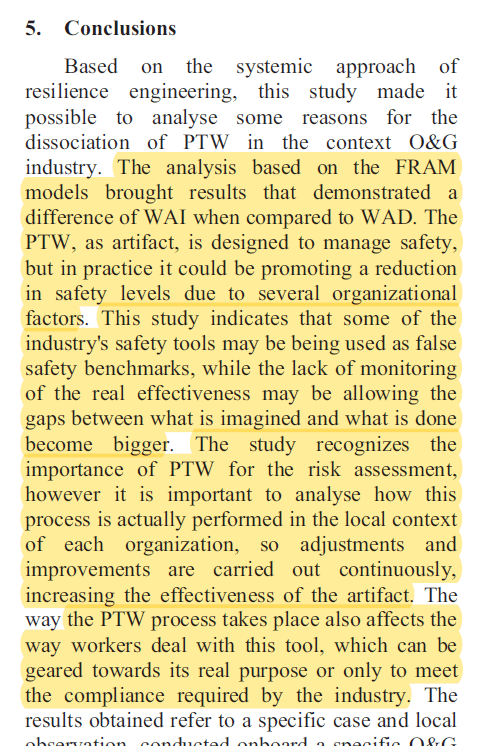
Concluding, the authors state that “The PTW, as artifact, is designed to manage safety, but in practice it could be promoting a reduction in safety levels due to several organizational factors” (emphasis added).
That is, reliance on the PTW system may, in some instances, be leading to a false sense of safety as it contains some critical differences in practice compared to as imagined.
Moreover, “the lack of monitoring of the real effectiveness may be allowing the gaps between what is imagined and what is done become bigger”.
They recognise the importance to “analyse how this process is actually performed in the local context of each organization, so adjustments and improvements are carried out continuously, increasing the effectiveness of the artifact.
Authors: de Freitas, J. H., Pulz, M. H., da Silva Junior, F. D. A., Henriqson, É., & Júnior, M. M. C. (2023). Safety Artifacts in Oil and Gas Industry: An Analysis of Permit-To-Work Process.
LinkedIn post: https://www.linkedin.com/pulse/safety-artifacts-oil-gas-industry-analysis-process-ben-hutchinson

 SafetyInsights.org
2 thoughts on “Safety Artifacts in Oil and Gas Industry: An Analysis of Permit-To-Work Process”