This coroner’s report detailed the death of a man during hydroblasting of a tank, where he fell through an open and unprotected hatch.
There’s quite a few more extracts from this report included here, but it’s worth the read.
Regarding fatigue and working hours, the coroner observed that:
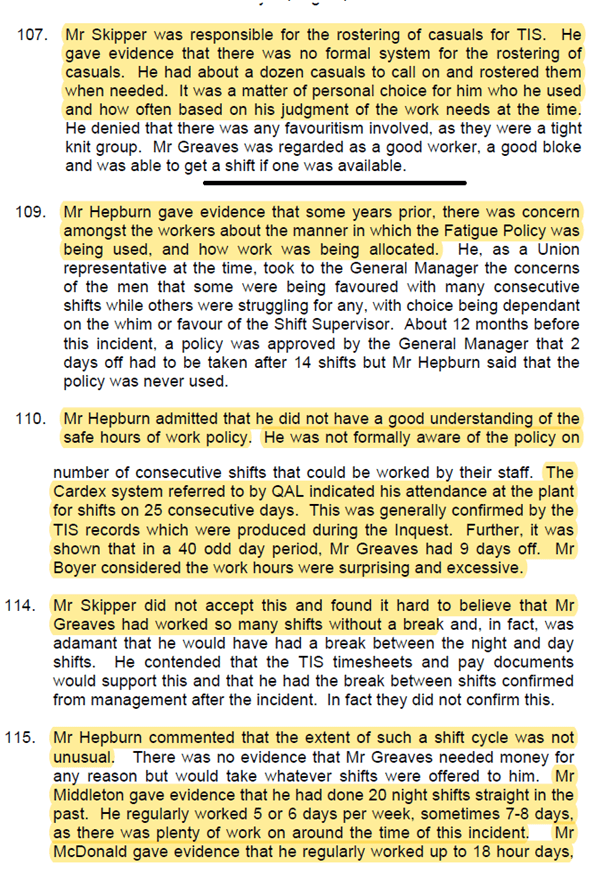
- No formal system existed for rostering casuals
- Prior to the fatal event, some had worked 25 consecutive days, and the deceased had only 9 days off over a 40 day period; these hours were considered “surprising and excessive”
- Although the supervisor seemed surprised at such shift cycles, a colleague of the deceased said it was not unusual – including working up to 18 hour days
- The supervisor responsible for rostering casuals had no training in fatigue management, and would instead be “reliant on workers telling him that they were fatigued and could not work”
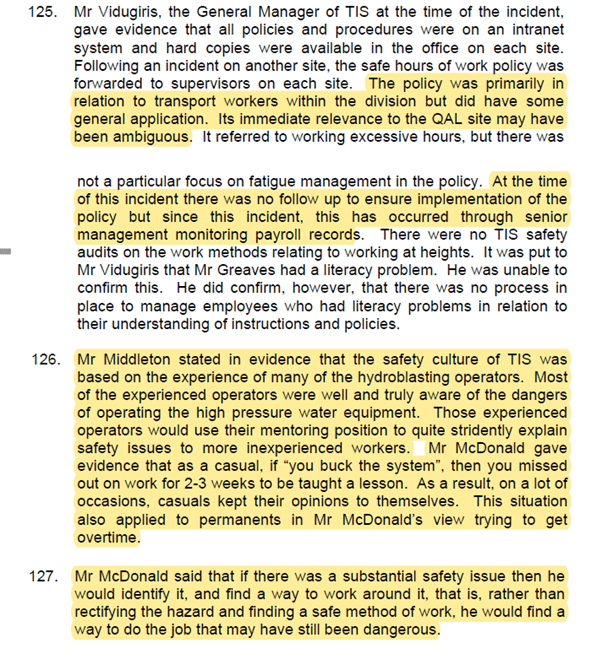
- The GM gave evidence about availability of policies/procedures being available in the office of each site and on the intranet. The safe hours work policy was sent to all supervisors, but since it was written primarily about transport workers its relevance to other workers “may have been ambiguous”
- No follow-up to ensure implementation of the policies were undertaken
More generally, the coroner was critical of safe work planning and documentation:
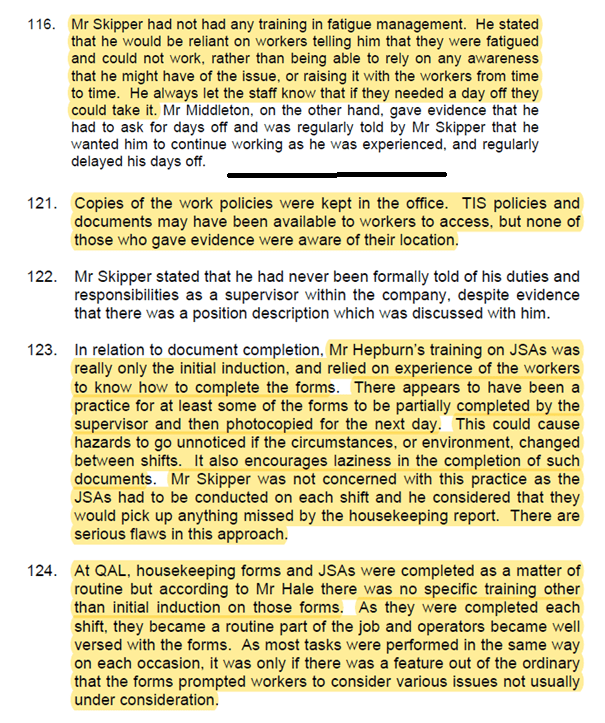
- Copies of work policies were kept in the office but “none of those who gave evidence were aware of their location”
- The deceased’ workmate had next to no training on the JSA save for the initial induction and his own experience
- For the JSA, there “appears to be a practice for at least some of the forms to be partially completed by the supervisor and then photocopied for the next day. This could cause hazards to go unnoticed if the circumstances, or environment, changed between shifts”
- The supervisor was not concerned with this practice since “the JSAs had to be conducted on each shift and he considered that they would pick up anything missed by the housekeeping report. There are serious flaws in this approach”
- Because of the routinisation of JSAs etc., being completed each shift, and since most tasks were completed the same way, “it was only if there was a feature out of the ordinary that the forms prompted workers to consider various issues not usually under consideration”
- No audits on the work methods relating to work at heights were undertaken
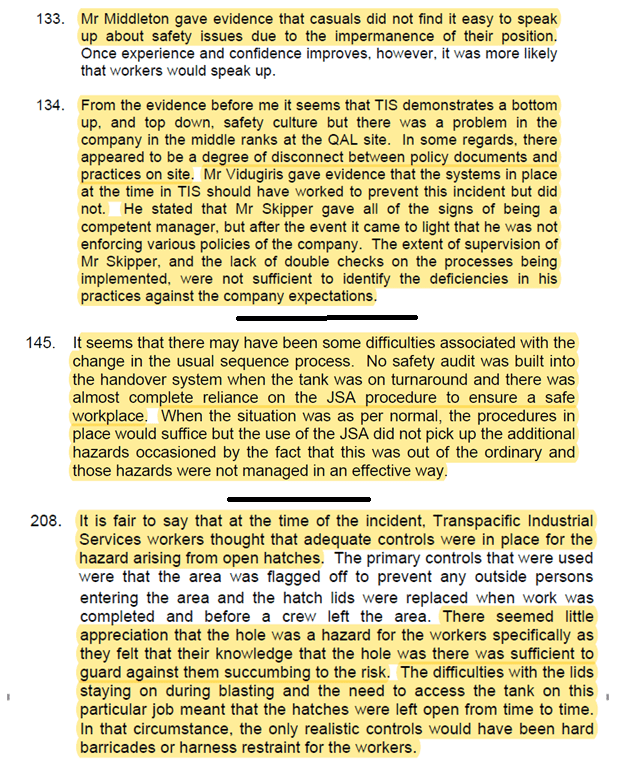
- No inspection was built into the handover system between shifts and there was “almost complete reliance on the JSA procedure to ensure a safe workplace”
- Moreover, the JSA work method didn’t effectively pick up hazards for out-of-ordinary work
- At the time of the incident, the company had little appreciation that the hatch was a fatal hazard as they felt that a worker’s “knowledge that the hole was there was sufficient to guard against them succumbing to the risk”
The coroner then discussed problems with culture and speaking up:
- Staff would keep opinions/concerns to themselves so they weren’t penalised by missing out on work and overtime
- Casual staff “did not find it easy to speak up about safety issues due to the impermanence of their position”
- If substantial safety issues were identified, one person gave evidence that they would “find a way to work around it rather than rectifying the hazard or finding a safe method of work”
Qld Coroner’s Court. Inquest into the death of Colin Arthur GREAVES. COR 1804/05(7)
Report link: https://www.courts.qld.gov.au/__data/assets/pdf_file/0003/86763/cif-greaves-ca-20080814.pdf

 SafetyInsights.org
One thought on “Coroner blasts overuse of JSAs, unknown safety processes, and fantasy fatigue management”