This explored via interviews with 33 employees their experiences with using an incident reporting system (RUO; reports of unwanted occurrences) and the barriers to reporting incidents.
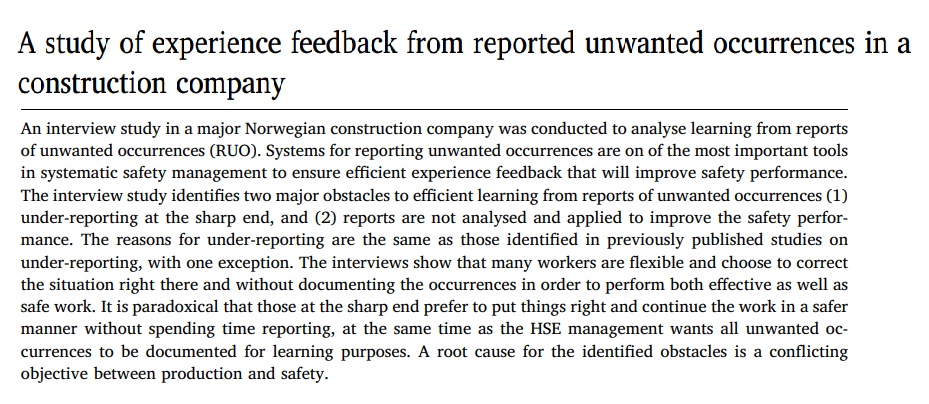
Previous research was first covered in the paper. Issues of trust and blame inhibit reporting, as is also related to solidarity between colleagues. Other factors include unclear reporting guidelines, poor user-friendliness of the system and workers who perceive that they can’t control their working conditions are also inhibitors, as is pressure to produce.
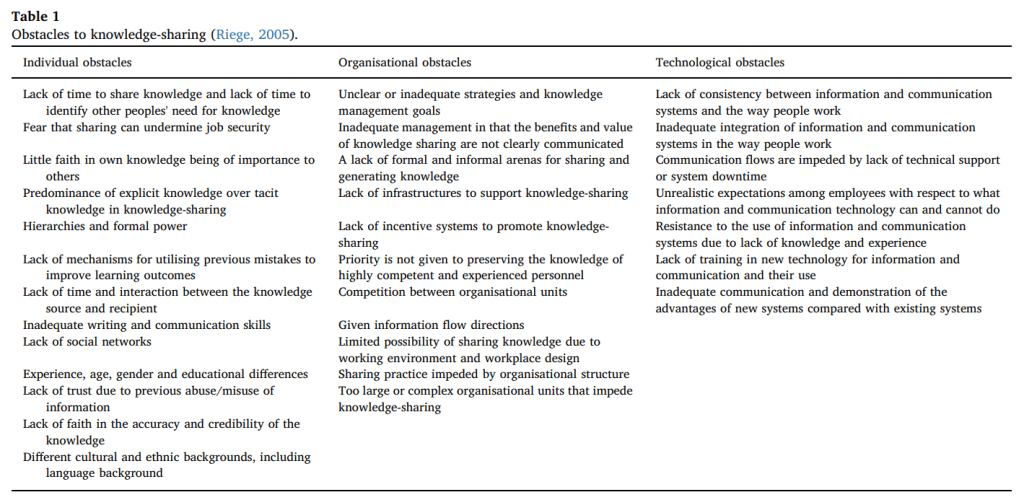
For background, they provide a list of obstacles to knowledge sharing in organisations:
Results
Expectedly it was found that many minor incidents go unreported. Some factors include:
- The incident being seen as normal and therefore not worth reporting
- Not serious enough to report (being fixed at the time)
- Perceptions of laborious paperwork and forms
- Fear of blame
Some people didn’t consider dangerous near misses as those to be reported and would only report things that have happened. Moreover they didn’t consider deviations to expected outcomes as worthy of reporting if they could fix them at the time.
One manager highlighted that under-reporting sometimes occurred due to the fact that it “looked better ‘on paper” (p50). Here, the severity of the incident may be downgraded because of how they are followed up by management. In some cases, people likened the incident investigations as though they were being interviewed by police for a serious crime – and felt incidents went unreported because of how fuss can be generated around incidents.
In another case, one site manager admitted to reporting as few unwanted occurrences as possible since “he was afraid that it would be considered harassment by the workers” (p50).
Regarding a fear of blame for workers following an incident, one supervisor noted that a challenge in changing this view is that the “management system itself is presented as infallible, so that the end result is always to find a scapegoat on the site”.
One finding different in this study compared to previous work was that the findings showed the skill and discretion that workers and supervisors would take to correct issues there and then rather than to document the issues.
This highlighted that workers just wanted to perform their work safely and efficiently, and viewed the process of discussing issues and incidents as the important factor in safety rather than the paperwork as directed by upper management. Another supervisor said he finds too much nonsense written around incidents and learning and scraps the notes as they are meaningless. Rather, the teams talking with each other add value.
At the same time, site workers lamented the fact that incident reports could sometimes lead to new rules being introduced from above without any consultation with them. In other cases, site managers said the expectation that incidents will involve implemented measures was challenging.
Further, the incident reporting system was seen sometimes to be wielded as a source of power to exert pressure against certain people or groups in order to get new things like tools or equipment.
When asked about the value of the reporting system, although two site managers said it can be an important database for referencing for work, only one admitted to using it in connection with job safety analyses and neither knew how the incident systems influenced decision making.
Besides the under-reporting of events, another factor which impedes organisational learning is that the information that is collected is not always made explicit and shared to others in the organisation.
Because of this, the quality of registered info reduces since people become disengaged from wasting their time when the information seems to go nowhere. Conversely, the local operators do share information and learn.
Authors: Sandberg, E., & Albrechtsen, E. (2018). A study of experience feedback from reported unwanted occurrences in a construction company. Safety science, 107, 46-54.
Link: https://doi.org/10.1016/j.ssci.2018.03.028
LinkedIn post: https://www.linkedin.com/pulse/study-experience-feedback-from-reported-unwanted-ben-hutchinson-ocyfe

 SafetyInsights.org