This systematic review evaluated the research between leadership walks on clinical outcomes.
12 studies met inclusion criteria.
Providing background:
· Different type of leadership walks exist, including management-by-walking-around (MBWA). Gemba Walks, and Patient Safety Leadership Walkarounds (PSLWs)
· A prior lit review of PSLWs found that, despite the limitations of studies, LWs were generally effective in informing leaders on safety issues that impacted front-line staff and patients
· LWs may “remove the ineffectual, layered and indirect communication flows that commonly exist between senior leaders and front-line workers”
· Despite benefits of some LW interventions, walkarounds may also bring unintended consequences, with some research highlighting impaired perceptions of performance following LW interventions and reduced trust
Results
Based on the 12 studies:
· LWs were found to generally “help staff, nurses and physicians feel psychologically safer to report, discuss and learn from errors”
· Their results suggested that “longer exposure to LWs combined with feedback mechanisms appears to be associated with a more definitive and positive impact of LWs on operational and cultural outcomes”
· And “The manifestation of such positive association could be viewed as an early warning system of potential system latent failures”.
For specific findings:
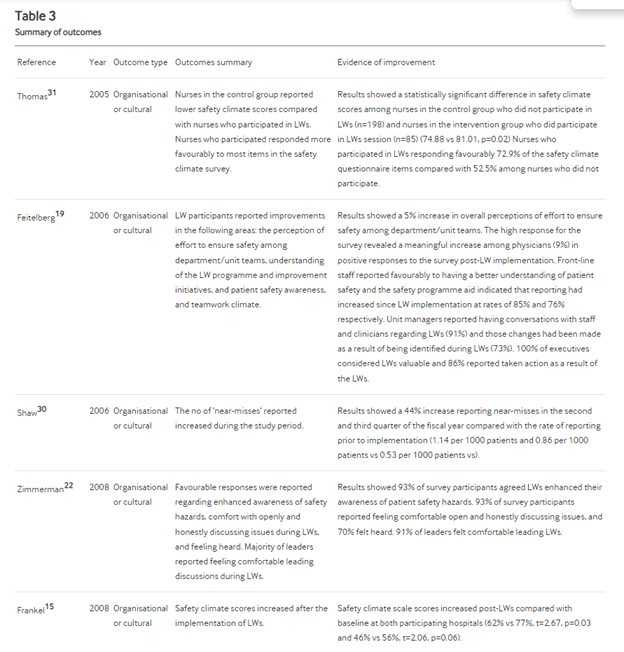
· one study found that monthly LWs over 3 months found lower safety climate scores in the non-LW intervention group (control group). The intervention group exposed to LWs reported higher survey perceptions.
· Another study found LWs resulted in greater perceived effort among team members, 85% reported having a better understanding of patient safety, 76% indicated an increase in reporting or discussion of incidents and near misses, and 91% of unit managers reported having had conversations with staff following the LW.
· All executives in that dataset reported that they “gained new learnings from the walkarounds and considered them valuable” and further “Most (86%) executives reported that they had taken actions as a result of feedback received on the LWs”
· Other data found that near miss incident reports increased 44% over 24 months following the LW program
· Another study over 18 months found elevated perceptions of improvements in performance following a LW intervention with “results of regression analysis suggest[ing] a negative association with LWs implementation and performance”. Performance in hospital units that participated in LW programs reported a 21% increase in perceptions of performance compared to controls
They also explored characteristics of LWs that seemed to be connected with enhanced performance. For instance:
· Successful LWs were “well organised and coordinated creating a feeling of an organisational programme and not ad hoc leadership visits”
· Leaders were found to use “a form of humble inquiry to spearhead conversations and provide feedback to staff, nurses and physicians”
· LWs were found to promote “the vision of culture of patient safety where no-blame culture and learning from errors were valued and supported”
They note that practically speaking, LWs when optimised seem “quite effective in the areas with lower perception of culture of patient safety as these areas were already subjected to more scepticism that organisational leaders truly stand behind patient safety efforts”.
Further, the authors speculate that in organisations with leaders already mature in specific local engagement philosophies like just culture, use of LWs may be particularly effective since the LWs can “appear more cohesive and effective”.
In contrast, “if organisations and leaders are less familiar with improvement-based philosophies and programmes, a more centralised intervention might be of better choice to spearhead changes focused on the culture of patient safety”.
Some of their data is shown below:
Authors: Foster, M., & Mazur, L. (2023). Impact of leadership walkarounds on operational, cultural and clinical outcomes: a systematic review. BMJ Open Quality, 12(4), e002284.
Study link: http://dx.doi.org/10.1136/bmjoq-2023-002284
LinkedIn post: https://www.linkedin.com/pulse/impact-leadership-walkarounds-operational-cultural-ben-hutchinson-zxxae

 SafetyInsights.org
2 thoughts on “Impact of leadership walkarounds on operational, cultural and clinical outcomes: a systematic review”