This brief open access paper may interest you – the authors detail systems principles that can be applied by healthcare teams to “analyse, learn and improve from unintended outcomes, reports of excellent care and routine everyday work ‘hassles’”.
I don’t think it’s intended as a replacement for other systems frameworks, nor a systematic approach, but rather as an approachable tool which can be employed by frontline operators to understand work (compared to other techniques like FRAM, STAMP, and a range of systems engineering techniques which are difficult for frontline operators).
Providing context they argue that “Systems in healthcare are described as complex”.
Being complex systems, their performance interactions can’t be readily fully described. Complex systems “consist of many dynamic interactions between people, tasks, technology, environments (physical, social and cultural), organisational structures and external factors”.
Healthcare system components “can be closely ‘coupled’ to other system elements and so change in one area can have unpredicted effects elsewhere with nonlinear, cause–effect relations”, where interactions can result in “unpredictable changes in system conditions”.
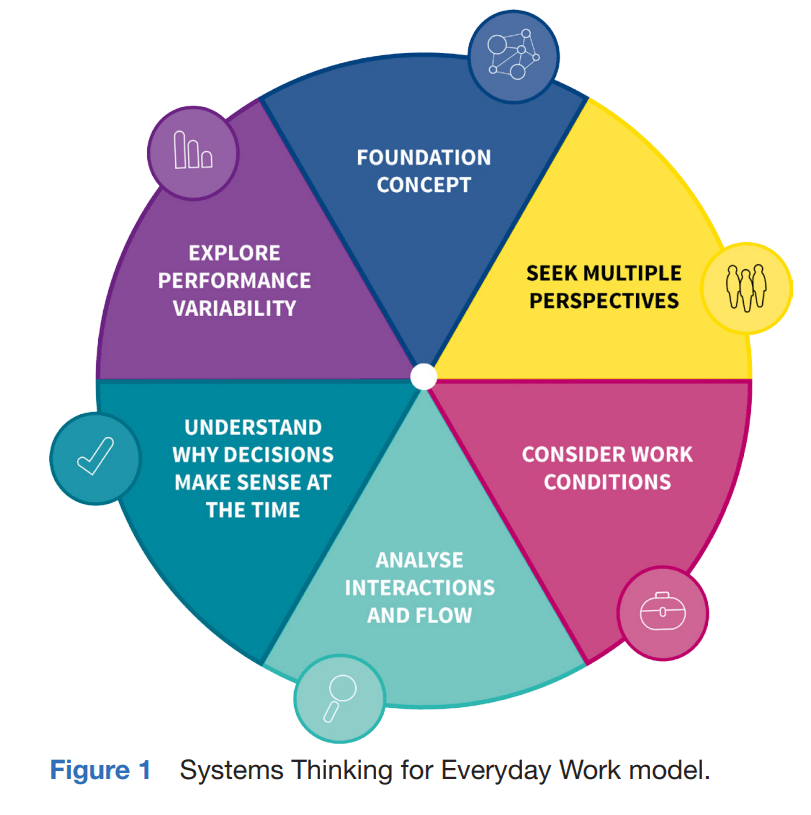
They propose six interrelated principles:
1. Seeking multiple perspectives
2. Considering the influence of work conditions – demand, capacity, resources and constraints
3. Analysing interactions within system work flows
4. Understanding local rationality and decisions
5. Explore performance variability
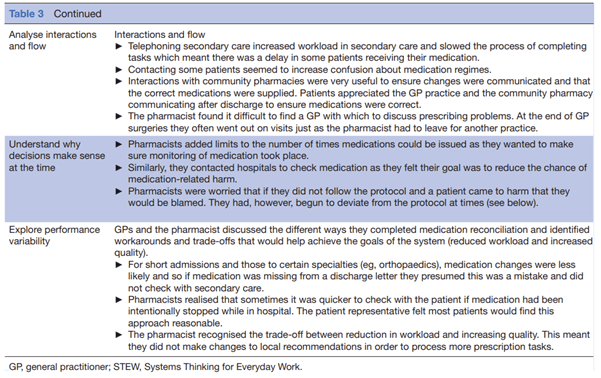
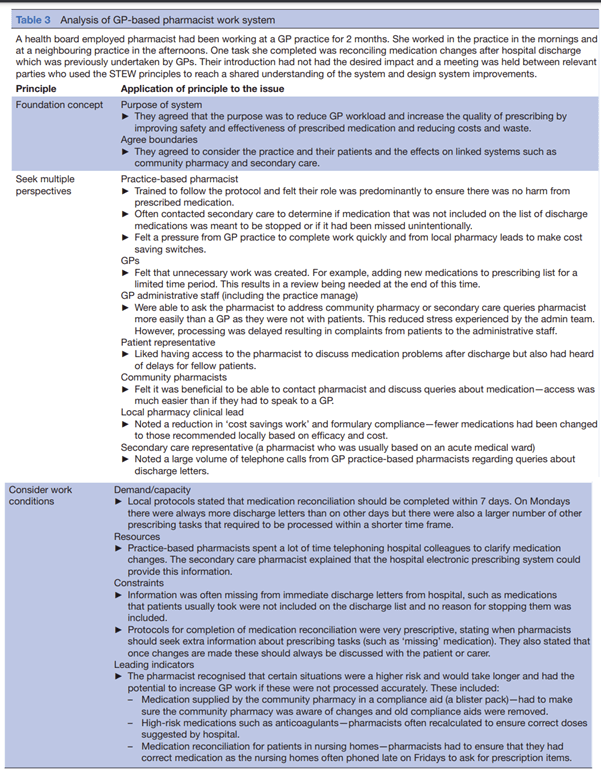
Authors: McNab, D., McKay, J., Shorrock, S., Luty, S., & Bowie, P. (2020). Development and application of ‘systems thinking’principles for quality improvement. BMJ open quality, 9(1), e000714.
Full paper: http://dx.doi.org/10.1136/bmjoq-2019-000714

 SafetyInsights.org
One thought on “Development and application of ‘systems thinking’ principles for quality improvement”