Does the hierarchical nature of organisations, such as in medicine, inhibit speaking up and voice behaviour from those lower in the hierarchy? A systematic review in healthcare suggests yes.
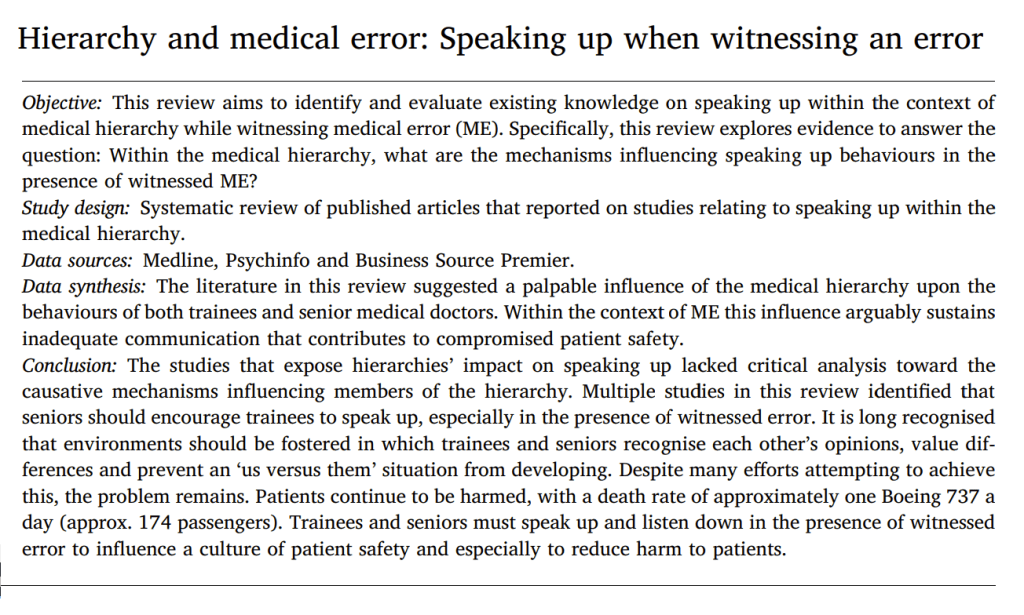
A 2020 study evaluated 19 papers for the links between hierarchy and voice behaviour in response to human performance variability (e.g. medical errors and the like).
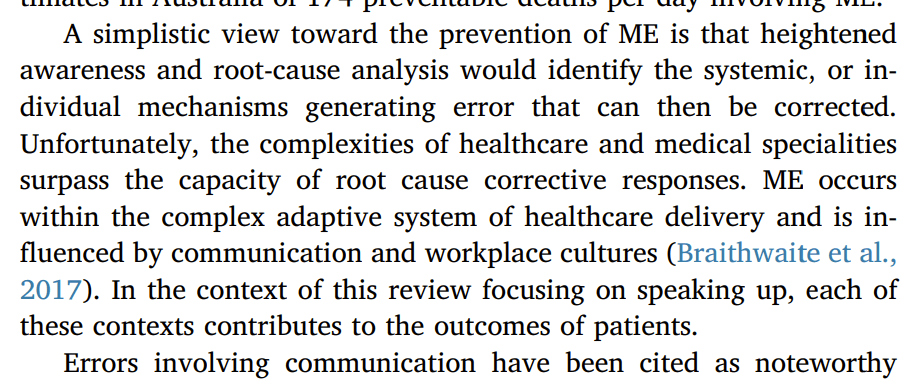
First they argue that a simplistic view around human performance is that “heightened awareness and root-cause analysis would identify the systemic, or individual mechanisms generating error that can then be corrected”.
However, this underappreciates the “complexities of healthcare and medical specialities [that] surpass the capacity of root cause corrective responses”.
They found that, at least in medicine:
· Medicine is an “overtly hierarchical discipline”
· The hierarchical structure in relation to medical errors “arguably sustains inadequate communication that contributes to compromised patient safety”
· The “characteristics of medical hierarchy create difficulties in the challenging of authority (Outliers, 2008) consequently hampering open communication”
· While the hierarchical structure in medicine is “indispensable” for driving training and transfer of accumulated wisdom, it is “imbued with power and responsibility”
· Interestingly, one study found that while 97% of senior physicians thought that they encouraged trainees to speak up, only 55% of trainees felt encouraged to do so
· This suggests a “dissonance between the speaking up expectations of seniors, and the actual behaviour from the trainees”
· Other data observed speaking up in response to hierarchy associated with fear and intimidation, with personal safety, individual barriers (comm skills and confidence), and perceived efficacy (feeling of powerless, fear or being wrong, or fear of repercussions)
A consistent theme was that “hierarchy can be detrimental to open communication and that failure to challenge contributes to patient morbidity and mortality (M&M)”. That is, not speaking up and inhibited communication due to hierarchy is associated with poorer patient safety outcomes.
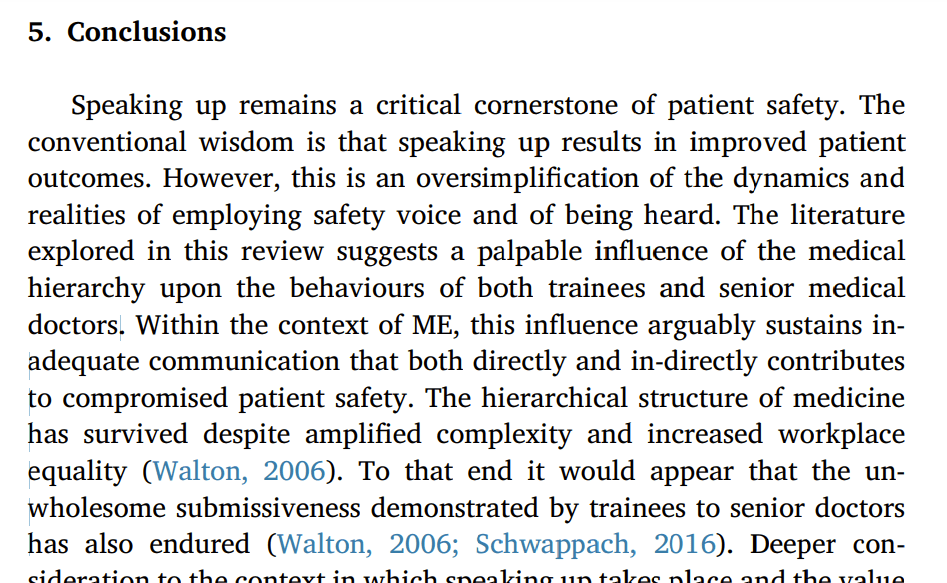
In the context of human performance, the “hierarchical structure of medicine has survived despite amplified complexity and increased workplace equality” and that to this end, “it would appear that the unwholesome submissiveness demonstrated by trainees to senior doctors has also endured”.
Authors: Hurley, J., & Hutchinson, M. (2020). Hierarchy and medical error: Speaking up when witnessing an error. Safety Science, 125, 104648.
Study link: https://doi.org/10.1016/j.ssci.2020.104648

 SafetyInsights.org
One thought on “Hierarchy and medical error: Speaking up when witnessing an error”