This paper explored the application of micro-experiments with a rule management framework in order to close gaps between work-as-imagined (WAI) and work-as-done (WAD).
The approach was applied to several examples where a gap was evident in an operational squadron within the Royal Netherlands Air Force.
Note: There’s way too much to cover in this paper and I can only scratch the surface. Check out the full paper.
Providing background:
· They discuss the importance of differentiating WAI and WAD. While rules and procedures are important, as they help provide some structure and order, collaboration, as a source of organisational memory and more, “they cannot capture the dynamics and complexities of every work situations”
· Work occurs in a context of limited resources, multiple goals, pressures, surprises, constraints and novelty. Therefore, “it can be impossible to follow the rules and get the job done at the same time”
· Employees come up with “creative solutions” to get work done in spite of rules and procedures. Creative solutions have also been called violations, deviations, short-cuts or workarounds; said to stress the undesirability
· However despite the judgemental language, in some cases working outside of prescriptions can be useful. Nevertheless, “an enduring difference between practice and prescription as a result of hampering rules is considered undesirable from an organisational point of view” as this highlights “ill-functioning rules and process innovations [which are] are actively hidden from management and bypass the controls”
· An enduring gap may result from operators on the one hand utilising an “adaptive paradigm paradigm towards rules to cope with the complexities of work” whereas management “actively disregards this reality and instead abides by a classical paradigm focused on compliance – possibly out of political necessity”
· Prior research from these authors found that a political focus on compliance “seems reminiscent of abogeyman story: ‘good behaviour’ is ensured by the threat (fear) of punishment (Boskeljon-Horst et al., 2023a)”
· Next they discuss the use of micro-experiments as promising for reducing the gap between WAI and WAD. This is useful since “As Snowden and Boone (2007) state, in a complex situation it is very difficult to infer the right solution upfront” and use of safe-to-fail micro-experiments allows an intuitive and iterative approach of trial interventions
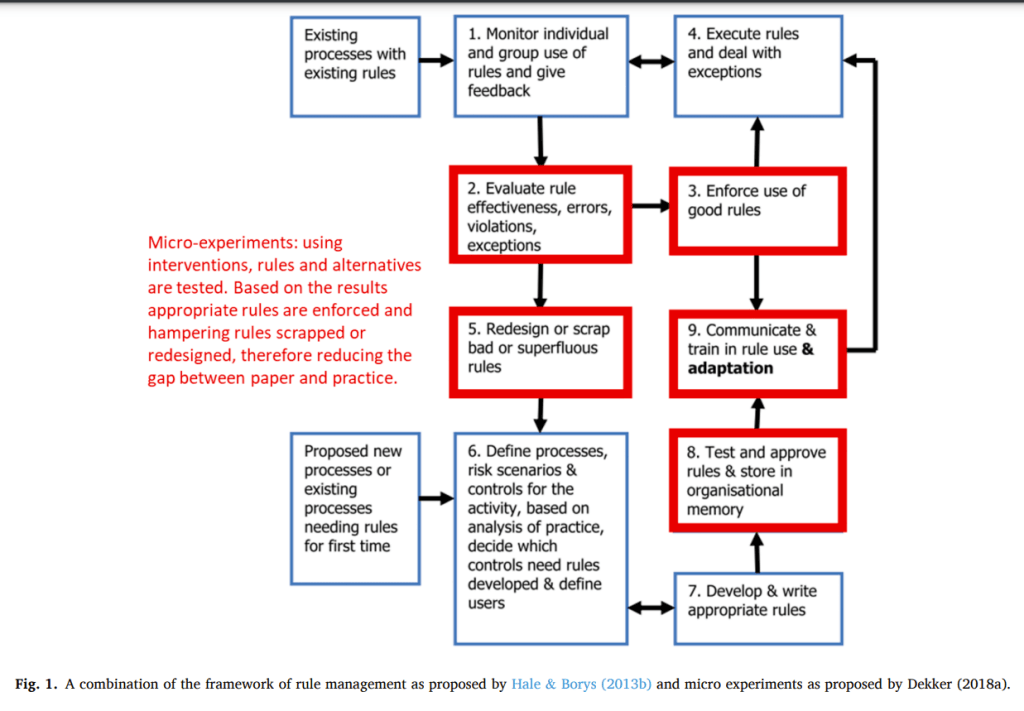
· They applied micro-experiments with a rule management framework from Hale & Borys, seeing the monitoring and adaptation central to the management of rules “rather than focusing on rule-use discipline”
Their framework is below:
Again, I’ve skipped heaps and importantly skipped the specific examples of WAI vs WAD that feed into the results. Check out the full paper.
Results
Key findings were that:
· Micro-experiments were “technically successful in showing the effectiveness of the interventions and generating shop floor commitment for them”
· Reducing the gap between WAI and WAD was accomplished in 3 of the 4 situations
· However, “changing the rules to better match daily operations, was only partly achieved”.
It’s explained that reducing the gap by modifying rules is a “separate step that does not follow automatically” when combining a procedural approach with micro-experiments.
In 3 of 4 situations the gap was shrunk; one situation had no rule change, another situation resulted in sustained changes due to the local ingenuity, and in the third intervention “the legal departments halted formalisation of the agreed change”.
These findings indicated that “closing a gap is easy when no rules are involved but when rules are involved it can actually be difficult”. Reducing the gap by modifying rules was impeded when “the mandate for the rules lay outside the group involved”.
Breaking through the “organisational complicity” was challenged by belief systems. Here it seems that “the belief system regarding compliance … ultimately gets in the way of structural change”.
In two cases the researchers found “explicit examples of fear”, which may indicate tension between compliance and adaption. Both cases were indicative of a lack of trust, with the lack of trust (the bogeyman belief mentioned earlier), which indicated noncompliance, interfered with reducing the gap.
Interestingly, the authors argue that belief systems impeding actual changes “seems to have been overlooked in the framework proposed by Hale and Borys (2013b) and is insufficiently expressed in the micro-experiments proposed by Dekker (2018a)”.
Hence, the adopted approach in this paper was “insufficient to break through the organisational complicity because the belief system”.
In some cases, the belief system actively encourages organisational complicity, where operators adopt more rules or the process involves more stakeholders. E.g. in prior work these authors found that because some operators had a lack of trust in management, they wanted to add more rules to feel protected. Sticking to the classical rule compliance logic provided the operators “the promise of compliance”.
They also showed how all four situations involved conflicting values. Hence, they argue that real change may not necessarily lie in technical alignment but “in enhancing restorative just culture, resolving value conflicts and, subsequently, preventing moral disengagement” [** I skipped most of the prior discussion on moral disengagement which gave the background on this finding.]
However, instances of psychological unsafety and a culture of fear was evident in the dataset, and these effects had hindered operators discussing crucial matters of fatigue. It’s said that there’s always some tension with speaking up in a chain of command within hierarchical organisations, and the hierarchical culture makes speaking up more difficult.
Discussing these findings in the context of previous research (largely from the same authors), they found previously that “the hierarchical structure of the RNLAF hampered psychological safety and speaking up”. Moreover, they found that the bogeyman belief “intensifies the inhibition against speaking up and subsequent tension”.
Management considered rules and compliance to be more important than operators; e.g. squadron staff wanted rules to govern innovation but operators didn’t feel the need for these rules.
Finally, they summarise the findings by noting:
· This studied approach appeared valuable in closing the gap between paper and practice
· Technical alignment with rules and practice isn’t in itself sufficient for overcoming the obstacles to rules
· On the above, success also requires a “focus on the softer side of an organisation, that of psychological safety, restorative just culture, psychological contracts and betrayal and moral disengagement”
· This approach requires “leaders throughout the entire chain of command to display moral courage to ensure that gaps between work-as-imagined and work-as-done are reduced and to actually change the rules if needed, even if that means breaking the promise of compliance”.
Authors: Boskeljon-Horst, L., de Boer, R. J., & Dekker, S. W. A. (2024). Safety Science, 170, 106291.
Study link: https://doi.org/10.1016/j.ssci.2023.106291
LinkedIn post: https://www.linkedin.com/pulse/reducing-gaps-between-paper-practice-requires-more-than-hutchinson-uwa2c

 SafetyInsights.org
2 thoughts on “Reducing gaps between paper and practice requires more than a technical alignment”