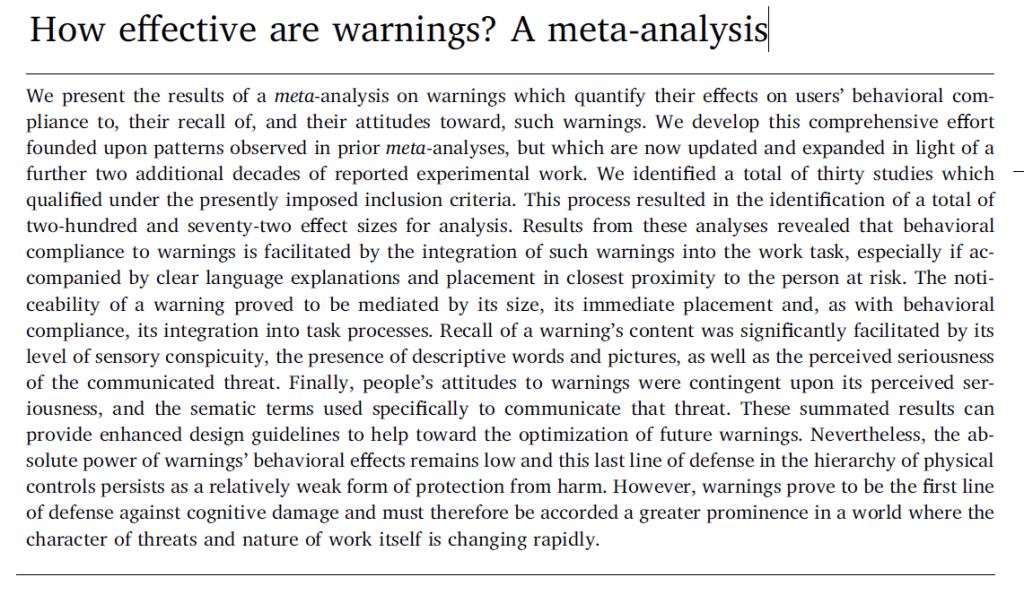
How effective are warnings? So explores a meta-analysis of 30 studies.
Warnings include hazard labels, signs, safety data sheets, medication and more.
A few key findings:
· Recall of a warning’s content was significantly facilitated by its level of sensory conspicuity (e.g. how visible, like with red or yellow boundaries)
· Presence of descriptive words and pictures, and perceived seriousness of the communicated threat
· Attitudes towards warnings ere contingent upon the perceived seriousness and semantic terms used to communicate the threat
· Overall, the “behavioral effects [of signs] remains low and this last line of defense in the hierarchy of physical controls persists as a relatively weak form of protection from harm”
For other specific findings, they found:
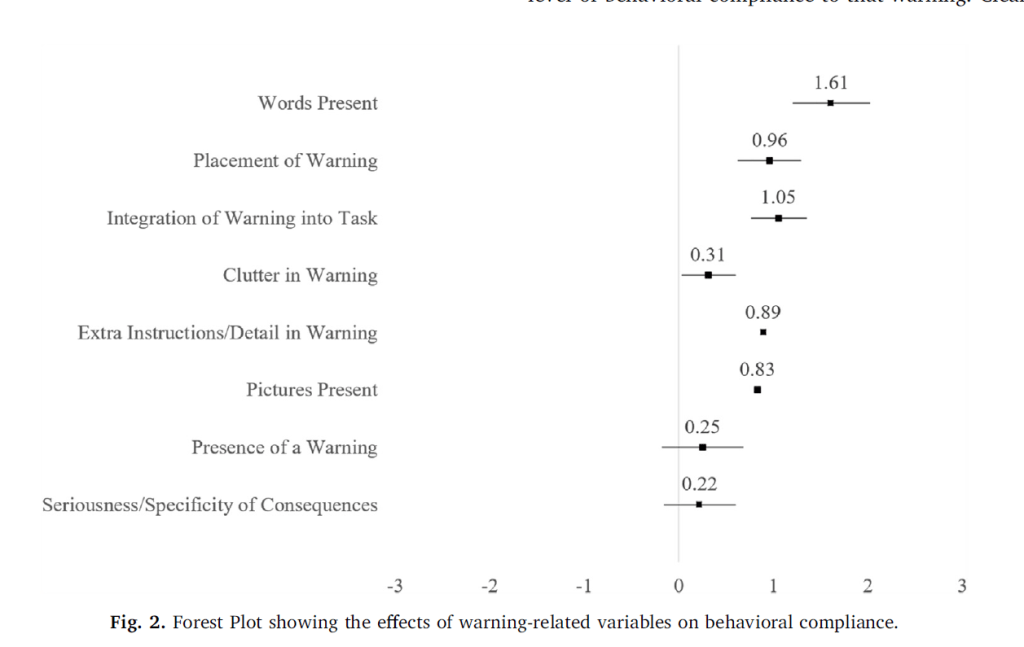
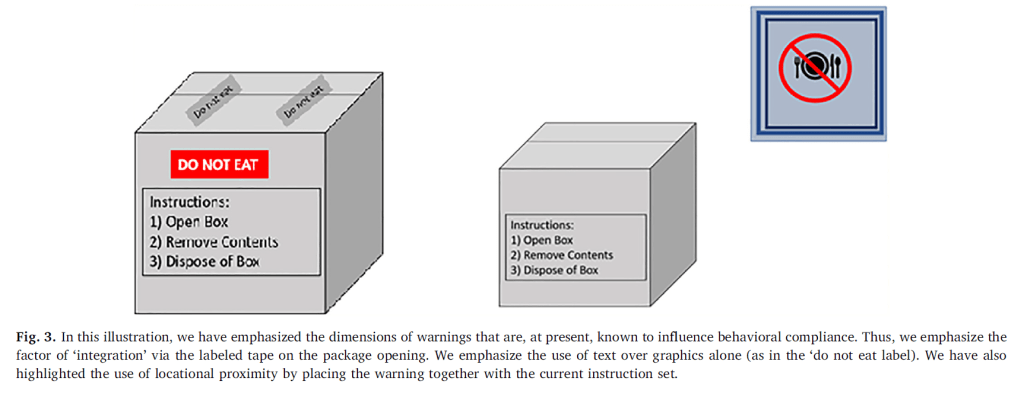
· Increasing behavioural compliance is enhanced by presenting uncluttered info which is directly integrated into the task at hand (like with instructions), or placed in a salient location to the task
· Using simple and clear text is advised
· How long the warning will remain salient, e.g. hours, days, months, is not well known. However, “information foraging humans … do find progressively less impetus and value in directing their attention to a progressively more uninformative source”
· Use of standardised formats, like with SDSs, with pictograms, hazards and precautionary statements may be useful. Precautionary statements, like seen on SDSs, was the largest single predictor of behavioural compliance in this analysis
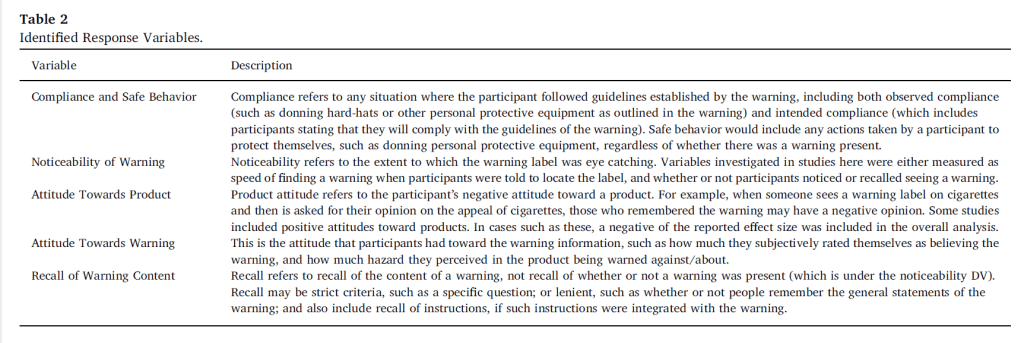
· Pictures increase the probability of somebody recalling the specific content of warnings
· Signal words and specificity of hazards are also important for explaining warning signs
· Integrating warnings into the immediate task is also important, and it works primarily via a memory effect
· However, “The fact that someone recognized the presence of the warning does not equate linearly to the degree of their subsequent behavioral compliance” and people can recognise a warning but not actually respond to it
· Location of warnings is also important, with horizontal warnings more salient than vertical, as they could be recognised quicker
· Warnings placed to the left of centre proved faster in response compared to warnings on the right
· People reported higher believability of warnings when the words appeared, to them, more serious
· i.e. “Danger: this product will kill you” or “Death: if you eat this you will die” leaves little ambiguity and appears serious
· Thus, greater specificity of the warning, the more seriously people will treat the warning
They note “behavioral compliance is not simply and linearly related to the differing facets of the warning but vary based on numerous moderating influences”.
Authors: Hancock, P. A., Kaplan, A. D., MacArthur, K. R., & Szalma, J. L. (2020). How effective are warnings? A meta-analysis. Safety Science, 130, 104876.
Study link: https://doi.org/10.1016/j.ssci.2020.104876

 SafetyInsights.org
One thought on “How effective are safety warnings? A meta-analysis of 30 studies”