Blame, what is it good for? Absolutely something positive, according to a new study to be posted soon.
van Mourik et al. explored the interaction between the role of specific learning orientations in financial auditing that enhance or limit learning.
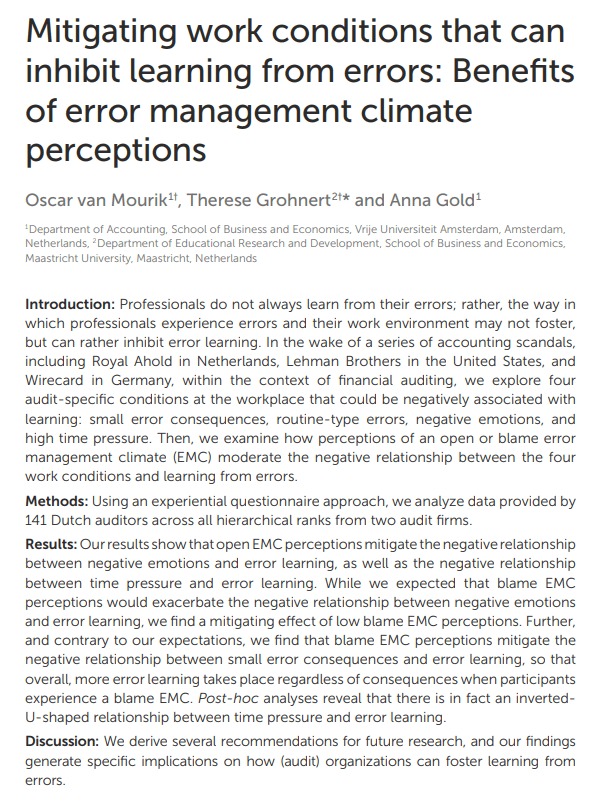
Specifically, they looked at how an open error climate (open EMC) or blame error climate (blame EMC) moderates the relationship between four work conditions and learning from errors.
EMC “describes the beliefs, norms, and practices related to how errors are dealt with that are shared within an organization”.
An open EMC promotes opportunities for learning from errors, whereas if auditors perceive a blame EMC, errors will be seen as personal failures and punishable actions.
Key findings:
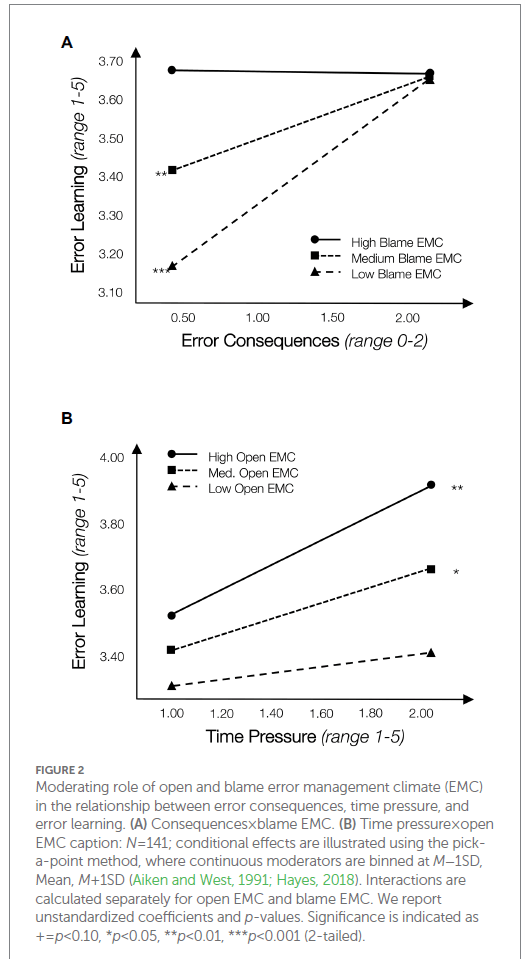
· As expected, an open EMC improved learning from error and mitigated negative emotions
· An absence of blame values can contribute to error learning
· However, unexpectedly, , they found that “some blame-oriented values and beliefs may create a sense of urgency to learn from smaller errors to prevent their recurrence in the future”; leading to a heightened impetus to learn.
Therefore, they conclude that “some blame-oriented values and beliefs within an organization may not be as problematic as previously assumed … and may even carry some potential benefits for error learning”.
While they caution the application of purposeful blame-orientations, they argue that organisations should strike a balance between openness and blame orientations.
Unfortunately, they didn’t unpack the relationship between ‘blame’ and forward-looking accountability.
Authors: van Mourik O, Grohnert T and Gold A (2023). Front. Psychol. 14:1033470.

Study link: https://doi.org/10.3389/fpsyg.2023.1033470

 SafetyInsights.org
2 thoughts on “Blame climate found to enhance error learning (* with caveats)”