This paper evaluated the role of resilience engineering principles in managing safety in building repair and maintenance.
Data was from 145 professionals in this area, using structural equation modelling.
Providing background:
· Work in modern socio-technical systems often differs substantially between work-as-imagined versus work-as-done
· A resilience engineering (RE) approach “has been identified as a viable solution to address the limitations of conventional SMSs in responding to the varying and unforeseen safety risks associated with the complexity of socio-technical systems”
· RE approaches seek to boost the capability of systems to thrive under varying conditions
· “Accidents, according to resilience engineering, do not signify a failure of a system’s functions in dealing with risks, but rather imply failures in the adaptations required to deal with the real-world complexity”
· Prior work has discussed the application of RE in the application of SMSs, like via recovery resilience (recovery efficiency of an organisation’s SMS due to accidents) and defence resilience (an SMSs ability to prevent and control performance variability)
· Resilience for SMSs has been defined as ‘‘the capability of an organization’s SMS to adjust its people, place, and system reactively, concurrently, and proactively by ‘anticipating, monitoring, responding to and learning from’ the safety risks”
· Different definitions of resilience and RE exist – I’ve skipped these discussions
· However, a common thread is the ability to make adjustments under varying conditions. These adjustments are described as three-dimensional: 1) reactive, where adjustments are needed in the post disruption phase and to rebound from disruptions to the original state, 2) concurrent, where rapid reactions take place during the disruption phase and 3) proactive, where adjustments are made to transform normal operational functions into a state of enhanced preparedness prior to disruptions
Results
The findings confirmed three dimensions of resilient capacity in this sample: people resilience, place resilience and system resilience. See image below for descriptions on these dimensions.
Safety performance of building repair and maintenance was “significantly affected by the interactions between people resilience and place resilience and the interactions between place resilience and system resilience”.
Interesting (for an RE paper), they also evaluated the relationship between resilience capacities and LTIFR, finding a significant negative correlation (as one goes up, the other goes down).
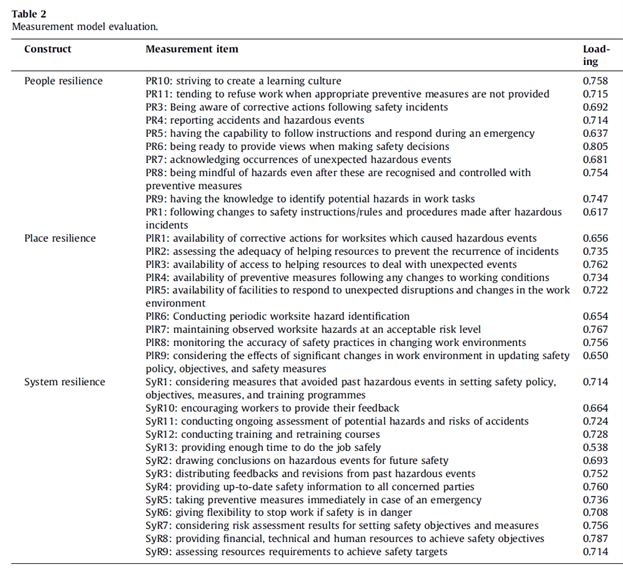
The relationship between place resilience and LTIFR varies with different levels of place resilience capacity, and people resilience capacity and LTIFR varies with different place resilience capacity.
The relationship between place resilience capacity and LTIFR varies with different system resilience.
I’ve skipped a bunch of other relationships. However, one finding highlighted that the measurable scales predicted performance in the ability of workers to learn from safety incidents.
These scales were also associated with proactive workforce adjustments to risk, themselves “essential to prevent the occurrences of undesirable safety incidents in the future”.
The scales also were associated with proactive adjustments, suggesting a link with anticipating workplace hazards.
As expected, there were several important limitations, including the source of data, and some low statistical values, among others. However, they argue that some of these values “does not affect the validity of the results as the R2 value of safety performance is significant (t-value = 2.874, p < 0.01) and thus the results confirmed that resilience for SMSs is an important predictor of safety performance”.
Authors: Pilanawithana, N. M., Feng, Y., London, K., & Zhang, P. (2023). Journal of safety research.
Study link: https://doi.org/10.1016/j.jsr.2023.04.008
LinkedIn post: https://www.linkedin.com/pulse/framework-measuring-resilience-safety-management-ben-hutchinson-t6jgc

 SafetyInsights.org
One thought on “Framework for measuring resilience of safety management systems in Australian building repair and maintenance companies”