This coroner’s report investigated the death of a worker who fell into a tank.
Key factors were a failure to secure a hatch on the tank, and the absence of barricades, harnesses, and restraints.
The event occurred on night shift.
The coroner astutely observed that there was “almost complete reliance on the JSA procedure to ensure a safe workplace”.
Commenting on the circumstances:
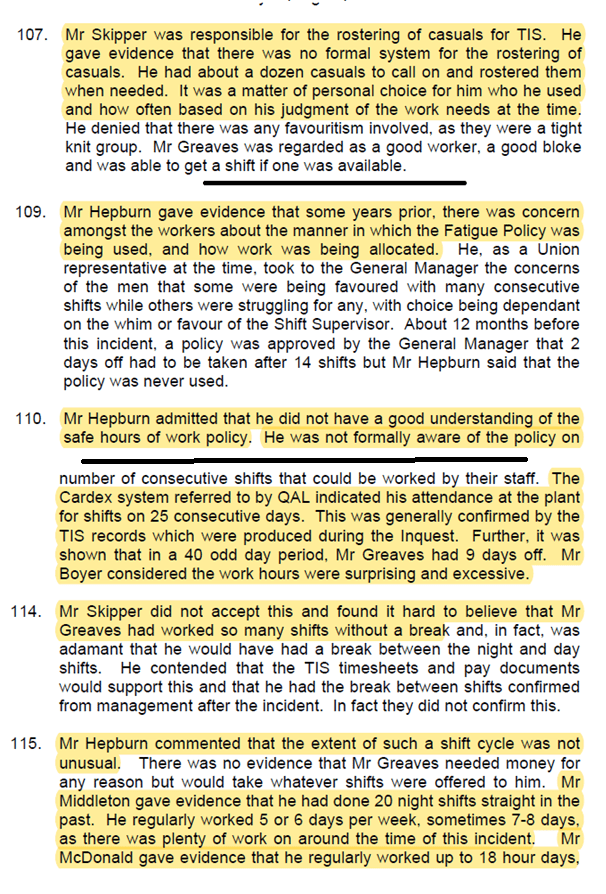
For fatigue:
· The deceased’s supervisor was responsible for rostering casuals. There was “no formal system for the rostering of casuals”
· The supervisor had no training on fatigue management and was “reliant on workers telling him that they were fatigued and could not work”
· Records indicated that the deceased had worked for 25 consecutive days and had just 9 days off over the preceding 40 days
· A worker said that “the extent of such a shift cycle was not unusual”. Others reported working 8 straight days and 18 hr days
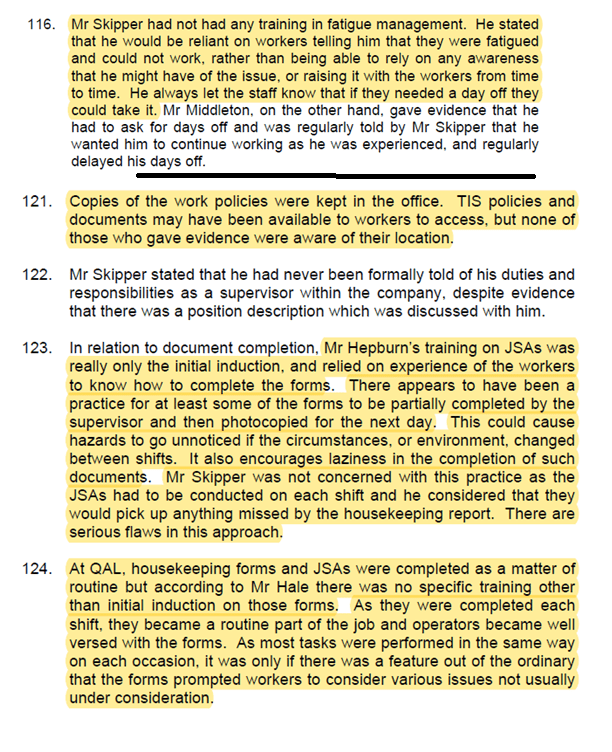
For JSAs and safety arrangements:
· While safety policies “may have been available to workers to access”, none of those “who gave evidence were aware of their location”
· The supervisor really only had training on JSAs in his initial induction, and “relied on experience of the workers to know how to complete the forms”
· There appeared to be a practice where forms were partially completed by the supervisor and photocopied the next day. This could “cause hazards to go unnoticed if the circumstances, or environment, changed between shifts”
· The JSAs were completed each shift and “became a routine part of the job and operators became well versed with the forms. As most tasks were performed in the same way on each occasion, it was only if there was a feature out of the ordinary that the forms prompted workers to consider various issues not usually under consideration”
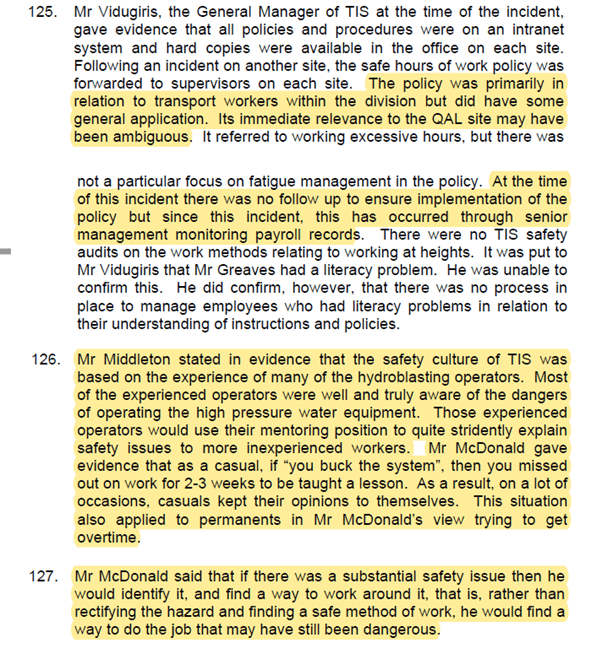
· “there was no follow up to ensure implementation of the [safe hours of work] policy”, nor audits on work methods relating to working at heights
· Workers were incentivised to remain silent on safety concerns because if you ‘buck the system’, you might miss out on work as punishment; casuals found it difficult to speak up
· There appeared to be a “disconnect between policy documents and practices on site”; systems which should have prevented the incident did not
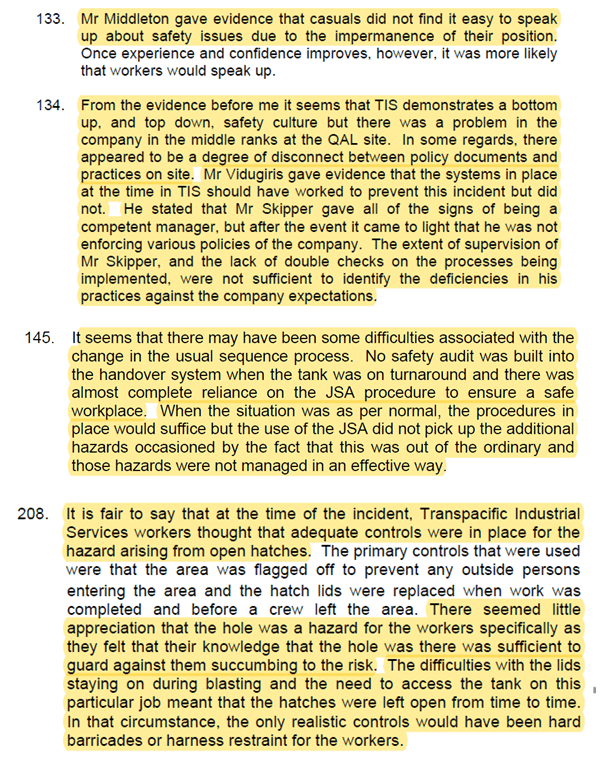
· “No safety audit was built into the handover system when the tank was on turnaround” and there was “almost complete reliance on the JSA procedure to ensure a safe workplace”
· The company “thought that adequate controls were in place for the hazard arising from open hatches” but in practice the “primary controls that were used were that the area was flagged off”
· There “seemed little appreciation that the hole was a hazard for the workers specifically as they felt that their knowledge that the hole was there was sufficient to guard against them succumbing to the risk”
Ref: Coroner’s Court 2008. Inquest into the death of Colin Arthur GREAVES

 SafetyInsights.org
One thought on “Coroner: reliance on paperwork systems, lack of operational verifications and almost complete reliance on JSAs to maintain safety”