An interesting study which explored the role of specific learning orientations in financial auditing that enhance or limit learning.
Specifically, they looked at how an open error or blame error climate moderates the relationship between four work conditions and learning from errors.
An experiential questionnaire approach was utilised with 141 Dutch auditors.
Providing background:
- “Human errors at work are unavoidable, even when organizations develop sophisticated systems for their prevention” and despite considerable efforts to prevent planes from crashing and patients dying from preventable causes, these still happen
- They argue that effective error management in organisations requires both prevention and subsequent learning from errors that occur
- It’s argued that “Learning from errors does not occur spontaneously; rather, it is an effortful process that requires time, resources, and vulnerability, which may not always be available or desirable in the workplace”
- Prior research indicates that learning from errors “depends on whether conditions at work are perceived by individuals to positively or negatively affect their self-worth and well-being”
- Four work conditions that may inhibit auditor error learning in daily practice are studied: small consequences for errors, routine-type errors, strong negative emotions, and high time pressure.
- Errors with small consequences are expected to lead to less learning, as they’re considered “less ‘learn-worthy’. These errors are more easily discounted as irrelevant. They note that because “professionals focus on achieving expected outcomes … errors that do not significantly affect these outcomes are not made a priority for learning”
- Routine errors are expected to be reported less than non-routine, as “these errors are easily attributable to inattention or coincidence, rather than a lack of knowledge”. Non-routine errors occur when the necessary knowledge to solve a problem is present but not used correctly or when a task is so complex or is unfamiliar, that the person needs new knowledge to solve the situation (rule-based and knowledge-based errors)
- Non-routine errors typically challenge people more to reconsider the applicability and limitations of their knowledge, mental models etc and thereby learning to improve
- They expect auditors learn less when they experience strong negative emotions, compared to weak negative emotions, as “these emotions take up crucial cognitive resources needed for learning, and may inhibit error learning”. Strong negative emotions like shame, fear, guilt can limit learning because negative emotions both occupy working memory (limiting info that is essential to learning) and resulting in people withdrawing from a situation and missing out on important learning opportunities
- Other research has indicated that individuals prioritise relieving strong emotions over problem-solving and learning; hence strong negative emotions may impact learning potential
- They expect auditors will report less error learning in the face of high time pressure, compared to low time pressure as “they are likely to prioritize urgent tasks over learning, and because the error’s cause can be externalized (in line with, create necessary conditions for enabling error learning)”
- With time pressure, this may push people to rely more on information-processing strategies that limit their cognitive capability, and ignore competing possibilities and filtering out contradictory information
- They examine how error management climate (EMC) affects error learning. EMC “describes the beliefs, norms, and practices related to how errors are dealt with that are shared within an organization”
- An open EMC promotes opportunities for learning from errors, whereas if auditors perceive a blame EMC, errors will be seen as personal failures and punishable
Results
Overall they found that:
- An open EMC mitigates negative relationship between negative emotions and error learning and also mitigates the negative relationship between negative emotions and error learning
- Blame EMC, contrary to expectations, mitigated the negative relationship between small error consequences and error learning “so that overall, more error learning takes place regardless of consequences when participants experience a blame EMC”
- For negative emotions, auditors engaged in more moderation by blame EMC
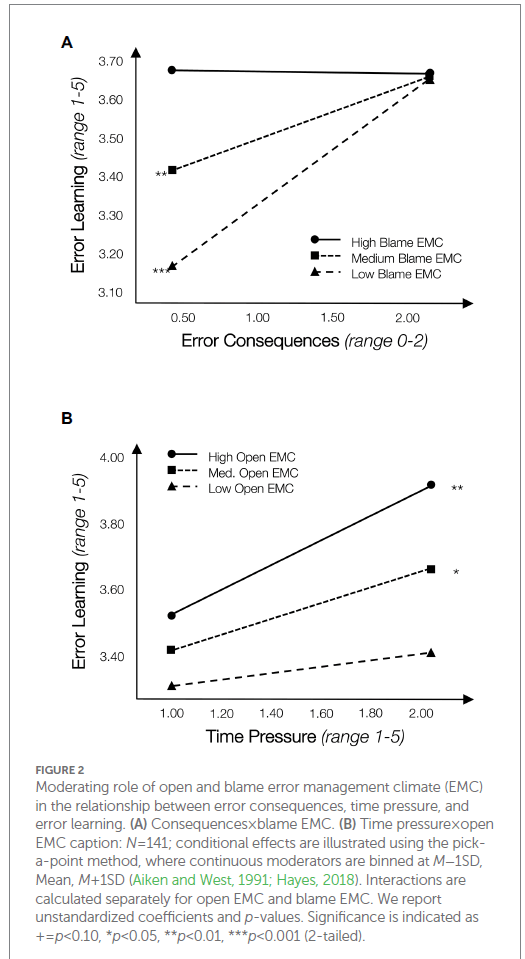
Moreover, “an absence of blame values and beliefs can contribute to error learning from negative emotions; a strong open EMC is not required”. That is, blame and non-blame (openness to learning) aren’t different ends of a spectrum but are different constructs, and you need only have low blame to effectively learn (rather than also needing an open climate to learning).
Most interestingly, they found that “more error learning takes place from smaller errors when auditors perceive themselves to work in a blame EMC” (emphasis added). This was against expectations about the expected relationship between a blame climate and impaired learning.
Rather, they found that “some blame-oriented values and beliefs may create a sense of urgency to learn from smaller errors to prevent their recurrence in the future”; leading to a heightened impetus to learn.
Therefore, they conclude that “some blame-oriented values and beliefs within an organization may not be as problematic as previously assumed … and may even carry some potential benefits for error learning”.
However, they’re careful to highlight that while some blame-based values diminish barriers to learning, “we are cautious in recommending the maintenance of a blame climate based on this finding”. Nevertheless, there appears to be some merit in communicating the consequences of error repercussions.
Time pressure and error learning were related via an inverted U-shaped function, indicating that medium levels of time pressure are associated with more error learning than both low and high time pressure.
They argue that evaluating both blame and open climates are important in their own respects (and aren’t just different ends of the same construct; just like trust isn’t the other end of mistrust but rather both unique and independent constructs)
Finally, they argue that organisations should strike a balance between both components of error climate – openness and blame. Creating an open EMC, with leadership support “centers on being a role model for learning from one’s own errors, providing opportunities for reporting errors rather than punishing subordinates, listening and assisting in the analysis and mitigation of future errors, and sharing knowledge derived from errors with others” and having elements of a blame EMC helps to create a sense of urgency for learning and breaking down some barriers.
Unfortunately, they didn’t unpack the relationship between ‘blame’ and forward-looking accountability.
Authors: van Mourik O, Grohnert T and Gold A (2023). Front. Psychol. 14:1033470.

Study link: https://doi.org/10.3389/fpsyg.2023.1033470
LinkedIn post: https://www.linkedin.com/pulse/mitigating-work-conditions-can-inhibit-learning-from-error-ben-skyhc/

 SafetyInsights.org
One thought on “Mitigating work conditions that can inhibit learning from errors: Benefits of error management climate perceptions”