This studied how the timing of decisions to mitigate risks, pre-construction vs construction phases, influenced the type of control against the hierarchy of control (HoC).
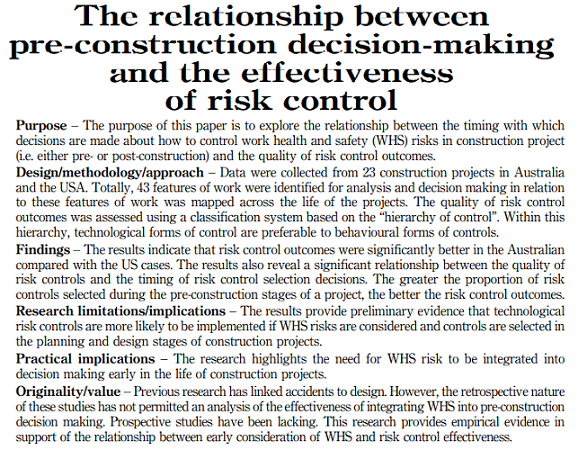
Data was collected from 23 Australian and American construction projects, including interviews with 288 project staff.
Authors first outlined the research and basis for safety-in-design (SiD). Research from others (Behm) found in their study that 42% of fatalities could be linked to design. Another study from Australia similarly found around 44% of fatal construction accidents to be related to design in some way.
Authors note that while safety professionals & others have been pushing for SiD, “designers have been slow to “pull” WHS upstream, presumably due to litigious concerns” (p110). Factors relating to designers not believing that safety design is related to them, or that they don’t fully understand what good practice looks like may additionally be barriers.
In some cases where upstream design solutions are implemented, it’s argued many of these “represent fairly modest solutions” (p110). They cite examples like fixing rails or fall arrest devices rather than eliminating the need for working at heights.
In the author’s words, they assessed the effectiveness of safety controls against the HoC as a leading indicator.
Results
The findings indicate that when hazards are identified and controlled at the pre-construction phase (compared to construction), the controls are more likely to be of a higher order and technological nature compared to when identified or controlled at the construction phase.
Thus, the “greater the proportion of risk controls selected during the pre-construction stages of a project, the better the risk control outcomes” (p108). They note that under the assumption that higher order controls will have greater risk reduction effects, the results support the notion that the ability to influence health and safety will be lower if left to the construction phase.
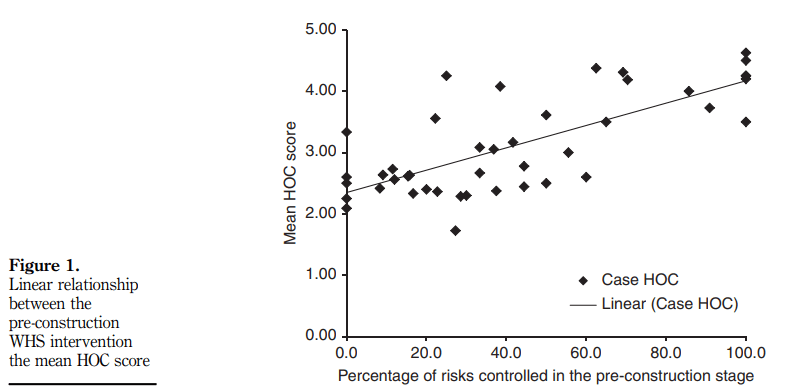
Further, if decisions to control risks are left immediately prior to or during construction, risk controls may be more likely to be of a behavioural nature.
Authors suggest that their findings provide preliminary support for Szymberski’s time-safety influence curve, which suggests by the slope that the ability to influence safety decreases through the project lifecycle.
Interestingly it’s argued that findings from other retrospective design or accident research which looks backwards in time may over-state the effects of relationships as researchers may be “actively looking for “design relatedness” … a phenomenon referred to by Lundberg et al. (2009) as “what-you-look-for-is-what-you-find” (p121).
They also explained how their use of the HoC for measuring the dependent variable acted as a leading indicator, as opposed to the usual way to “measure the occurrence of accidents, which is a notoriously unreliable and rare measure of WHS performance in construction projects” (emphasis added).
Hence, in their view, analysing the HoC over incidents “more directly measured the quality of WHS risk management”.
Overall, authors note that the research “highlights the need for WHS risk to be integrated into decision making early in the life of construction projects” (p108).
Authors: Lingard, H., Saunders, L., Pirzadeh, P., Blismas, N., Kleiner, B., & Wakefield, R. (2015). Engineering, Construction and Architectural Management, 22(1), 108-124.
LinkedIn post: https://www.linkedin.com/pulse/relationship-between-pre-construction-decision-making-ben-hutchinson-dlttc

 SafetyInsights.org