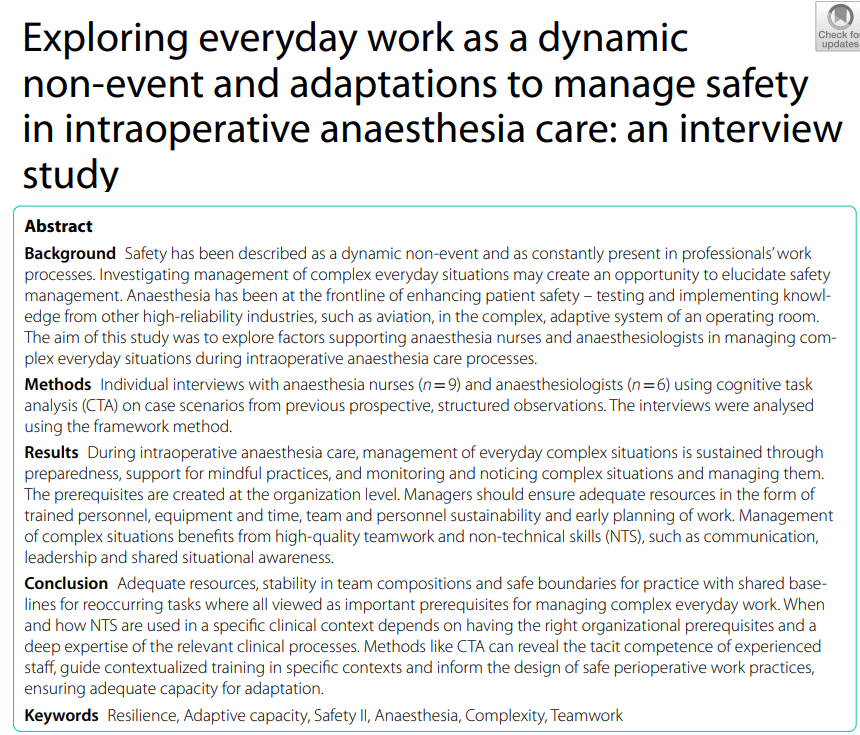
A study to be posted soon evaluated everyday work via cognitive task analysis to map the factors that enabled surgical staff to navigate complex work and situations.
Firstly they note that many official processes and protocols “reflect the work methods intended to meet the demands at the frontline (WAI – work as imagined).
However, because of the complex nature of many workplaces, with continuous variations and interdependencies, the actual work performed (work-as-done), is “never completely aligned with WAI”.
Resultingly, “resilient performance is dependent on the adaptive capacity of frontline staff managing both the gap between WAI and reality and the challenges that emerge when everyday work is done in a complex adaptive system”.
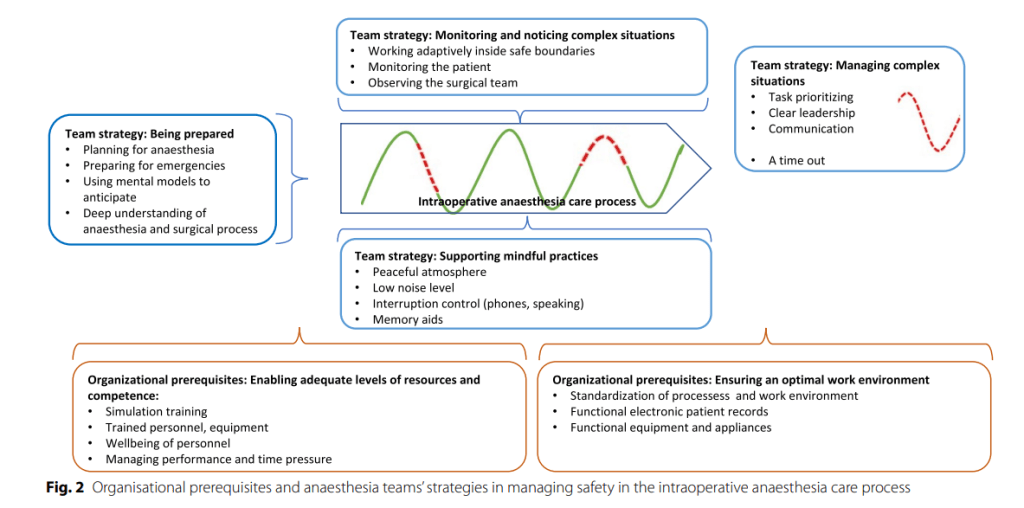
For adaptation during routine and non-routine situations, teams employed the following strategies:
· Preparation in advance of surgery, like aligning mental models
· Monitoring complex situations
· Managing complex situations
· Supporting mindful practices
Organisational prerequisites were necessary to enable adaptative behaviour:
· Enabling adequate levels of resources and competence
· Ensuring an optimal work environment
Authors: Olin, K., Klinga, C., Ekstedt, M., & Pukk-Härenstam, K. (2023). BMC Health Services Research, 23(1), 1-15.
Study link: https://doi.org/10.1186/s12913-023-09674-3

 SafetyInsights.org
One thought on “Safety as a dynamic non-event and exploring everyday work”