This study evaluated the impact of narrative/story-based approaches to safety messages; e.g. injury stories on actual safety behaviour versus mechanistic instructions without use of anecdotes and ‘traditional abstract safety messages’.
Providing background:
· They aptly ask whether people pay attention to safety and health messages? For one, despite warnings not to hold children in your lap while operating a ride-on mower, these tragic incidents are frequently reported around the world
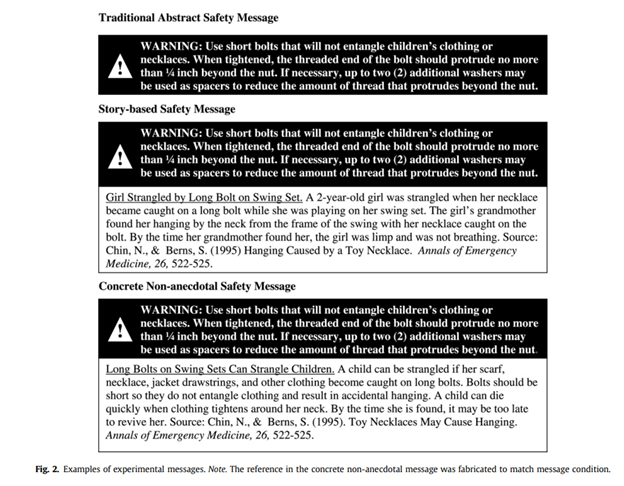
· They provide a message that transmit both info and conveys the importance of that info via a family’s personal experience. I’ve skipped the full message due to brevity but see the image below. It involved a serious injury to a child’s foot due to a ride-on mower incident. A year after the incident her father remains stricken with guilt
· The story is described as providing a victim’s experience to grab attention and “unmistakably communicates the personal consequences of a child-passenger mowing injury”
· As opposed to an alternate message that only conveys info or a warning (see again below), the anecdotal story-based example “triggers images of real events that profoundly altered the lives of a child and her father. The message was designed not simply to inform but to change behavior by motivating readers to reflect on the high personal risks”
· Some story-based interventions include simulation exercises, designed to present realistic stories of workers in hazardous situations
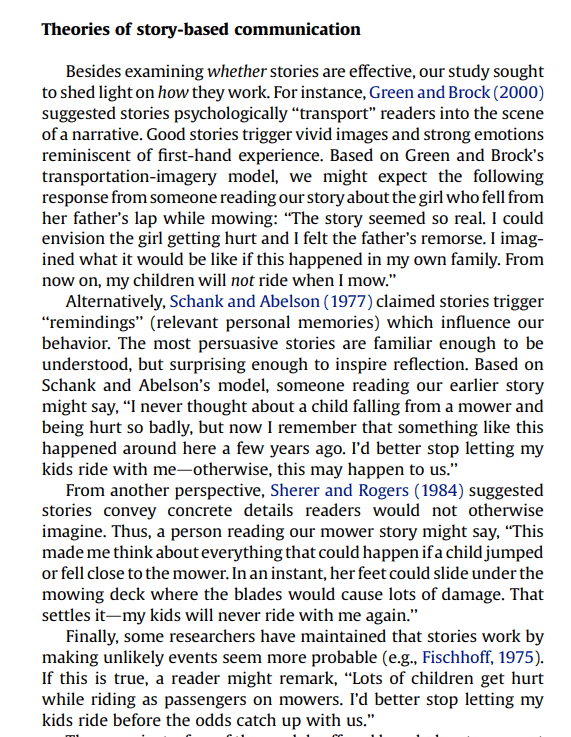
· They propose several mechanisms why narratives may be more persuasive (see below image)
The different stories or warnings used are shown below:
Results
Overall they found that:
· Story-based messages resulted in a 19% improvement in safety behaviour compared with non-narrative comms
· Moreover, “injury stories did not create undue fear of the message object, demonstrating that brief anecdotes about accident victims can convince people to take reasonable precautions without creating unwarranted alarm about risks”
· Safety messages were thus more effective “when they contained brief stories about people who were injured in the past. This effect occurred even when we controlled for message concreteness, informational content, reading difficulty, message length, use of personal pronouns, message channel, and level of participant activity and interaction”
Discussing the findings, they contrast with an earlier study which found no behavioural effects for story-based messages compared to equivalent non-narrative comms.
Discussing the psychology of stories, the behavioural impact of stories “seemed to arise from some distinct narrative property that was absent from otherwise equivalent non-anecdotal messages”.
However, the psychological variables examined in this study weren’t connected to the narrative effectiveness. Rather, the effectiveness of stories seemed to be due to “ narrative transportation (the experience of being absorbed in a story), remindings (memories of similar events), richness of thoughts involving concrete details, or risk perception”.
The lack of connection between psychological explanations and behaviour may have been due to the use of brief stories that were not particularly engaging.
Finally, they discuss how use of injury stories “did not appear to trigger irrational fears”; supporting prior work that found that illness anecdotes didn’t increase health worries among medical patients.
This contrasts another study which found that victim stories did elicit “exaggerated perceptions of risk”. They believe the difference lies in that the prior study “made deliberate use of sensationalistic stories”, which the current authors tried to avoid by “omitting graphic depictions of suffering and attribution of blame”.
Authors: Ricketts, M., Shanteau, J., McSpadden, B., & Fernandez-Medina, K. M. (2010). Social science & medicine, 70(9), 1441-1449.

Study link: https://doi.org/10.1016/j.socscimed.2009.12.036
LinkedIn post: https://www.linkedin.com/pulse/using-stories-battle-unintentional-injuries-safety-ben-hutchinson-weczc

 SafetyInsights.org
4 thoughts on “Using stories to battle unintentional injuries: Narratives in safety and health communication”