This explored the relationship between individual & system-level variables on procedure use & departure. Individual factors included attitude towards utility of procedures & rule compliance.
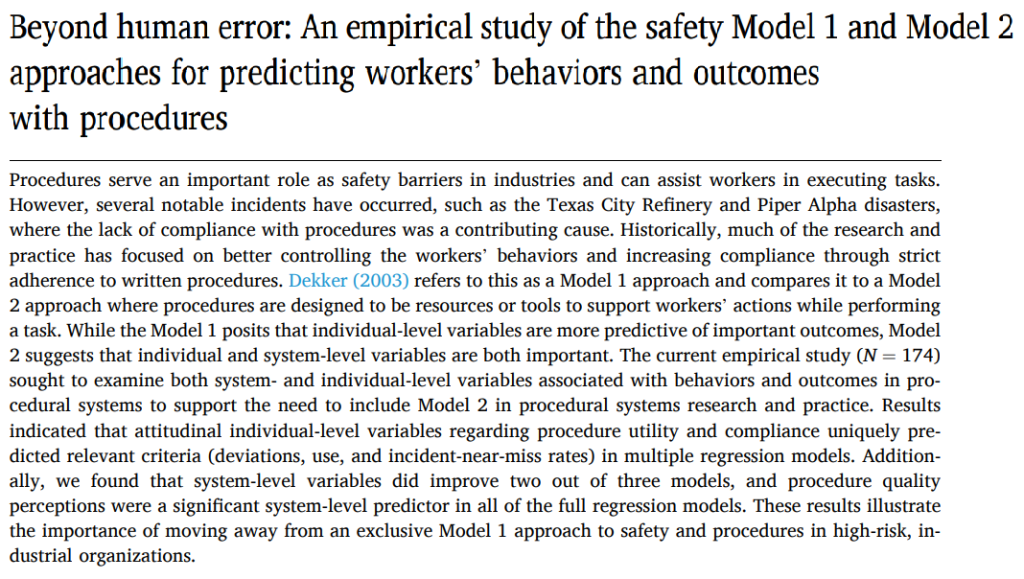
System factors included procedure quality, perception of procedure change process & safety climate.
The analysis was framed via the model 1 / model 2 concept (for a great discussion see two papers from Hale & Borys “Working to rule or working safely?”).
Model 1 sees rules as an embodiment of the better way to work, designed by experts in advance to cover requirements & where things are seen to be safe providing people just follow the rules. Model 2 focuses on rules as tools that people use for support but relying more on their experience – accepting that rules can’t cover all contingencies & people need to adapt to successfully & safely complete work.
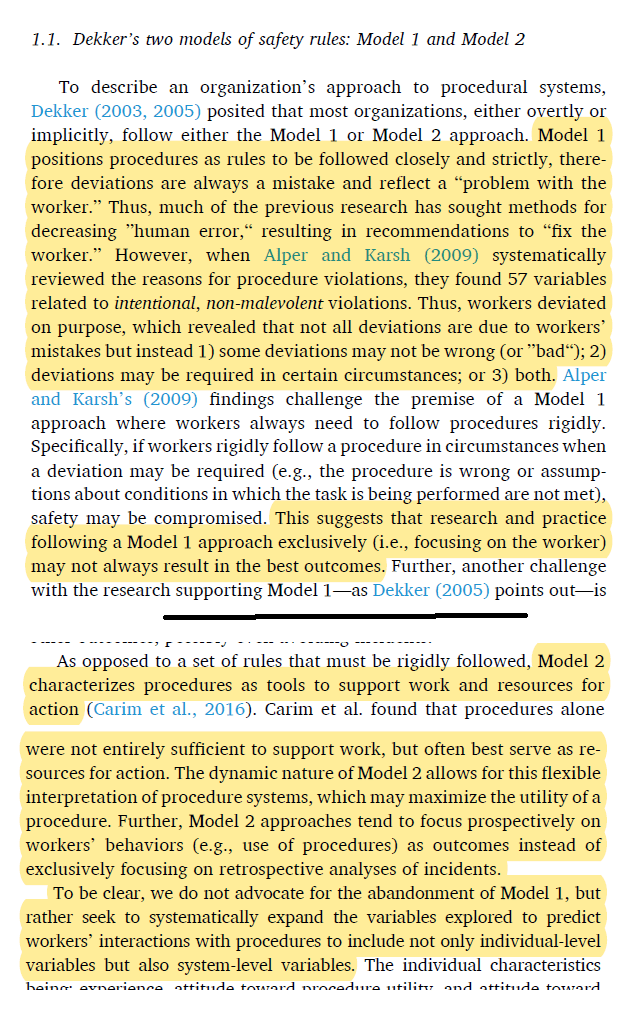
Prompting this study, it’s argued that improving procedural systems may be limited if focus is placed mostly on trying to tightly control worker behaviour (via model 1) rather than accounting for broader organisational factors.
Results
Evidence was found for both individual and system variables where things like perceived procedure quality (system), and role experience, attitudes towards procedure utility and their own compliance attitudes (individual factors) were all related to the outcome measures.
Attitudes towards procedure utility was found to be the only predictor of incidents & near misses where better attitudes regarding utility was related to fewer self-reported yearly incidents and fewer departures. A system level variable “perceived procedure quality” was overall the best predictor for all outcome & behaviour variables.
Predictably higher industry experience was related to less procedure use & greater rule departure.
Perception of higher procedure quality was related to fewer incidents & near misses in both individual & system models. Notably the authors say that the results indicate “the importance of procedure quality, as it is the best, unique predictor of both procedure deviation and procedure use (behaviors)” (p7).
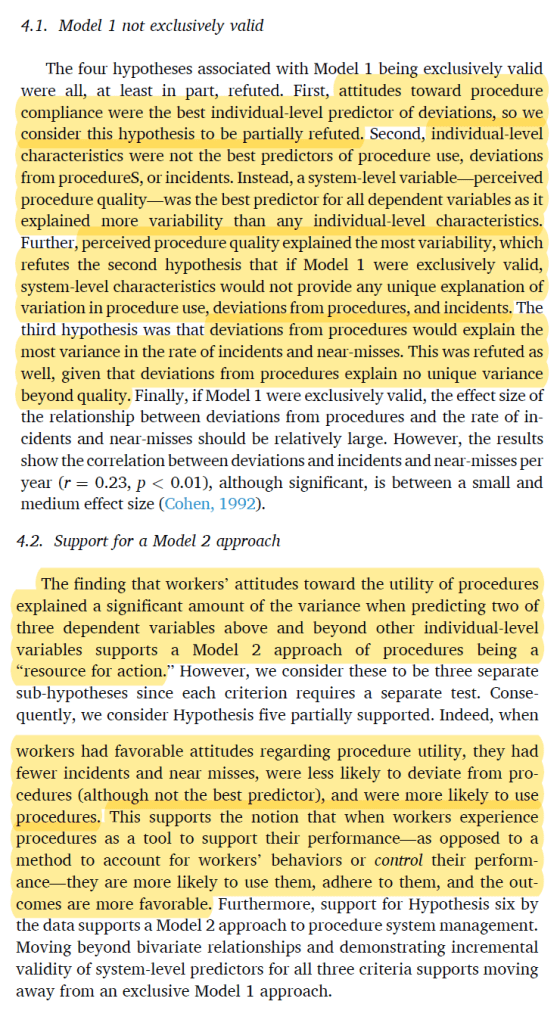
These findings indicate that “not only do system-level variables predict procedure-related behaviors and outcomes, but they uniquely predict above and beyond individual-level characteristics” (p7), suggesting the importance of system variables.
Further to this point is that a model 1 view of procedures may be necessary but insufficient for understanding & predicting procedural system effectiveness. Said differently, a view of procedures as strict prescriptions of ideal ways to do work that enable people to adequately overcome challenges & variability by following the rules (eg model 1) is “not exclusively valid”.
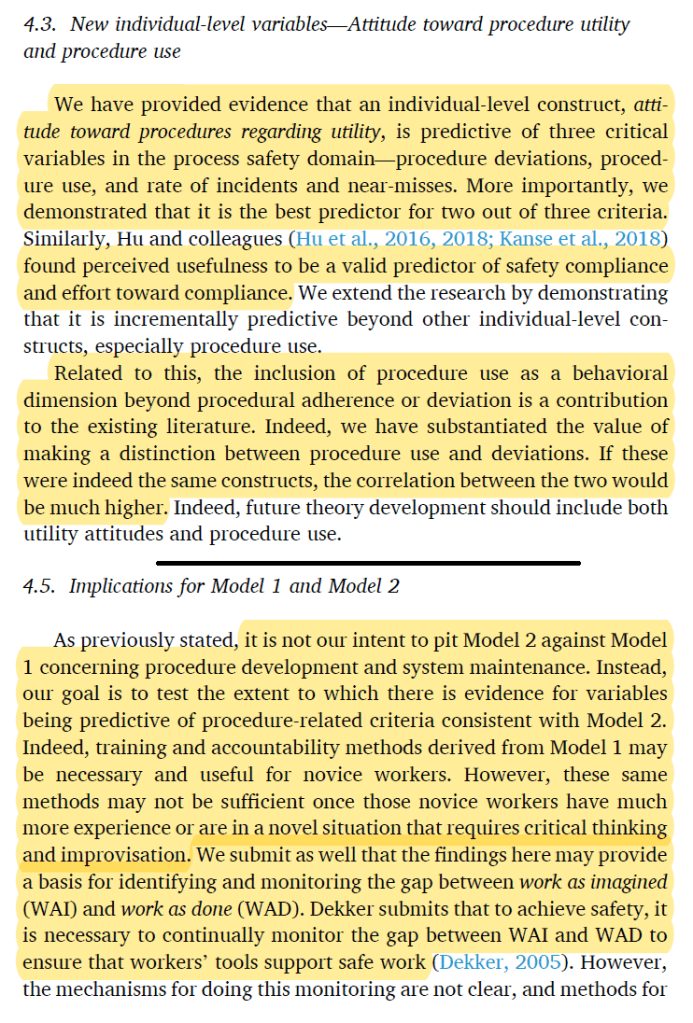
When workers perceive procedures as tools to support them rather than as prescriptions to follow or control their behaviour they are “more likely to use them, adhere to them, and the outcomes are more favorable” (p7).
Other system variables like safety climate & change process evaluation (e.g. how long it takes for procedures to be updated & released) didn’t uniquely predict any behaviours or outcomes.
Of further interest is that while reported deviations of procedures are correlated to incidents, they don’t provide more predictive ability beyond perceived procedure quality. That is, “procedure deviations are often due to the procedures’ quality” (p7) rather than issues related to people.
Overall this study suggests that model 1 / model 2 views of procedures are complimentary and not conflicting. Further, only focusing on procedure quality in itself “creating the perfect procedure” without accounting for the utility of the procedure as experienced by workers, may fail to make any significant progress and thus highlights the need for workers to create useful procedures as defined by themselves.
Hendricks, J. W., & Peres, S. C. (2021). Safety science, 134, 105016.

Study link: https://doi.org/10.1016/j.ssci.2020.105016
LinkedIn post: https://www.linkedin.com/pulse/beyond-human-error-empirical-study-safety-model-1-2-ben-hutchinson-63qsc

 SafetyInsights.org
2 thoughts on “Beyond human error: An empirical study of the safety Model 1 and Model 2 approaches for predicting worker’s behaviors and outcomes with procedures”