Can excessive focus on procedural compliance hamper our ability to learn from major incidents? Yes, according to a 2014 study which evaluated the fallout from the 2011 Wivenhoe Dam flood event.
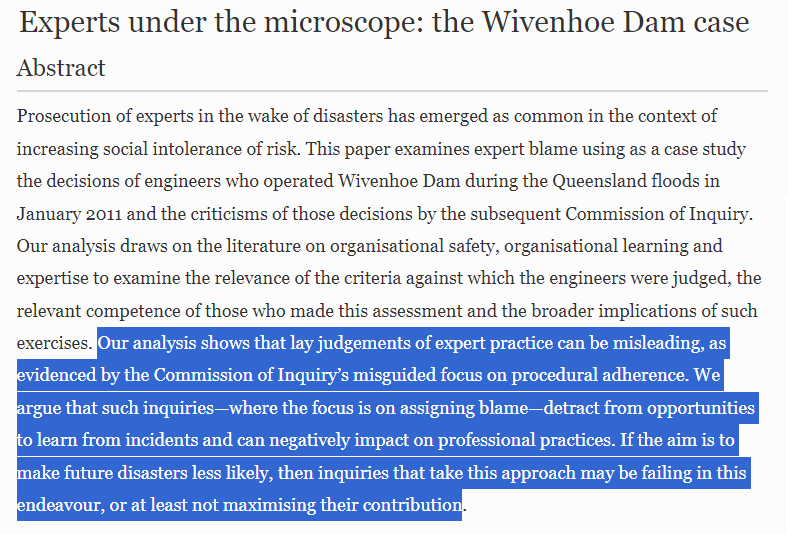
Maslen and Hayes unpack the resultant Commission of Inquiry. While preventing a downstream flood was seen to be unavoidable, and hence, the on-duty engineers performed a nearly ‘perfect outcome’, significant criticism was levied towards their decisions.
The “apparent insistence [by the commission] that the best decisions are made by slavishly following procedures is at odds with the literature on expert decision-making and excellence in safety”.
Engineers reported that “compliance alone is not a sufficient strategy for ensuring excellent safety outcomes in complex industries” and that, organisations engage expert engineers for professional judgement in the form of risk management “over and above a simple compliance approach”.
However problematically, “in the case of assessing risk management ‘it is easier to audit and assess deviations from procedures or processes than understand … safety on a case-by-case basis”.
Nevertheless, the Commission still found that the operational manual (which guides dam releases), was “confused and so compliance on the part of the engineers was difficult, if not impossible”.
The authors then discuss the problem of blame. They note “When things go wrong, blame can take on a life of its own outside of expert opinion or even common sense” and “It is easier to assess judgements in the context of their procedural adherence”.
A fallacy of counterfactual logics is believing that if rules were simply followed, then nothing bad would have happened.
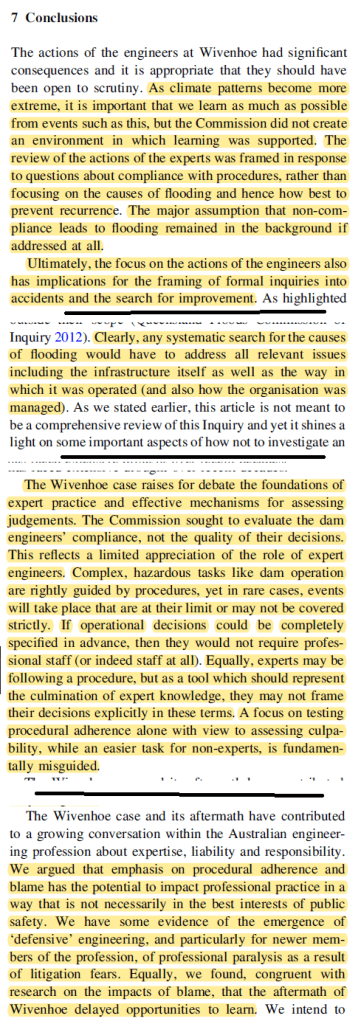
The problem of assigning blame is that it “incubates a fear which, in turn, inhibits a readiness to learn from incidents …This can fundamentally shape professional practice”.
Fear drives defensive practices – e.g. defensive medicine where doctors order unnecessary tests and procedures to avoid liability, and defensive engineering – where engineers specify unnecessary designs, practices and paperwork; e.g. arse covering.
Finally, “Linking accident causality so strongly to the actions of individuals also effectively ignores research that shows accidents are fundamentally suffered by organisations, not individuals”.
The Commission process was seen to have generated an environment of poor learning.
Authors: Maslen, S., & Hayes, J. (2014). Environment Systems and Decisions, 34, 183-193.

Study link: https://doi.org/10.1007/s10669-014-9492-7

 SafetyInsights.org
One thought on “Investigations driving fear and lack of learning following major incidents”