Among the most important studies influencing my own research is this excellent 2011 work from Blewett and O’Keeffe.
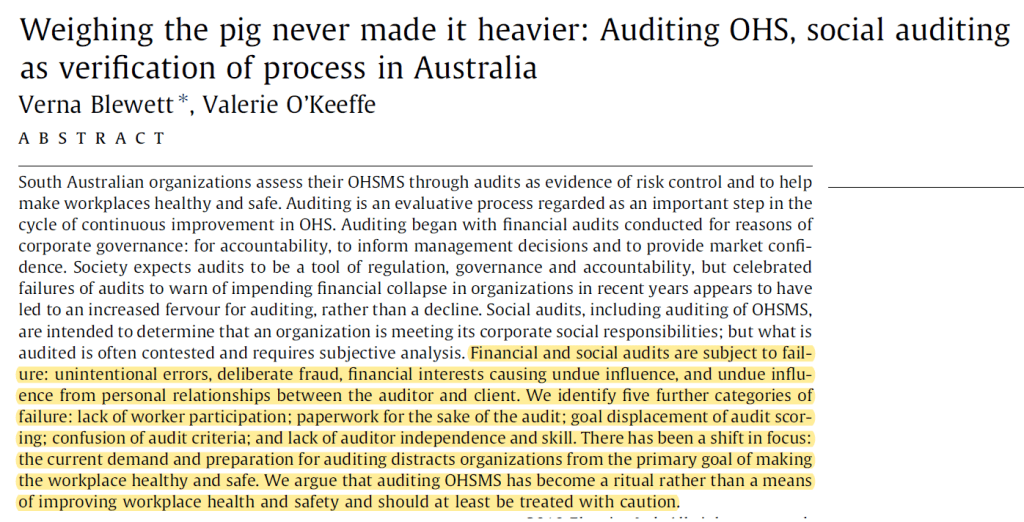
They explore the underlying factors behind ‘failures’ of auditing. First, they flag prior research which had a focus on the auditors themselves – e.g. unintentional errors, deliberate fraud, financial interests and personal relationships
They expand this with five additional categories:
· Failure to allow worker participation
· Lack of auditor independence and skill
· The confusion of audit criteria
· Paperwork for the sake of the audit
· Unintended consequences, goal displacement and audit scoring issues
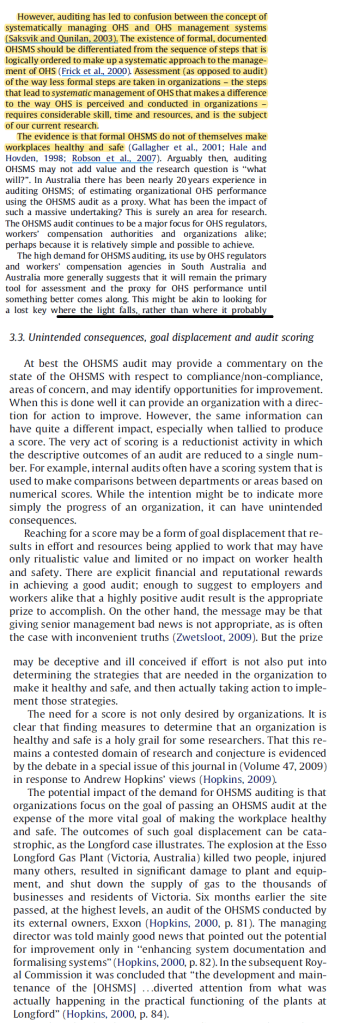
While audits may “provide a commentary on the state of the OHSMS” when done well, this “same information can have quite a different impact, especially when tallied to produce a score”.
That is, the “very act of scoring is a reductionist activity in which the descriptive outcomes of an audit are reduced to a single number”. Aiming for a better score may “be a form of goal displacement that results in effort and resources being applied to work that may have only ritualistic value and limited or no impact on worker health and safety”.
This is compounded with financial and reputational rewards linked to a good audit. This can also give senior management a false view and absence of bad news.
They also observed two categories of paperwork (image 2):
· Paperwork that helps to manage risks and assure safety
· Paperwork that helps to complete the audit
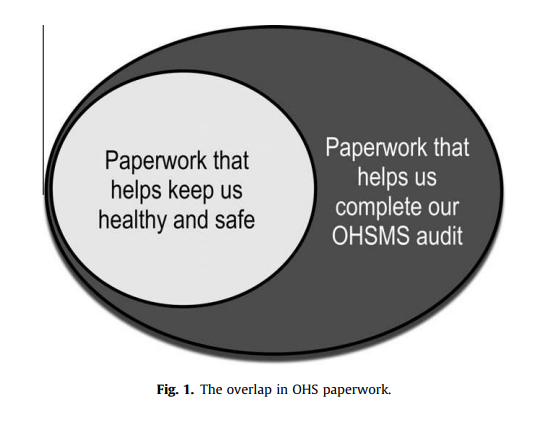
As expected, they found a lot of effort invested towards paperwork to pass an audit – e.g. “organizations may be driven by the audit imperative to over-document OHS-related activities”.
They also observed instances of resources devoted to ensuring the efficient administration of paperwork in order to maintain an auditable trail. Here, the “quality of the information within the paperwork in those circumstances was often a secondary consideration”.
Moreover, they “observed a disconnect between the purpose of the paperwork and the exercise of collating it. In other organizations, the management system was stored on computer and was inaccessible in real terms to the operational workers whom it was intended to protect”.
It’s an interesting and relatable read. You can access the full paper in the link in comments.
Ref: Blewett, V., & O’Keeffe, V. (2011). Safety science, 49(7), 1014-1021.

 SafetyInsights.org
One thought on “Weighing the pig never made it heavier: Auditing OHS, social auditingas verification of process in Australia”