This study explored the biasing effects of witness opinions and background knowledge held by ‘investigators’ during workplace investigations.
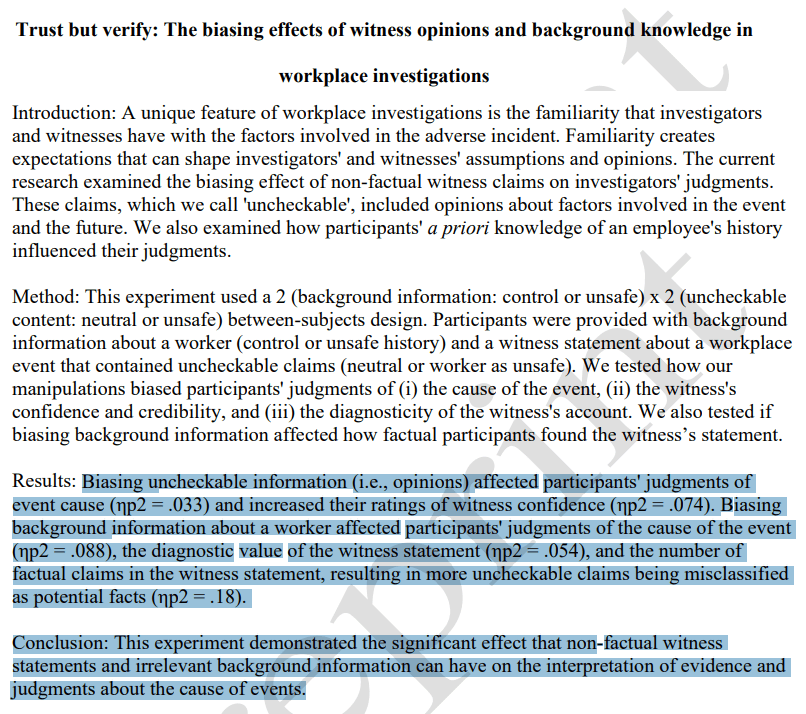
124 participants were involved in an experimental design; not professional investigators as far as I could tell (so note that limitation).
In short, they checked the biasing effects of non-factual witness claims on investigator judgments. These judgements were called ‘uncheckable’ and included opinions/speculations.
Providing background:
· Bias is “any factor that systematically influences decision making other than the truth” and is “an inherent feature of the human experience and of widespread and current concern in professional decision making”
· Individuals frequently draw on (at least) two heuristics relevant for investigations: representative heuristic, being how people gauge how closely the current situation resembles past experience and availability – how easily information comes to mind
· Information with similarity to past experiences but with no real informational value for the current situational “that are not factual but seems relevant (e.g., opinions), can manipulate our sense of representativeness or availability or both, and thus deliver a biased theory and perspective”
· Further a range of other biases and heuristics show how knowledge, expectation and maintaining consistency can frame how we select and interpret information
· Here, info that confirms an individual’s hypothesis is given greater weight in decision making whereas inconsistent info is given less attention
· Moreover it’s common for investigators involved in investigations to be familiar with the factors involved in the incident, thereby influencing their base rate expectations. E.g. it’s noted “Familiarity has been shown to bias the content of witnesses’ testimonies to workplace events”
· Base rate is “experience-based knowledge about the likelihood of an occurrence. Base-rates have been shown to bias professional workplace investigators’ judgments about event cause”
· The author then discusses the context of uncheckable content. They note that opinions can be derived from facts, but neither an opinion nor a future projection can be a fact. Rather, “At best, individuals’ opinions are derived from objective information, however, individuals’ subjective assertions can also be the product of unconscious mechanisms such as stereotypes, loyalties, and self-protection”
· An uncheckable claim is something that can’t be verified because there are no details that can be fact-checked, for instance “he’s sloppy” is a value judgment and does not contain factual details”. Thus, “Because an uncheckable claim made by a witness can never be verified, it is information that is not evidence of what happened”
· Prior research has found that uncheckable opinions constituted 19-32% of witness statements (of whom had no prior experience with the workplace or people involved in those events)
· Also the value of information is also relevant. The author nots that info value will vary based on its salience, diagnosticity and reliability. Saliency is noticeable and may be cognitively fluent to process but not necessarily informative.
· Diagnostic and reliability are features of a cue’s informational value, with diagnosticity offering “evidence of a true state, for instance CCTV footage”. An individual’s statement of a vehicle driving “too fast” is said to be interesting but not diagnostic, because this isn’t evidence of a true state (it’s not the actual speed of the vehicle, nor the expected norm)
· Witness statement credibility is said to be important in workplace investigations because often there’s little evidence available. Moreover, witnesses who are more confident have been rated as more credible
· The scenario in this study involved a worker involved in a workplace event. Some groups received background info on control vs unsafe behaviours of the worker, and other groups received witness statements with checkable and uncheckable info.
Results
Key findings:
· Biasing uncheckable information, like opinions, were found to affect participants’ judgements of event cause, and increased their ratings of witness confidence
· Biasing background info about a worker affected participant judgements about event cause, the diagnostic value of the witness statement and the number of factual claims in the witness statement resulting in “more uncheckable claims being misclassified as potential facts”
· “participants struggled at times to differentiate between checkable and uncheckable information”
· “participants’ judgments were affected by both sources of bias but independently and not cumulatively”
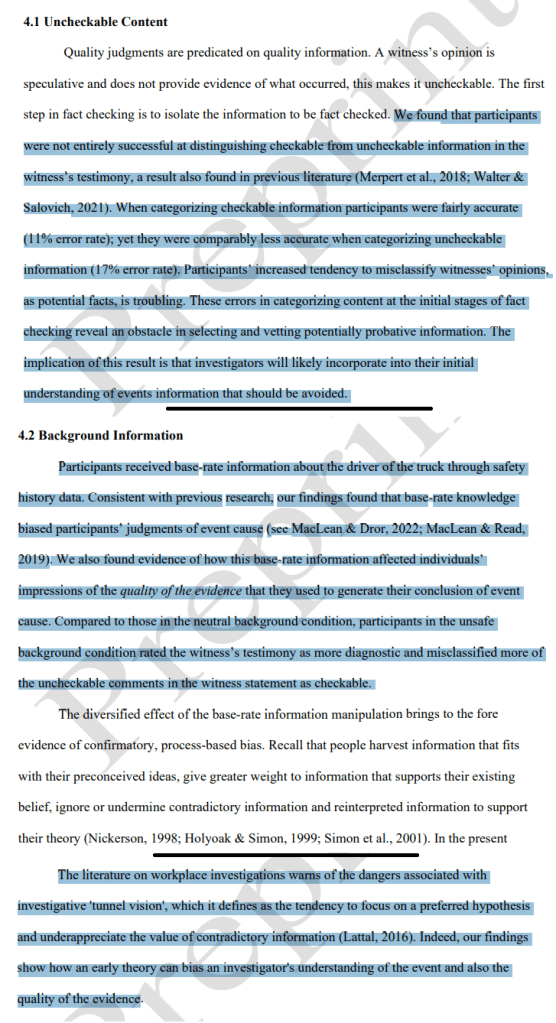
The authors note that the first step in fact checking is to isolate the info to be fact checked. Here, participants weren’t entirely successful at distinguishing checkable from uncheckable info in witness testimonies.
Participants were more successful in identifying checkable info (11% error rate) compared to uncheckable info (17% error rate).
Participants’ tendency to misclassify witness opinions as potential facts is said to be troubling. It’s argued “These errors in categorizing content at the initial stages of fact checking reveal an obstacle in selecting and vetting potentially probative information” and that investigators may be likely to incorporate initial info into their understanding of the event.
People tend to be more precise when they are more confident, and observers can detect an individuals’ confidence by their level of precision. Problematically, more confident witnesses (which may not be justified), may be rated as more credible in their statements.
The author argues that these findings “brings to the fore evidence of confirmatory, process-based bias”. Here, people “harvest information that fits with their preconceived ideas, give greater weight to information that supports their existing belief, ignore or undermine contradictory information and reinterpreted information to support their theory”.
Participants who received biasing background info about the worker used this info to develop an initial hypothesis about the accident cause and were more likely to emphasis operator error.
Moreover, participants in the groups that received biasing background info about the ‘unsafe’ worker also rated info in the witness statements as higher quality (more factual) because it aligned with their initial hypothesis of operator error.
In contrast, people without a primed “causal theory at the start of the investigation (control background condition) rated the witness statement and its contents as less probative”.
Discussing the findings, it’s said about the ‘dangers’ of tunnel vision, and how an early hypothesis can bias an investigator’s subsequent understanding of the event and assessment of the quality of the evidence. A number of debiasing methods may assist – I’ve skipped these as I’ve covered other research on debiasing on my site.
Authors: MacLean, C. L., & Miller, G. S. (2024). Trust but verify: The biasing effects of witness opinions and background knowledge in workplace investigations. Journal of Safety Research, Volume 89
Study link: https://osf.io/preprints/psyarxiv/7vxu3/download
LinkedIn post: https://www.linkedin.com/pulse/trust-verify-biasing-effects-witness-opinions-ben-hutchinson-h3omc

 SafetyInsights.org
2 thoughts on “Trust but verify: The biasing effects of witness opinions and background knowledge in workplace investigations”