An interesting thesis from Dean Wihnan & Søren Chr. Rossé Segel.
This thesis took a case study approach, via gamification, focus groups and semi-structured interviews of middle managers and their perceptions of receiving bad news within an energy company.
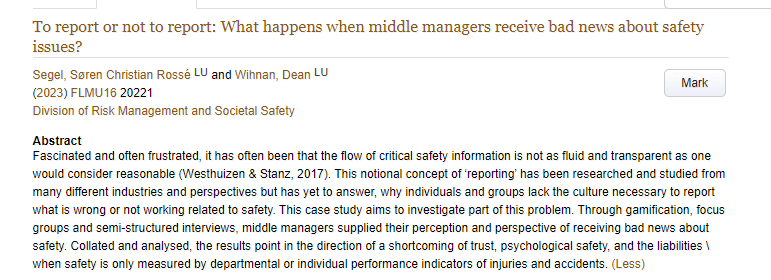
Way too much to cover, so some findings were:
- Middle managers “believe they face significant challenges around receiving and managing ‘bad news’ about safety in their organisation. e.g., “Management by fear” and “Sweeping it under the carpet”
- Thus, “middle managers believe that they were lacking capabilities to raise their concerns to senior management, thus limiting full disclosure of safety issues”
- A consensus among middle managers is that ‘bad news’ about safety impacted production, and this led to not reporting bad news
- Tensions were present between reporting bad news and on company measures. E.g. Middle managers ”experiencing control by senior management to adhere to KPI’s and other measurements of safety and production, and at the same time are responsible to fulfil production expectations”
- Middle managers, while not reporting all bad news upwards to senior managers, were also cognisant that the workforce that they supervise were also not disclosing all aspects of safety issues (‘fear of being seen as a snitch’); said to mainly occur due to a lack of trust and fair accountability
- Middle managers were trying to achieve disclosure about safety issues while also trying to build necessary trust and accountability. Here, “managers perceive they are also lacking trust and accountability from their supervisors … in effect, middle managers often become victims of the same forces they themselves are trying to control”
- Middle managers also understood the ability to build safety through trust and accountability, but noted the tension of that when they did report the bad news it could negatively impact the units they were part of. For instance, “highest-ranking quote from focus group was: “Bad news about safety – It will affect the dept.’s KPI negatively if reported”
- Moreover on KPIs, focus groups had the strongest agreement that bad news about safety “had a negative impact on the department’s KPI; hence, bad new will be less likely to be reported, leading to little or no dissemination of bad news which could potentially lead to serious accident”
- Measurement was seen as one of the most important factors influencing production. That is, “it was frequently mentioned that negative behaviour often arose from being measured. Some interviewees believed that cases in the reporting system (Synergi) were being closed for the sake of a deadline (often given by someone else), and less to implement a strong and sustainable action(s) to prevent the next accident”
- Hence, this finding may indicate that “measurements, such as department KPIs, which seemingly provides evidence of competent performance, can also drive a culture of not reporting bad news to ensure that a department’s measures remain strong and thus the department is seen positively by upper management”
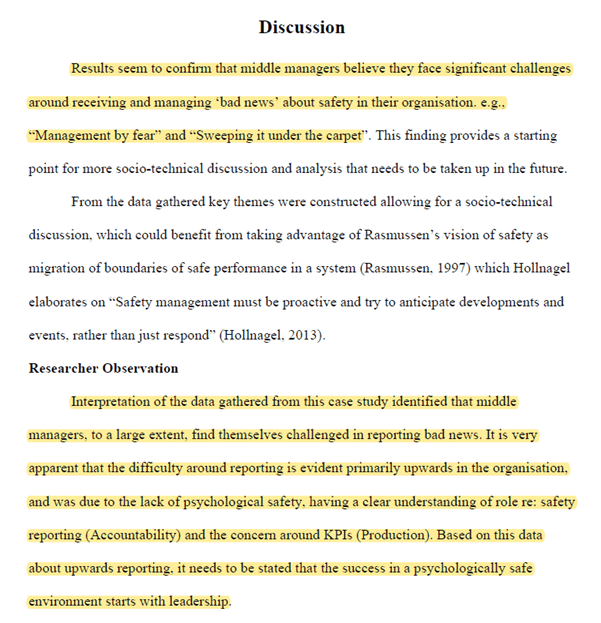
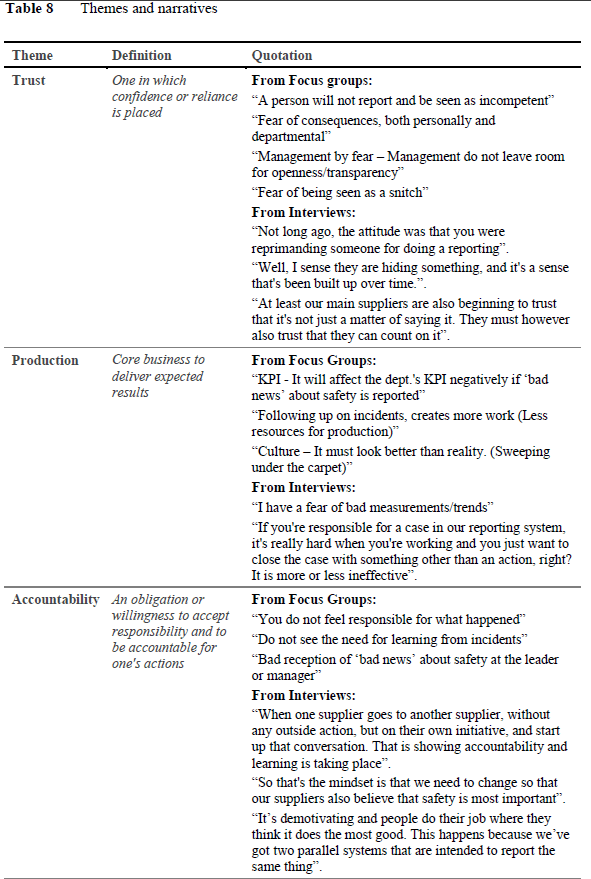
Image 3 covers some of the themes identified in the research.
Authors: Wihnan, D., & Segel, S. C. R. To report or not to report: What happens when middle managers receive bad news about safety issues?
Study link: https://lup.lub.lu.se/student-papers/record/9109895/file/9111214.pdf

 SafetyInsights.org
One thought on “To report or not to report: What happens when middle managers receive bad news about safety issues?”