Another study looking at the boundary effects of psychological safety (PS).
Using two protocols, they evaluated the role of PS and two mediators – fear of failure and work motivation, all as group-level constructs via aggregated group member ratings.
Note: I’ve skipped heaps of stuff in this paper. One thing I liked is that they properly defined ‘psychological safety climate’ and differentiated it from the other type of psychological safety climate. Normally in literature, PS is simply called PS, but some studies also call it PS climate. PS climate is also the individual-level construct of safety climate (as opposed to group-level safety climate). Hence, in some studies it’s confusing which construct they’re actually studying.
Providing background:
· PS as per Edmondson’s conceptualisation is a shared belief in the safety of the group environment. It promotes risk-taking behaviour as group voice, group learning behaviour and creative performance
· These behaviours are seen as ‘risky’ because“ people must take action without knowing whether things will work out as expected”
· The uncertainty related to these behaviours can create anxiety and fear in a group about that person’s social standing: fear of failure
· The positive attributes of PS have been widely recognised, although in some cases it’s also been linked to nonsignificant effects on learning behaviour and other types of performance
· They note that some of these null findings “is that psychological safety climate may not be entirely beneficial and that a concomitant negative effect may offset its positive effect”
· Edmondson noted that “if people are so comfortable with each other that they spend an inappropriate amount of time in casual conversation at the expense of their work” and “psychological safety climate may dampen the level of overall work motivation in groups because individual members may lack the edge to drive themselves forward”
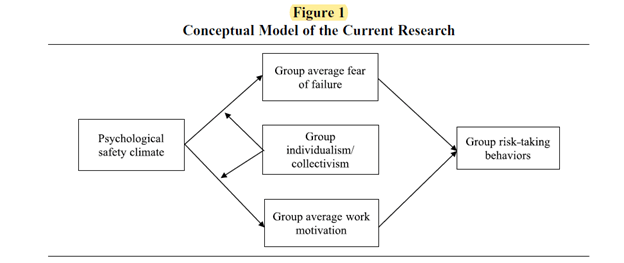
· This study developed a dual-pathway model of PS where negative mechanisms operates alongside the positive mechanisms
· For instance, when people know that their behaviour may be evaluated, judged or criticised, they tend to be more cautious and risk averse because the fear of failure will hurt their self-esteem or social image. Here, higher PS can act as a shield to alleviate the excessive concern about others and shield from socially penalising failure
· However, this shielding may also come at a concomitant cost where “such a comfortable socioemotional group context is likely to engender two opposite mechanisms that influence group outcomes” in the following ways 1) higher PS reduces fear of failure and hence promotes collective risk-taking behaviours, 2) reduces members’ work motivation because people tend to exert less effort when they don’t feel accountable or feel like they are being monitored or judged by others
· They argue that their dual-pathway model moves beyond “the traditional view that [PS] is always desirable”, and instead, has both positive and negative effects
· This study responds to Edmondson’s call for “investigating the boundary conditions of psychological safety climate and demonstrating the specific conditions in which its positive impact is enhanced and its detrimental effect reduced”
· They argue that it’s not immediately obvious why PS may “thwart work motivation in groups”. The accountability research provides some insight: namely, “evaluation by a salient audience and the likelihood of sanction are critical to the sustenance of effort in goal striving” and hence, group members being too socially comfortable “are less likely to exert effort to contribute to the group when they feel free of social monitoring a unit to accomplish common goals”
· Further, “[PS] is characterized by easy access to help, which encourages the tendency to shirk responsibility” and group members have been shown to reduce their effort when they have easy access to backup assistance
· Therefore, “the supportive and forgiving nature of psychological safety climate shields group members from social evaluation and weakens members’ overall work motivation”
Their dual-pathway model is shown below:
Results
Key findings:
· PS was shown to display “two concomitant, opposite effects on positive risk-taking behaviors via fear of failure and work motivation”
· PS reduced fear of failure, but only among collectivist groups
· PS negatively affected work motivation, but only among individualistic groups
· PS “reduces desirable risk-taking behaviors, including group voice, learning behavior, and creativity, through a reduction in work motivation, especially among individualistic groups”
· A significant relationship was found between PS and group average work motivation in protocol 1 but not the second protocol
· The findings demonstrate two opposing pathways that cancel out each other’s influence, resulting in non-significant effects of PS on risk-taking behaviours
For specific findings, PS had a significant inverse relationship with group average fear of failure (as one goes up, the other goes down). Group average fear of failure was significantly and inversely related to group voice and group learning behaviours.
For groups with individualistic characteristics, group average fear of failure wasn’t significantly different between the high and low PS conditions. PS reduced group average fear of failure only in the collectivist groups.
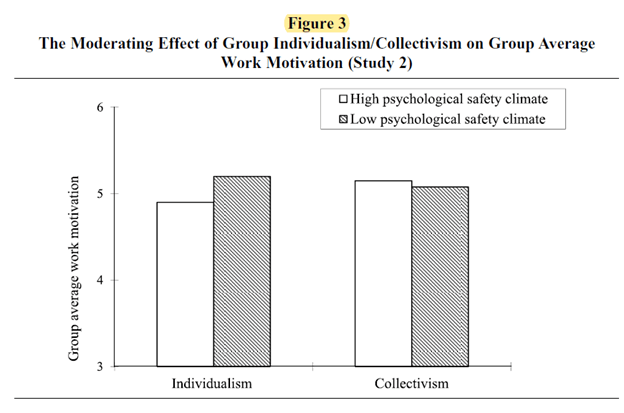
Back onto motivation, higher PS was found to significantly reduce work motivation in individualistic groups, but not in the collectivist groups. This “suggests that the negative pathway of psychological safety may be more subject to situational contingencies”.
While “Organizations are advised to create a psychologically safe group environment to promote important behaviors” these results “provides a clear demonstration that this advice is oversimplistic”.
Indeed, these findings provide evidence how higher PS can reduce “desirable risk-taking behaviors, including group voice, learning behavior, and creativity, through a reduction in work motivation, especially among individualistic groups”.
These findings seem to support Edmondon’s speculation that PS “may sometimes be counterproductive”.
Regarding the group orientations, low PS coupled with strong emphasis on “cordial relationships between group members” (a collectivistic group culture) may produce a “zone of wariness”, where group members are unwilling to take interpersonal risks. High PS reduces this tendency.
However, high PS in an individualistic group culture may “create a “zone of egocentrism” where motivation for group success is reduced”. Hence, in individualistic groups, “low psychological safety climate is actually desirable for maintaining work motivation for group tasks”.
Further, PS is “likely to lead to a significant loss of work motivation when group members are lukewarm about group success”.
For implications on practice, they argue that managers should be made aware of the boundary effects of PS and the “potential pitfall of [PS]”.
E.g. When managers measure PS, “they need to simultaneously take measures to maintain a certain level of group accountability (a key element of collectivism; Earley, 1993) to counteract the comfort zone created by psychological safety climate”.
Hence, if managers want to promote PS in groups then they “need to find ways to increase perceived accountability for group performance and emphasize group interest”.
Several limitations were present. For one, their methods employed an accountability perspective; although this has a long and robust empirical basis. They also focused on group voice, learning behaviour and creativity, all frequently evaluated in PS literature, but other interpersonal risk behaviours should also be evaluated. Plus some other limitations.
Authors: Deng, H., Leung, K., Lam, C. K., & Huang, X. (2019). Journal of Management, 45(3), 1114-1144.
Study link: https://doi.org/10.1177/0149206317693083
LinkedIn post: https://www.linkedin.com/pulse/slacking-off-comfort-dual-pathway-model-safety-ben-hutchinson-pvwhe

 SafetyInsights.org
2 thoughts on “Slacking Off in Comfort – A Dual-Pathway Model for psychological safety climate”