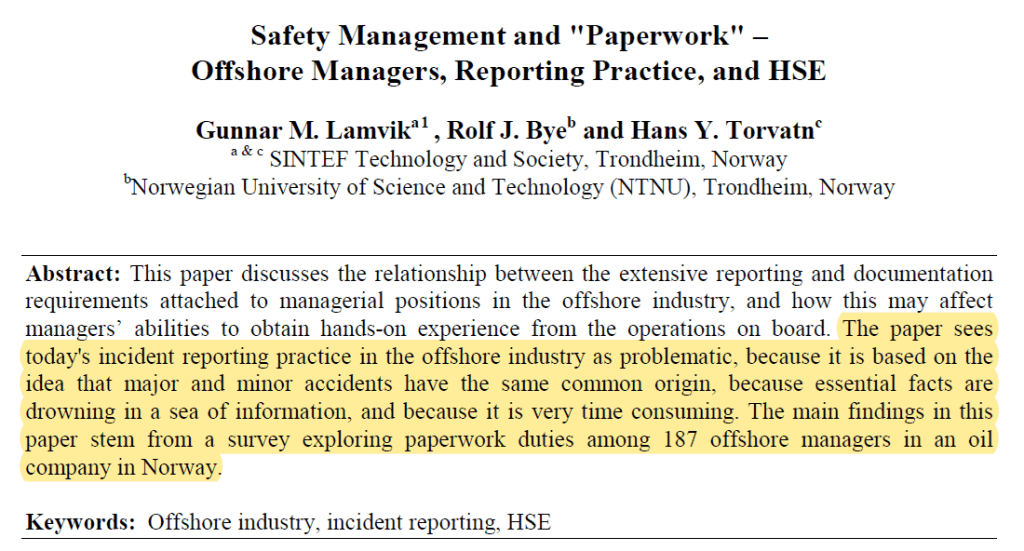
What are the types of bureaucracy encountered in offshore oil & gas and how does it affect operational work, HSE, and time on the floor? A study to be summarised explored this question.
Data came from surveying 187 offshore managers in a Norwegian oil company.
Key findings:
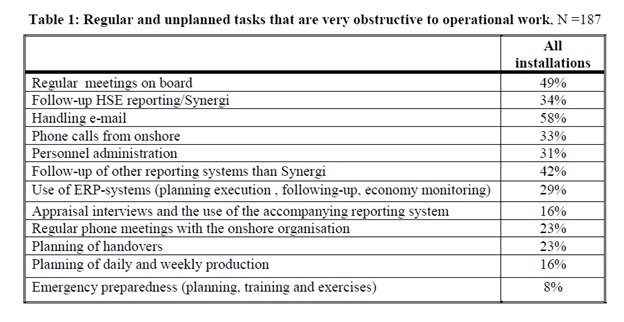
· Expectedly, managers didn’t spend enough time on the floor (72% spent less than 3hrs out of their office) and even some toolpushers estimated their hands-on work at just 10-15% of their workday
· People reported the reasons for spending so much time in the office as increased bureaucratisation, implementing new procedures, following rules and regulations, and managing the incident reporting system
· A heavy focus was placed on ‘green reports’: reporting and responding to low potential hazards or incidents like small cuts, splinters, and coffee spills. In contrast, red reports are the serious/HiPo level
· Focus on green reports was based on the logic that “registration of seemingly innocent incidents may keep the personnel on board more alert and more focused on discovering potential hazardous conditions in general”
· This is also based on the belief that major and minor events have the same underlying causal or contributory factors [A logic that has evidence on both sides of the spectrum, for and against]
· While it’s argued that conflating minor and major can “work as an example of an urban myth”, they also provide examples where there are and aren’t clear connections between them and why context is important
· However, broad brush assumption of the connection can be a “simplification when it comes to very complex and multiple processes, in particular processes involving the work practice of people”
· Hence, “core of the fallacy in this reporting regime” stems from a conviction to view almost any kind of deviation as a near miss”
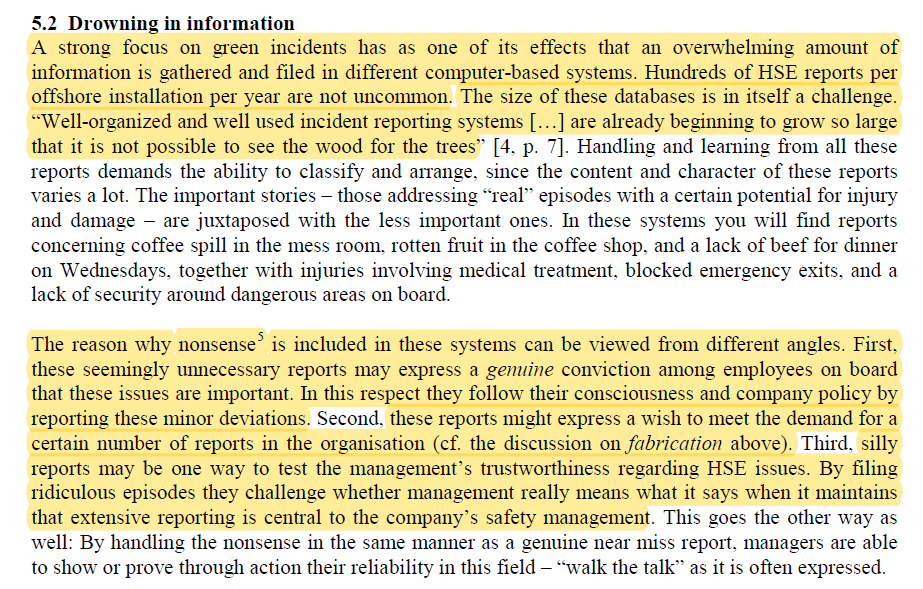
· Too much focus on minor potential events or minor personal injuries, e.g. green reports, can result in people “drowning in information”
· Some incident reporting systems have datasets to vast that it is “not possible to see the wood for the trees”. In these systems you can find reports about coffee spills, rotten fruit, and injuries involving medical treatment or lack of security on board
· Incident systems and reporting may also result in “fabrication” where silly and minor reports are logged in order to meet targets
In sum, findings highlight that “HSE reporting are regarded as very obstructive to the ability to perform “hands-on” management”, and having the incident reporting system “representing a major hindrance for safety-critical outdoor work was hardly the intention behind the introduction of this HSE tool”.
Ref: Lamvik, G. M., Bye, R. J., & Torvatn, H. Y. (2008, May). In International Conference on Probabilistic Safety Assessment and Management, Hong Kong, China (pp. 18-23).
Study link: https://www.sintef.no/globalassets/project/criop/psam9_0324_paper.pdf

 SafetyInsights.org
One thought on “Safety management, bureaucracy, and incident systems drowning in seas of information”