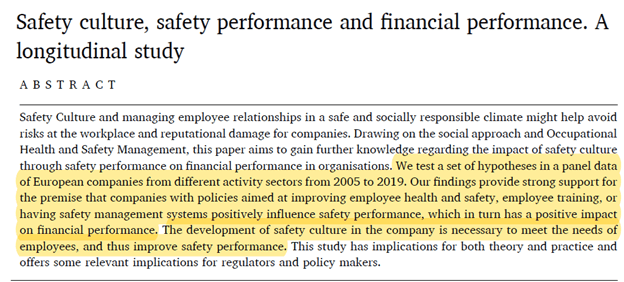
This paper explored the relationship between “safety culture” (SC) and safety and financial performance in 829 European firms from 29 European countries.
Data was drawn from the Thomson Reuters Refinitiv ESG scores, with safety culture being a composite of: 1) employee health and safety policies, supply chain health and safety, health and safety teams, employee & supply chain training, OHSAS 18001/45001 and/or a developed SMS.
Note. There’s substantial critical discussion, criticism and caveats around safety culture in the empirical space (e.g. what is SC, what variables form the construct, is it separate to or part of organisational culture, functionalist vs interpretivist approaches and more). I’ve covered this a lot in prior articles, so won’t rehash it here. Moreover, some may argue that their construct of what forms SC doesn’t really involve cultural elements. I’ll leave these considerations up to you.
Providing background:
· SC must be developed not only at the individual worker level but also the organisational level, incorporating multiple stakeholders and technological, organisational, human, and external aspects
· While SC is the focus of considerable attention, the “influence of “safety culture” on “safety performance” and the relationship between safety performance and financial results from an integral approach is underexplored”
· Moreover, in previous literature there has been a “tendency to confuse the concept of safety culture with that of safety climate has been identified”
· Safety climate “refers to a situational element at a given time, whereas the construct of safety culture presents a multidimensional nature and is a concept in continuous interaction”
· Due to the “multidimensional character” of safety culture, “there is no consensus about the concept and its measurement”. Further, due to the complex nature of SC, “there is no consensus on its definition (Guldenmund, 2000), causes, consequences, or indicators (Reiman and Rollenhagen, 2014)”
· Safety climate has been described by some as more indicative of the surface attributes of SC, therefore it’s considered “as the most accessible and quantifiable indicator for assessing safety culture … and it has a more passive connotation since it can be influenced by the external environment”
· SC is said to be a relatively stable social construct that develops gradually over time. It is influenced by several enabling factors which do not define SC but create the conditions that enable its development: 1) organisational factors, e.g. leader commitment, structures, systems, resources, 2) group level factors, e.g. cohesion, psychological safety, 3) individual level factors, e.g. safety-related knowledge, sense of control, individual commitment
· Many different perspectives and models have been proposed for SC. Reason proposed five independent subcultures. Guldenmund proposed an interpretive model based on Schein’s layered framework of patterns of basic assumptions, beliefs, espoused values and visible artefacts. Cooper proposed a reciprocal model rooted in a functional perspective of situational, psychological and behavioural
· The study relied on total injury rate for safety performance. They believe it is less problematic than lost time injury (so…whatever. It’s a limitation but take from it what you will)
Results
Key findings:
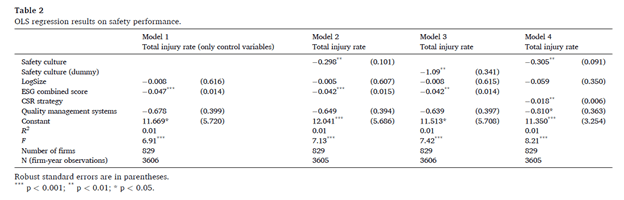
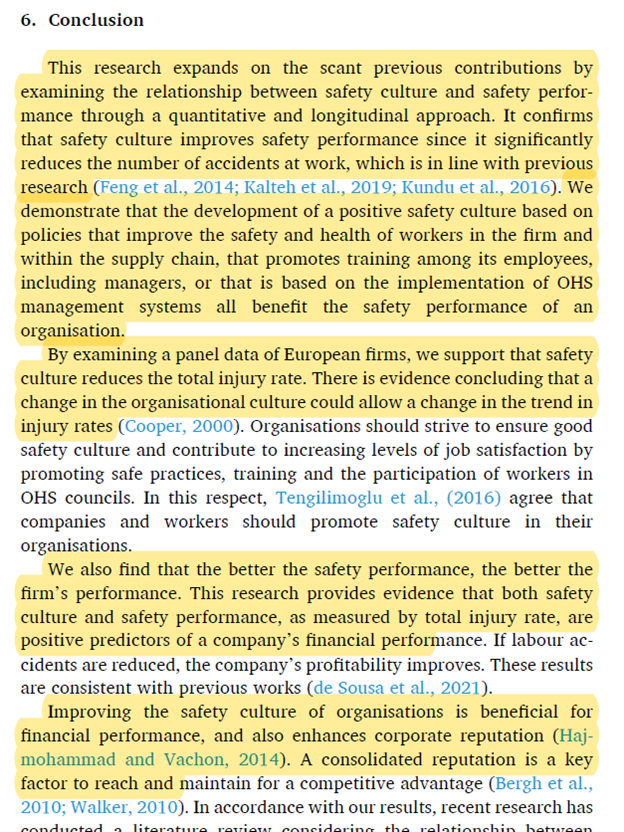
· Safety culture improves safety performance since it significantly reduces the number of accidents at work.
· The better the safety performance, the better the firm’s financial performance.
· “This research provides evidence that both safety culture and safety performance, as measured by total injury rate, are positive predictors of a company’s financial performance”.
· Companies with policies aimed at improving employee health and safety, employee training, or having safety management systems positively influence safety performance, which in turn has a positive impact on financial performance.
· They argue that the “development of safety culture in the company is necessary to meet the needs of employees, and thus improve safety performance”.
· Having in place a comprehensive safety culture and implementing all best practices has a strong influence on the total number of accidents.
· They found that the factors most strongly related to total injury rates was having a health and safety team and having a safety management system in place (e.g. such as those aligned with 18001 or 45001).
· Thus, “There is empirical evidence to ensure that the adoption of the OHSAS 18001 or ISO 45001 standards positively influences occupational safety
· Having policies in place to improve supply chain management was the most influential initiative to reduce the total injury rate of contractors.
Discussing the findings, they note that “Safety culture cannot be dissociated from the general organisational culture of the company and the latter can only be conceived as a dynamic concept that is generated through the interactions between the different members of the organisation”.
Moreover, the overall organisational culture of organisations also “plays an important role in building resilient organisations”. The idea of resilience “as a unique combination of organisational capacities and routines generates a comprehensive understanding of the phenomenon of resilience in organisations”.
Prior work divided resilience into different components. One for instance divided resilience into four phases between defensive behaviours (avoiding bad things happening) and progressive behaviours (making good things happen). The phases were: (1) preventative control, (2) mindful action, (3) performance optimisation and (4) adaptive innovation.
Preventative control approach (what they term defensive consistency) is achieved through risk management, physical barriers etc. This may prioritise risk minimisation and strict adherence to procedures. This may, however, “also limit the organisation’s ability to adapt and innovate”.
Mindful action (defensive flexibility) may help counterbalance the rigidity, by allowing more dynamic capabilities to respond to potential threats. Moreover, the optimisation of performance (progressive consistency) could “increase pressures to achieve ambitious goals and results, which could lead to neglecting preventive aspects for the sake of efficiency and productivity”.
Several limitations were present. For instance, there’s criticisms levied towards safety culture itself as a concept, the types of indicators the study used (many being management and system focused), use of mostly secondary data and more.
Authors: Bautista-Bernal, I., Quintana-García, C., & Marchante-Lara, M. (2024). Safety Science, 172, 106409.
Study link: https://doi.org/10.1016/j.ssci.2023.106409
LinkedIn post: https://www.linkedin.com/pulse/safety-culture-performance-financial-longitudinal-study-hutchinson-ovt5e

 SafetyInsights.org
One thought on “Safety culture, safety performance and financial performance. A longitudinal study”