Not much to add, but I found the following summary of evidence-based weaknesses of common hazard recognition interventions from Albert et al. pretty handy.
Although there will likely be few surprises here – it may be a helpful resource, particularly as it lists the citations with the weaknesses.
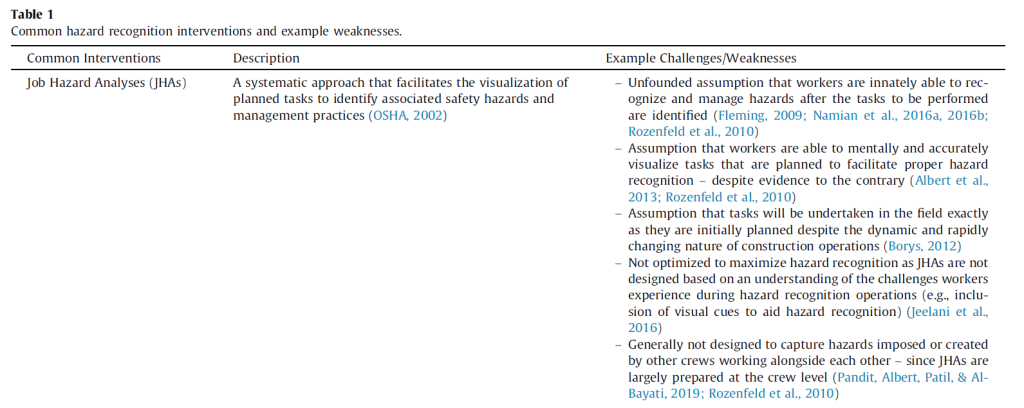
They tabulate some challenges or weaknesses for:
- JSA/JHAs: e.g. based on ‘unfounded assumption’ that workers will innately be able to recognise and manage hazards, assumption that the task will be undertaken in the field exactly as described, and generally unable to capture hazards from simultaneous work activities/crews
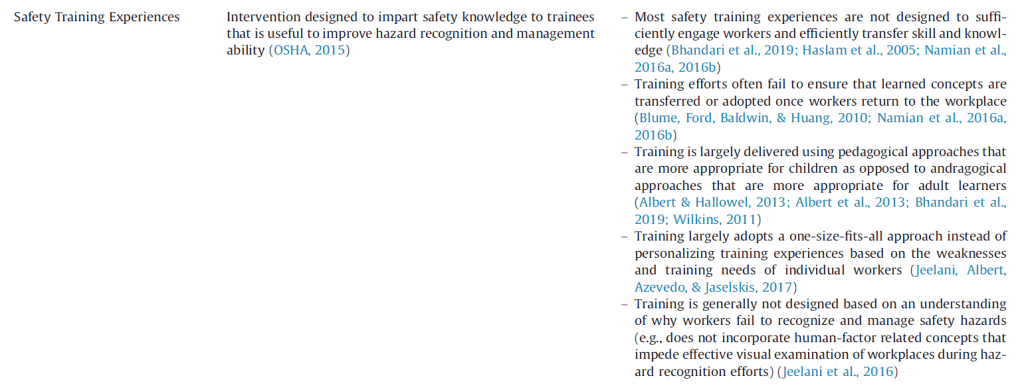
- Safety training experiences: most training experiences aren’t designed to sufficiently engage and transfer skills/knowledge and largely based on pedagogical approaches for children rather than andragogical (adult) learning
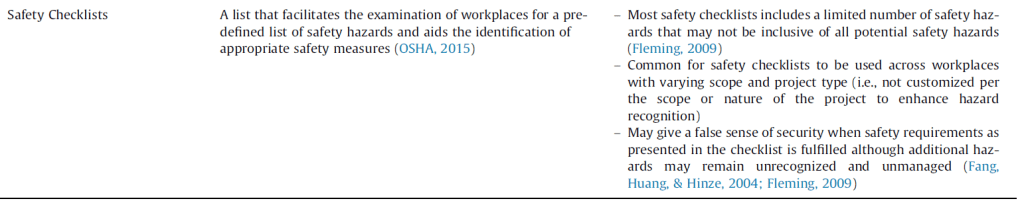
- Safety checklists: many checklists only capture a limited subset of hazards, may not be customised for the setting/context, and may “give a false sense of security when safety requirements in the checklist is fulfilled”
Ref: Albert, A., Pandit, B., Patil, Y., & Louis, J. (2020). Does the potential safety risk affect whether particular construction hazards are recognized or not?. Journal of safety research, 75, 241-250.
Study link: https://doi.org/10.1016/j.jsr.2020.10.004
My summary of their paper: https://safety177496371.wordpress.com/2021/02/20/does-the-potential-safety-risk-affect-whether-particular-construction-hazards-are-recognized-or-not/

 SafetyInsights.org
One thought on “Evidence-based weaknesses of common hazard recognition interventions – JHA/JSA, safety training and safety checklists”