What are some links between procedure use/departure, procedure quality, worker experience, task frequency and more? A study soon to be posted explored these interactions.
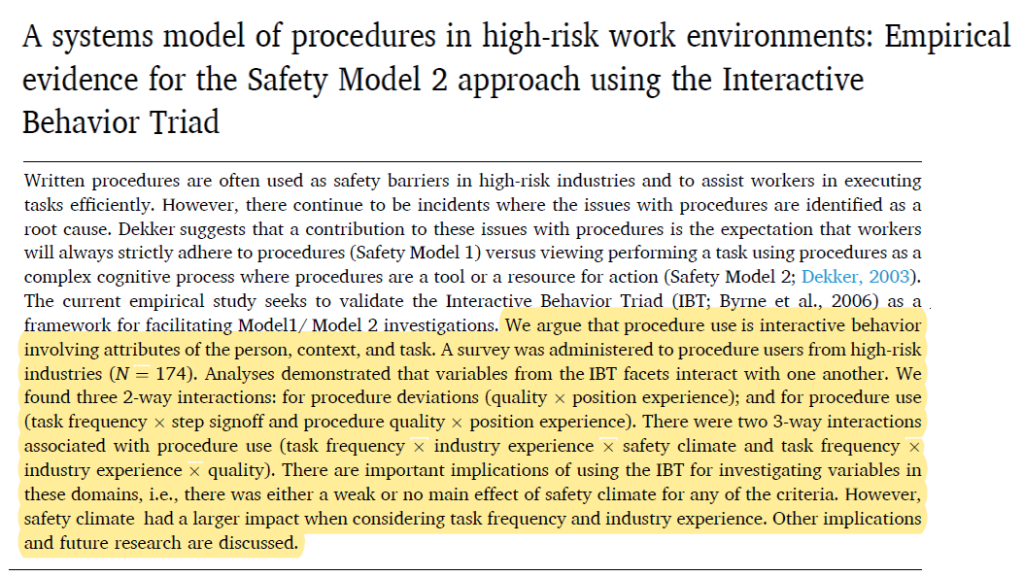
Researchers Peres & Hendricks, who have published several studies on similar links, explored these interactions via the model 1 and model 2 concept of procedures.
Model 1 conceptualises procedures as a means of standardising and controlling behaviour, and thus reducing unwanted variability and accident risk. This approach is argued by some to focus more on “fixing the human” [** which is a bit of an unfair characterisation, but whatever].
Model 2 conceptualises procedures as ‘resources for action’, forming a type of cognitive resource, among other resources, for operators to draw on to make skilled judgements about adapting procedures to circumstances.
Note: Model 1 / 2 isn’t Safety-I and II, although there are clearly similar underpinnings in the philosophies of performance.
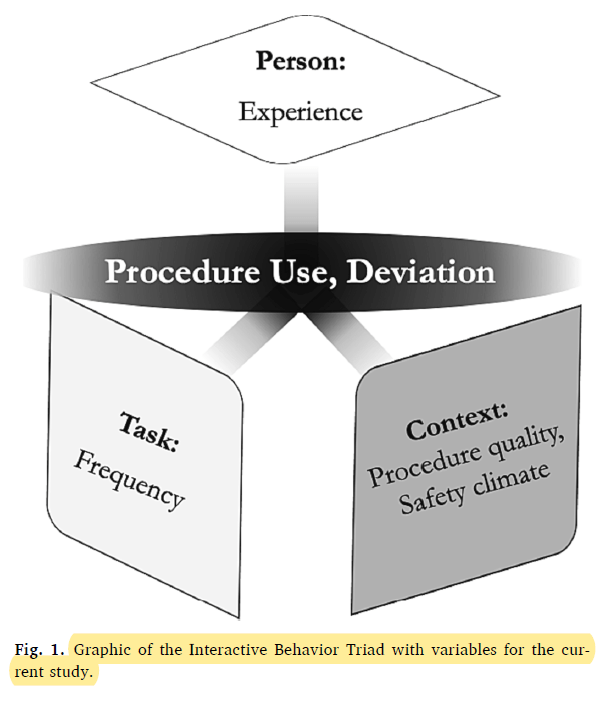
This study surveyed 174 workers from oil & gas and chemical. Key findings were that:
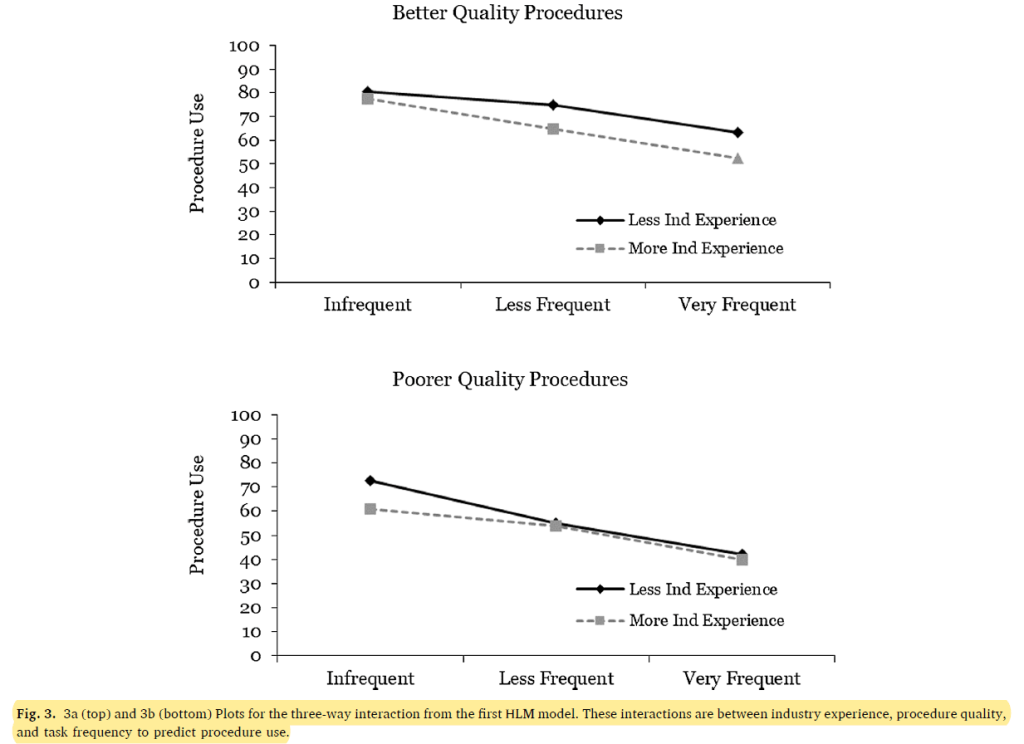
• A significant 3-way interactions between task frequency, industry experience and safety climate was found on predicting procedure use
• With poorer safety climate performance, both levels of industry experience (less and more) have similar impaired effects on procedure use
• For better quality procedures, the difference between more and less experienced workers’ procedure use is greater when the task is performed either very or less frequently, compared to tasks performed infrequently
• For poorer quality procedures, individual experience impacts procedure use mostly with infrequent tasks
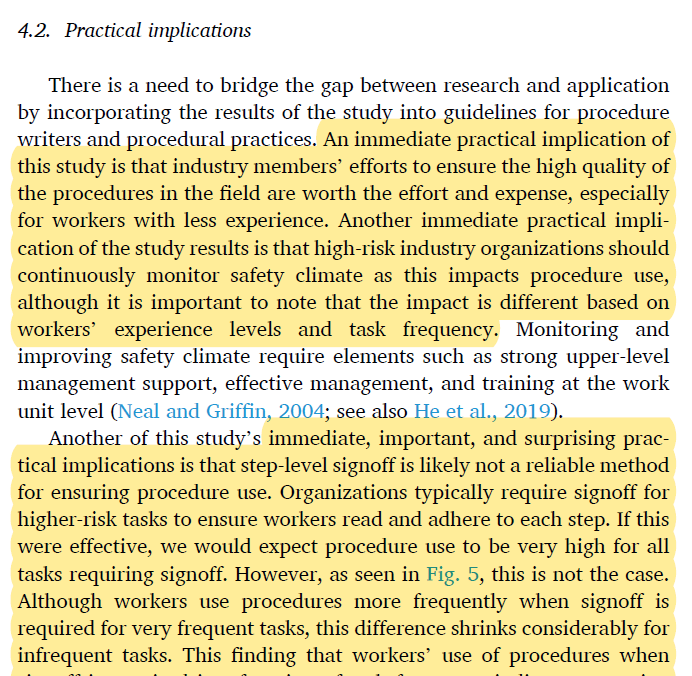
Whereas companies may try to encourage workers to always follow a procedure even for frequent tasks, the “results here suggest that this does not always occur”. The findings suggest that instead of beating the drum harder, perhaps more efforts should be placed on improving the quality of the procedures and elements of safety climate to off-set the worker experience and task frequency effects.
While they’re not pitting model 1 and 2 against each other, this work and their prior work suggests that a strict model 1 lens (seeing procedures and people mechanistically where people must follow procedures in any context) doesn’t represent reality.
Moreover, quoting Dekker, strict model 1 thinking doesn’t account for the “substantive cognitive activity” required in real work settings, and these factors “can never be completely prescribed by written procedure”.
Nevertheless, model 1 and 2 both have their places; where model 1 thinking may be more suitable for novice workers, infrequent tasks and possibly more hazardous tasks, providing considerations are given about the actual context. They argue that “Hendricks and Peres (2021) provide evidence that Model 1 is likely necessary but not sufficient for understanding procedural systems” (emphasis added).
Finally, this tension between worker goals and procedure use “illustrates the fallacy of an exclusive Model 1 approach—one with formal and rigorous social control—and could possibly be resolved if procedures are designed or presented differently based on task frequency—a Model 2 approach that focuses more on developing work practices (e.g., procedure use) based on how work is done”.
I’m a big fan of these researchers, so you can find a bunch more summaries of their studies below
Authors: Peres, S. C., & Hendricks, J. W. (2024). Safety Science, 172, 106328.
Study link: https://doi.org/10.1016/j.ssci.2023.106328
Other similar studies from this research group – these are worth reading:
- https://www.linkedin.com/pulse/beyond-human-error-empirical-study-safety-model-1-2-ben-hutchinson-63qsc
- https://www.linkedin.com/pulse/investigating-new-classification-describe-differences-ben-hutchinson
- https://www.linkedin.com/pulse/where-two-ends-meet-operator-stakeholder-procedures-ben-hutchinson
- https://www.linkedin.com/pulse/navigating-operating-procedures-everyday-work-wai-wad-ben-hutchinson
- https://www.linkedin.com/pulse/investigating-written-procedures-process-safety-data-from-hutchinson

 SafetyInsights.org
3 thoughts on “Links between procedure use, procedure quality, worker experience and task frequency”