This coroner’s report describes a fatal mining event where a worker was crushed between a Landcruiser and a platform basket attached to a loader.
The coroner is critical of SOPs not addressing non-routine or critical risks, excessive reliance on rules, and poor quality of risk assessments.
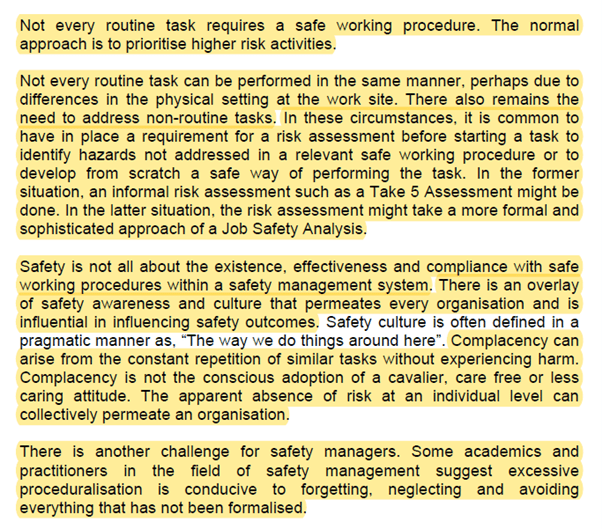
The coroner observes:
· Not every routine task requires an SOP, but the norm is to prioritise high-risk tasks
· Some ‘routine’ tasks aren’t always routine, with varying contextual factors at the time. Addressing non-routine tasks is commonly approached via risk assessment, e.g. JSA/SWMS, Take 5.
· “Safety is not all about the existence, effectiveness and compliance with safe working procedures within a safety management system”, but there is an “overlay of safety awareness and culture that permeates every organisation”
· While complacency is often mentioned in investigations, it largely arises “from the constant repetition of similar tasks without experiencing harm” and it is “not the conscious adoption of a cavalier, care free or less caring attitude”, but a normal and expected outcome of human sociocognitive processes
· “The apparent absence of [perceived] risk at an individual level can collectively permeate an organisation” [* what we may call a type of risk blindness or normalisation]
· It’s remarked that “excessive proceduralisation is conducive to forgetting, neglecting and avoiding everything that has not been formalised”
· And there is a “tendency to comply with prescriptive detail of procedures without thought that can be counter-productive to safety awareness”
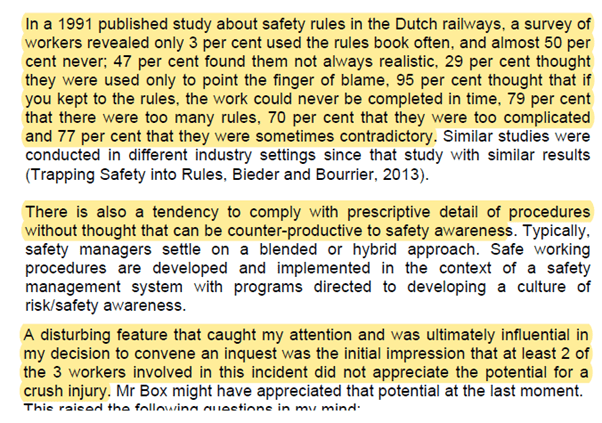
· In this fatal crush injury, the coroner was struck by how at least 2 or 3 of the workers involved in this incident “did not appreciate the potential for a crush injury” [* referring to the risk blindness/complacency]
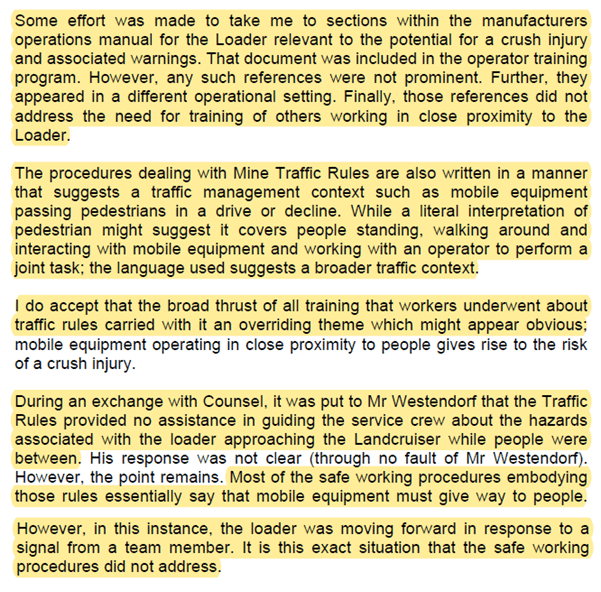
· Questions remained around how effective the mine traffic rules were for sensitising people to plant interactions. Where, perhaps, “the “Traffic Rules provided no assistance in guiding the service crew about the hazards associated with the loader approaching the Landcruiser while people were between”
· Whereas most SOPs essentially said that mobile plant must give way to people, “in this instance, the loader was moving forward in response to a signal from a team member. It is this exact situation that the safe working procedures did not address”
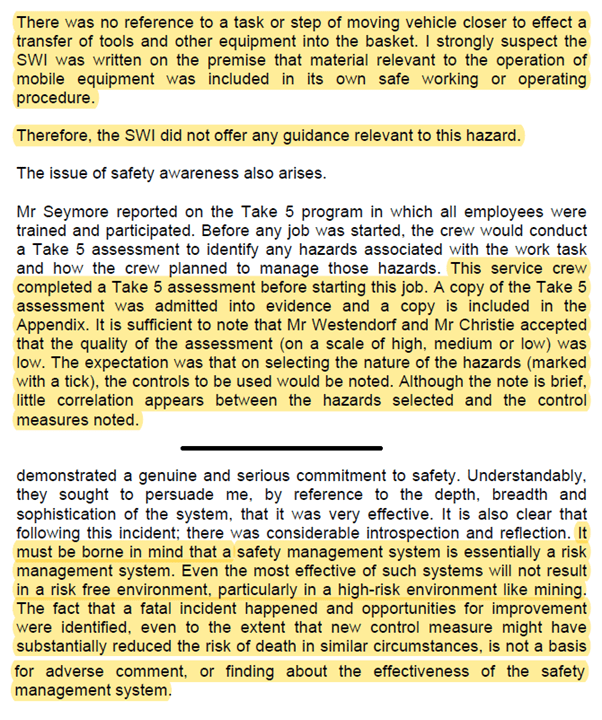
· Further, the SOP didn’t reference the task of moving the vehicle closer to people to load equipment. The Coroner suspects that this SOP “was written on the premise that [material handling from people to plant] was included in its own [SOP]”.
· Thus, the SOP “did not offer any guidance relevant to this hazard”
· The Take 5 was assessed as low quality, and there appears “little correlation … between the hazards selected and the control measures noted”
Source: Queensland Courts. Inquest into the death of Michael Earle Auld. 2008/256
Report Link: http://www.mineaccidents.com.au/uploads/michael-auld-coroners-report.pdf

 SafetyInsights.org
One thought on “Fatal mining plant/pedestrian interaction: Coroner highlights SOPs not addressing non-routine or critical risks, excessive reliance on rules, and poor quality of risk assessments”