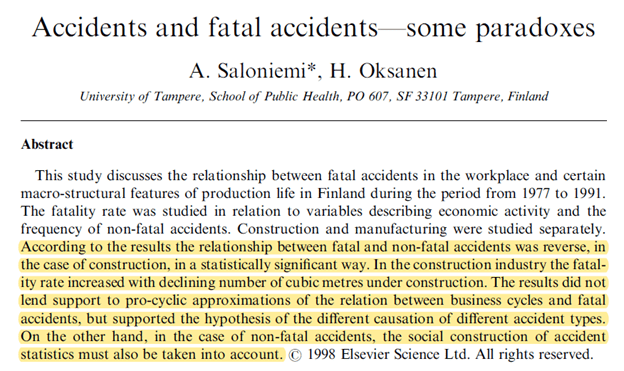
This study has been cited a lot, so I thought time to summarise it. It studied the relationship between fatal and non-fatal accidents, and economic activity, in Finnish manufacturing and construction industries (between 1977 – 1991).
Providing background:
· They provide some brief background on fatal workplace accidents (as of 1998); being largely male workers at the lowest levels of socioeconomic hierarchies
· Moreover, “Race seems to be an important explanatory factor, and it is not purely by chance that in many cases migrant workers are over-represented in fatal accident statistics”
· Analysing business cycles is a way of evaluating social or structural natures of occupational accidents, informing on potential pro-cyclical relationships (whether accidents increase during economic upswings and vice versa)
· They also briefly cover research between fatal and non-fatal accidents. Again, based on research prior to 1998, they cite one study that supports different causal mechanisms between fatal and non-fatal [** although newer research has challenged this finding]
· They observe some challenges with this type of research. For one, there are varying definitions/classification schemes for non-fatal accidents. Fatal accidents are less susceptible to definitions but aren’t immune
· Also, there is a general trend of decreasing fatalities over time (which is good), but this also makes time-span analyses more difficult
Results
Overall they found:
· The relationship between fatal and non-fatal accidents was reverse and statistically significant in construction
· That is,, the fatality rate in the construction industry increases when the accident frequency declines
· In construction, the fatality rate increased with declining number of cubic metres under construction
· Results didn’t support a pro-cyclic relationship between business cycles and fatal accidents
· Results support the hypothesis of different causal mechanisms between fatal and non-fatal [** although this paper didn’t evaluate hazardous energy and the like]
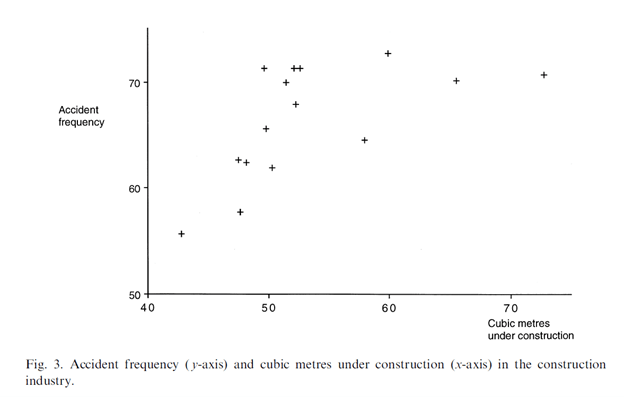
In manufacturing, none of the correlations reached statistical significance. Whereas, in construction, fatal accidents were inversely related to accidents such that as non-fatal accidents went down, fatal accidents went up.
Other explanatory variables, e.g. average labour market conditions, working hours, number of workers and unemployment had only minimal or no correlation with fatality rate.
In building and construction, there was a “clear connection between the fatality rate and both cubic metres under construction ( p=0.01) and accident frequency ( p<0.001)” and both were reverse (as one goes up, the other goes down).
In manufacturing the relationships were positive but not significant.
Again quoting the paper, “Cubic metres under construction show a negative correlation, implying contra-cyclic behaviour of fatal accidents with fatality rate (Fig. 2, p=0.11). However, if we look at accident frequency, the figures for cubic metres under construction lend clear support to a pro-cyclic interpretation (Fig. 3, p=0.02). If an increase in cubic metres means more accidents, it also means fewer fatal accidents”.
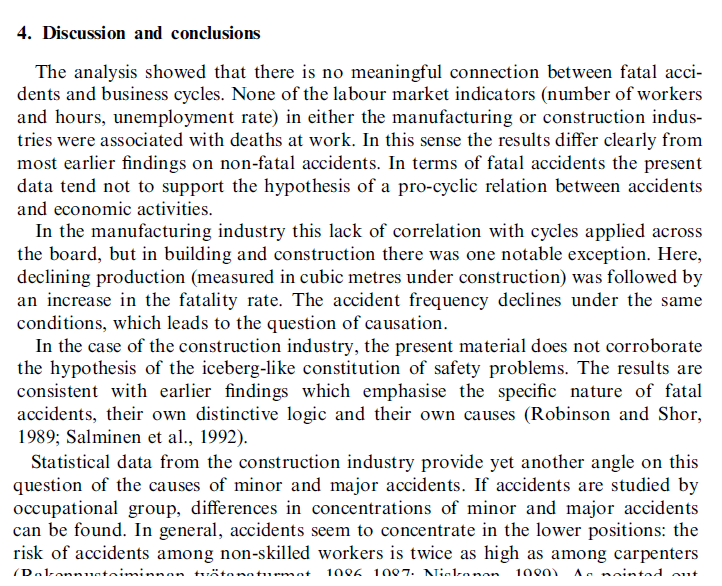
Discussing the findings, they observe that “there is no meaningful connection between fatal accidents and business cycles” and none of their labour market indicators as mentioned above were associated with workplace deaths. This is with the exception of declining production, which was followed by an increase in fatalities.
They note that dividing data into occupational groups then different concentrations of minor and major accidents can be found. Generally, “accidents seem to concentrate in the lower positions: the risk of accidents among non-skilled workers is twice as high as among carpenters”.
Moreover, in construction non-fatal and fatal accidents occur more frequently in “groups characterised by a low occupational status, wage level and job security”. In comparison, serious accidents necessitating longer sick leave are widespread among workers with better labour market resources.
Based on their data, they contend that “It is not possible to reconstruct a clear and natural chain from minor accidents to fatalities” [** I disagree based on newer work but think it’s still pretty prudent to aggressively focus on high-potential hazards/failures].
In explaining limitations, they note that general underreporting of accidents might be an explanation for the reverse relationship found, as with reporting definitions and social factors.
Further, the “statistical material used in this study is limited and could hardly have provided any conclusive solution either to the problem of the causation of different kinds of accidents or to the paradoxes regarding business cycles” but it does, nevertheless, provide some interesting paradoxes to be explored.
Authors: Saloniemi, A., & Oksanen, H. (1998). Accidents and fatal accidents—some paradoxes. Safety Science, 29(1), 59-66.
Study link: https://doi.org/10.1016/S0925-7535(98)00016-2
LinkedIn post: https://www.linkedin.com/pulse/accidents-fatal-accidentssome-paradoxes-ben-hutchinson-xyhjc

 SafetyInsights.org
2 thoughts on “Accidents and fatal accidents—some paradoxes”