A coroner’s report detailing a workplace fatality relating to an exploding gas strut.
Such a relatively ‘simple’ failure resulted in a tragic outcome when a gas strut on a trailer was tapped with a hammer and the hammer claw was used to lever it over the thread. The strut subsequently exploded, killing one person.
The corner reports:
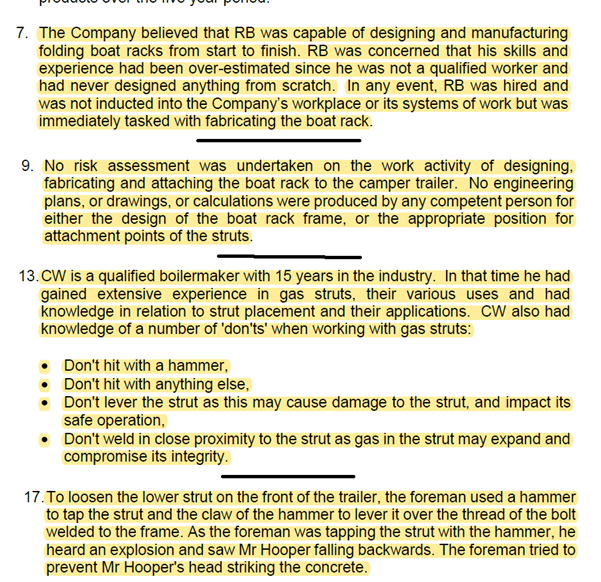
· The company believed that the killed worker was capable of designing and manufacturing the necessary components, while the worker was concerned his skills had been over-estimated since he wasn’t a qualified welder, nor had he designed anything from scratch
· He had not been inducted in the company’s workplace or its systems of work, despite ‘immediately tasked with fabricating the boat rack’
· No risk assessment was undertaken on the work activity of designing, fabricating and attaching the boat rack; nor a safe system of work incorporating the safe strut removal process
· Moreover, no engineering plans, drawings or calculations were produced by a competent person for the design of the rack or appropriate positioning for points of the struts
· Another stakeholder (CW) who provided gas struts to this company was aware of several ‘rules’ for working with gas struts, including not hitting with a hammer; these may not have been known by the worker or supervisor of that company
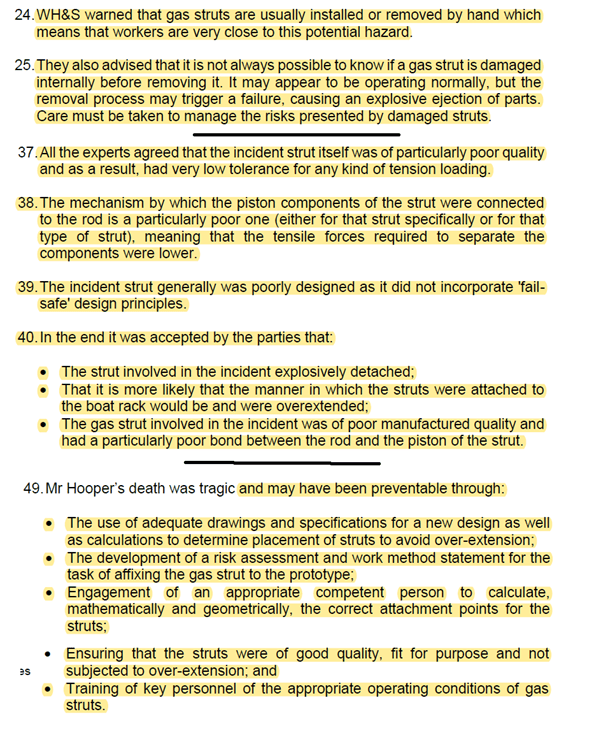
· WHSQ advised after the fact that gas struts are normally installed or removed by hand, meaning that workers are very close to the potential hazard (line of fire)
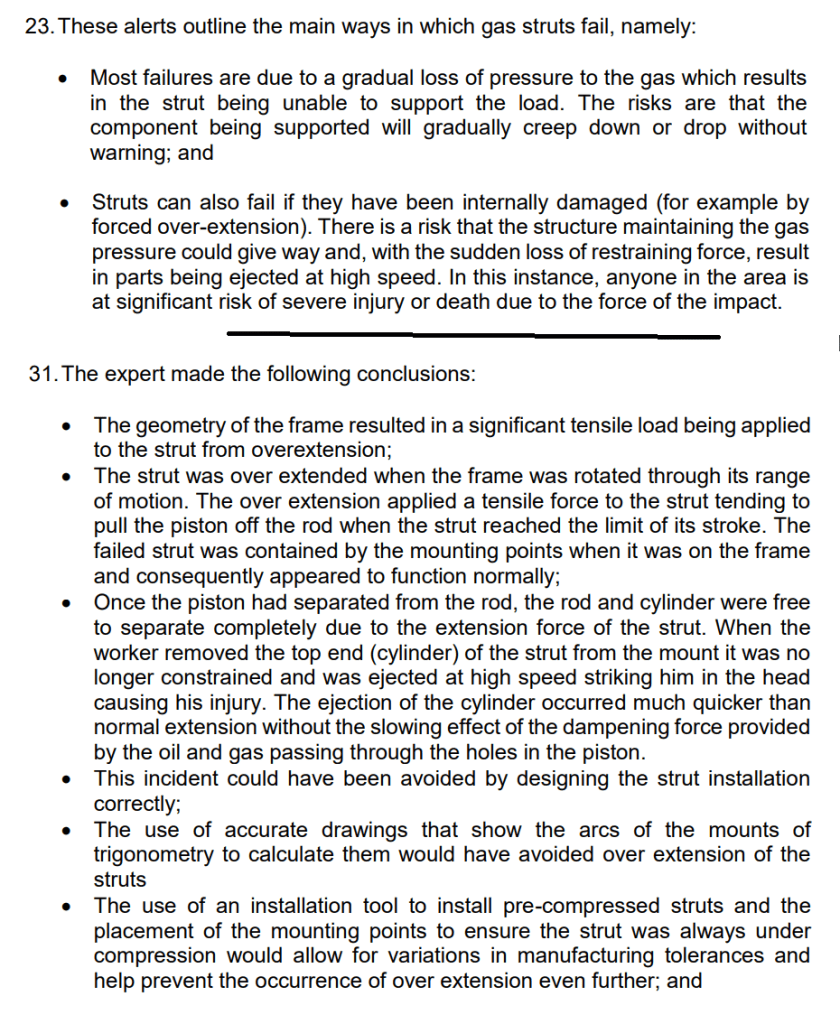
· It’s not always possible to know if a gas strut has internal damage, as it may operate normally but the removal process may trigger an explosive failure
· The strut was of a poor manufactured quality
Source: Coroners Court 2017. Non-inquest findings into the death of Troy Ronald Hooper.
Report link: https://www.courts.qld.gov.au/__data/assets/pdf_file/0005/532355/nif-hooper-tr-20170711.pdf

 SafetyInsights.org
One thought on “Coroners report: exploding gas strut; poor manufactured quality, no engineering design, drawings or advice, lack of risk assessment on installation process”