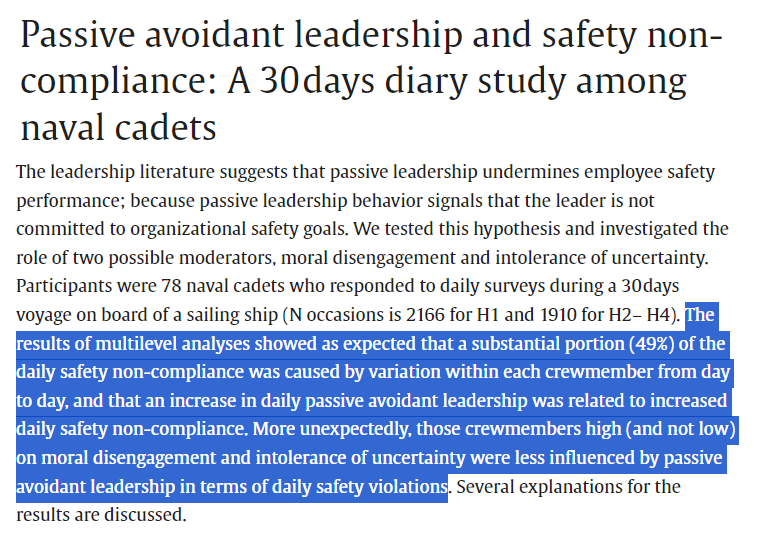
This study examined the malleable nature of safety compliance activities (adherence to procedures etc.) and how this can change on a daily basis with the impact of Passive Avoidant Leadership (PAL) styles. Laissez-faire leadership & management-by-exception are often referred to as PAL.
Also studied was the effects of moral disengagement (where people disengage from humane acts and commit to harassment or harming actions against others) and intolerance of uncertainty (being a dispositional tendency to perceive the occurrence of negative events as unacceptable or threatening, irrespective of whether they happen or not), where PAL may further exacerbate people who have high intolerance of uncertainty and thereby add to their stress.
PAL has been linked to adverse outcomes on work motivation, justice perception, burnout, psychological safety, safety climate and more.
78 naval cadets completed daily surveys during a 30 days voyage.
Results
49% of the variance in safety non-compliance related to variation within each crewmember from day to day, whereas 51% of the variation was between-person level. Thus, adherence to procedures etc. varied significantly on a day-to-day basis above & beyond what was explained by stable between-person differences.
Regarding PAL, a significant positive relationship between daily perceptions of PAL & daily non-compliance was found, where cadets engaged in significantly more non-compliances on days where they perceived their leader as more passive avoidant.
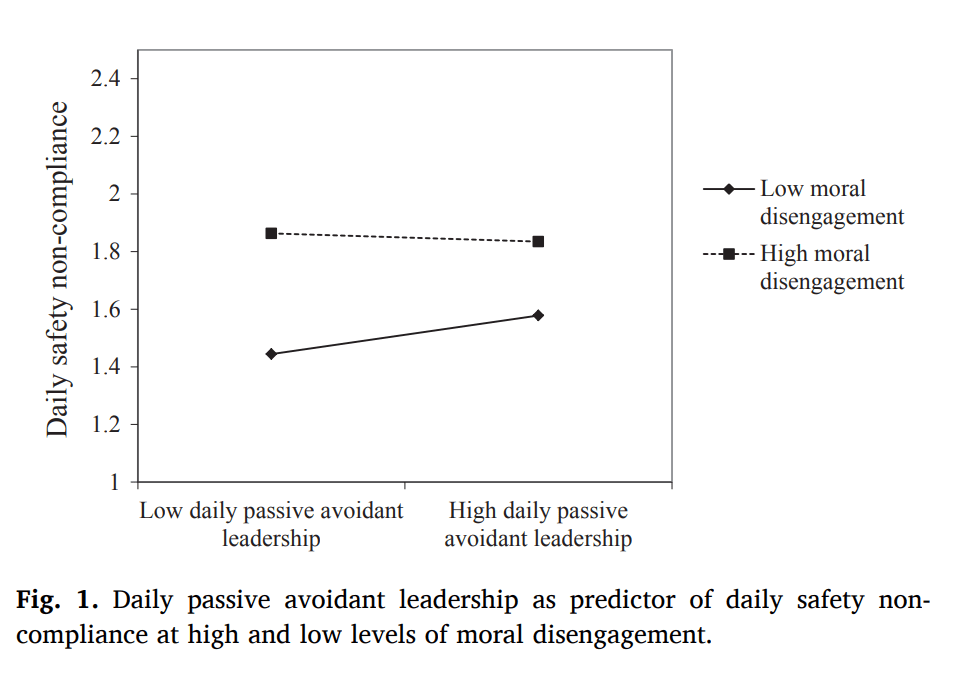
Daily PAL was said to be “particularly detrimental to breaches in safety compliance among those low on moral disengagement and among those low on intolerance of uncertainty. High moral disengagement and high intolerance of uncertainty, in contrast, buffer the negative impact of daily passive avoidant leadership on the cadets’ daily safety behavior” (p6).
Although people high on moral disengagement generally had more departures in procedures compared to those low in moral disengagement, they were less susceptible to the effects of PAL. In contrast, sailors low on moral disengagement were most vulnerable to rises in PAL regarding increased rule departures.
People low on moral disengagement may be more sensitive towards other’s well-being & rights and more personally challenged in moral situations relating to safety requirements. Thus prompting a stronger temptation to depart from requirements.
To quote, the “morally bad’ do not see a moral obligation, and are thus unlikely to change behavior, while ‘the good’ see, and thus, struggle to do what they ought to, particularly when no one are paying attention” (p6).
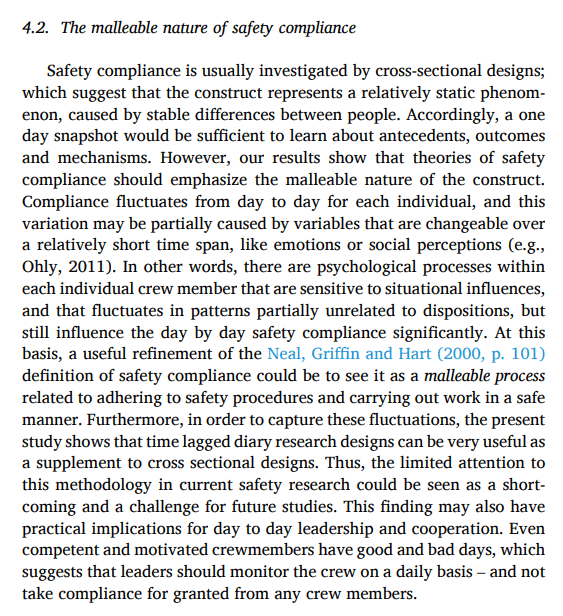
The authors discuss the malleable nature of safety activities and compliance. They note that it’s often studied as a static construct with stable between-people differences. However these results indicate that one-day snapshots are insufficient to learn about safety activity & compliance beliefs.
That is, “compliance” fluctuates day-to-day for each individual & the psychological processes within each crewmember is influenced by variables like emotions, social perceptions & situational factors that are partially unrelated to dispositions.
Findings are said to underscore the importance of not being perceived as a leader that is absent and avoidant during the day. They note that even relatively short periods of perceived avoidance may negatively impact safety perceptions at the workplace. Notably, the relationship between PAL & safety non-compliance was relatively weak, indicating that safety activity (and thus compliance) are influenced by multiple factors, with leadership being one amongst them.
Daily perceptions of transformational leadership didn’t explain daily variation in safety activities, which according to the authors suggests that “it is more important not to be perceived as passive and avoidant than it is to appear inspirational” (p6).
Authors say that the “theory of safety-leadership should emphasize both the malleable nature of safety behavior and safety leadership itself” (p6).
Authors: Olsen, O. K., Hetland, J., Matthiesen, S. B., Hoprekstad, Ø. L., Espevik, R., & Bakker, A. B. (2021). Safety science, 138, 105100.
Study link: https://doi.org/10.1016/j.ssci.2020.105100
LinkedIn post: https://www.linkedin.com/pulse/passive-avoidant-leadership-safety-non-compliance-30-days-hutchinson-acqtc

 SafetyInsights.org