Do perceptions of individual blame and error contribute to nursing aide (caregiver henceforth) assault and lack of reporting? Yes, according to a study to be posted shortly.
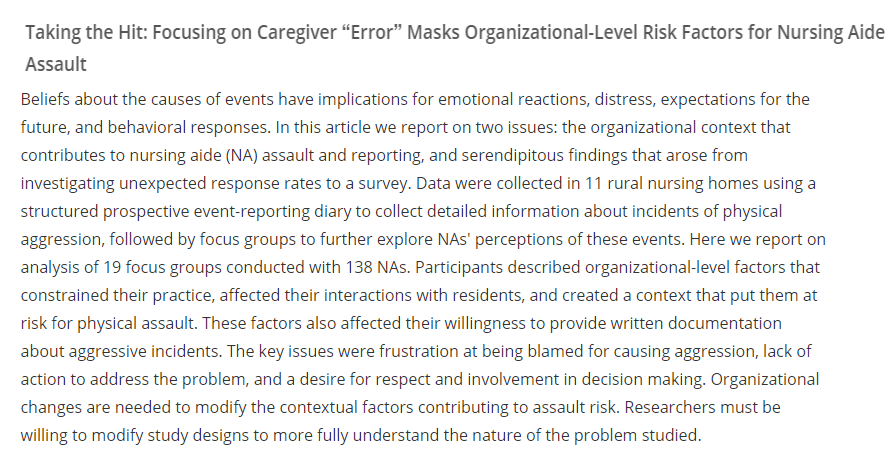
This study explored the beliefs and organizational contexts of caregiver assaults due to aggressive residents.
Although the cohort is pretty specific (caregivers in rural nursing homes), the social and systemic lenses that the study takes, and the mechanisms of blame and error that mask the issues are broadly transferable.
This study found that:
· Organisational-level factors constrained caregiver practices (like strict rule adherence and time pressures), affecting their interactions with aggressive residents and putting them at risk of assault
· Organisational factors also affected their willingness to report the events
· Key factors were grouped into three themes: 1) “frustration at being blamed for causing aggression”, 2) “lack of action to address the problem” and 3), “a desire for respect and involvement in decision making”
1) Aggression and feeling blamed:
Caregivers felt their approach with residents was regularly questioned after they were assaulted, e.g. “what did you do wrong?”. Being blamed for the assault made the caregivers upset and angry.
2) Lack of acknowledgement and action:
Caregivers reported a consistent lack of action following their reports of assault or aggressive incidents; validating their perception that they were expected to “quietly tolerate aggressive resident behavior”.
Incident reports of aggressive incidents were seen to be brushed off or disappeared into a reporting system with little follow-up.
3) Desire for respect and involvement
Caregivers are at the frontline, directly interfacing with residents and hence, have unique and important insights into resident aggression and behaviour. Despite this, they perceived themselves to be at the bottom of the hierarchy, e.g. “the grunts”.
The findings support the broader issue of caregiver assault, with a shift “in focus away from the behavior of [individuals] to the broader system level”.
Problematically, when failures occur there may be an “implicit assumption … that the person closest to the failure was the cause”. That is, unreliable and erratic performance of people at the sharp end primarily cause accidents.
Blaming people is said to “[mask] the deeper story—a story of multiple contributors that create the conditions that lead to operator errors”.
In this case, “attributing physical aggression to the behavior of [individuals] … masks the underlying systematic factors that [put workers at risk]).
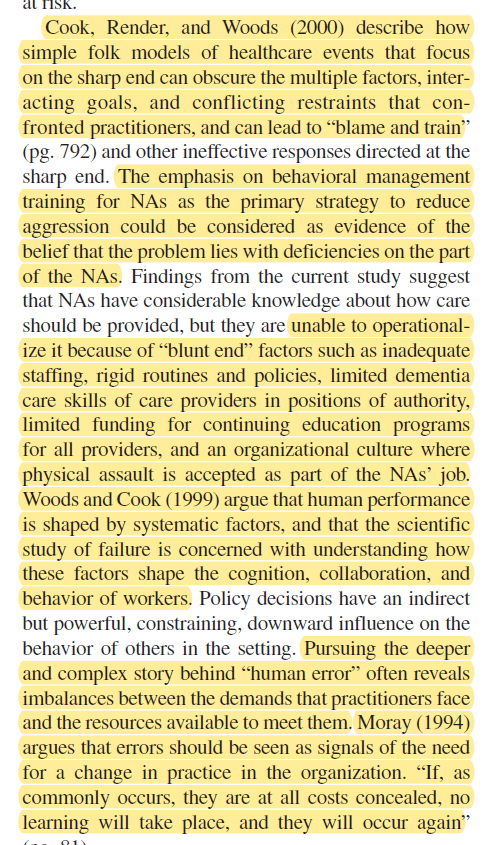
Authors: Morgan, D. G., Crossley, M. F., Stewart, N. J., D’Arcy, C., Forbes, D. A., Normand, S. A., & Cammer, A. L. (2008). Qualitative Health Research, 18(3), 334-346.

Study link: https://cchsa-ccssma.usask.ca/ruraldementiacare/publications/Taking%20the%20Hit%20paper%20as%20submitted.pdf

 SafetyInsights.org
2 thoughts on “Attributions of blame and individual error in workplace assault and aggression mask the underlying issues”