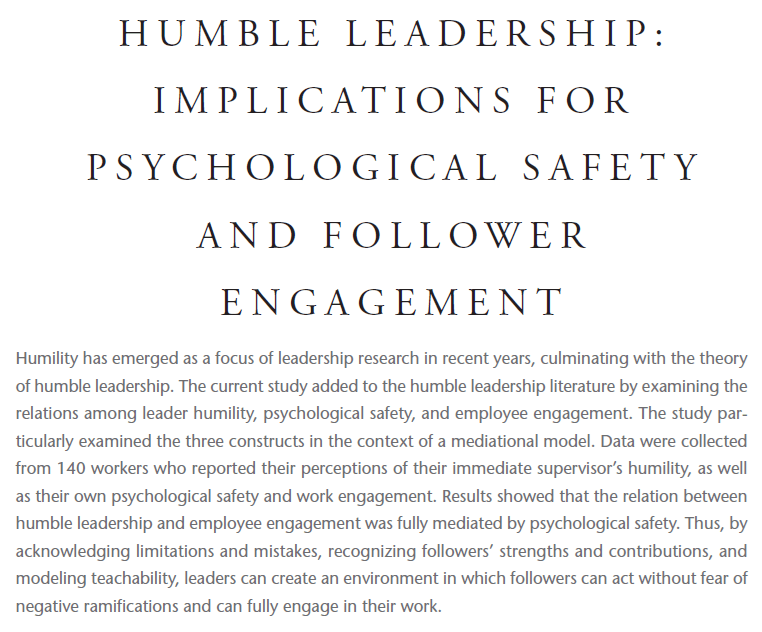
What are the relationships between leader humility, psychological safety and employee engagement? A study to be posted soon explored these links via survey of 140 workers.
Leader humility is “an interpersonal characteristic that emerges in social contexts that connotes (a) a manifested willingness to view oneself accurately, (b) a displayed appreciation of others’ strengths and contributions, and (c) teachability”.
In this study humility was categorized by 1) leaders acknowledging limitations and mistakes, 2) recognizing followers’ strengths and contributions, and 3) modelling teachability (learning, modelling tasks, seeking feedback, listening etc).
They found:
- The relation between humble leadership and employee engagement was fully mediated by psychological safety in their model
- Hence, “by acknowledging limitations and mistakes, recognizing followers’ strengths and contributions, and modeling teachability, leaders can create an environment in which followers can act without fear of negative ramifications and can fully engage in their work”
- Significant correlations were found between humble leadership, psychological safety and follower engagement
Psychological safety significantly predicted employee engagement in their analytical model. When humble leadership was added to the model, and controlling for psychological safety, the previously significant relationship between humble leadership and follower engagement became non-significant.
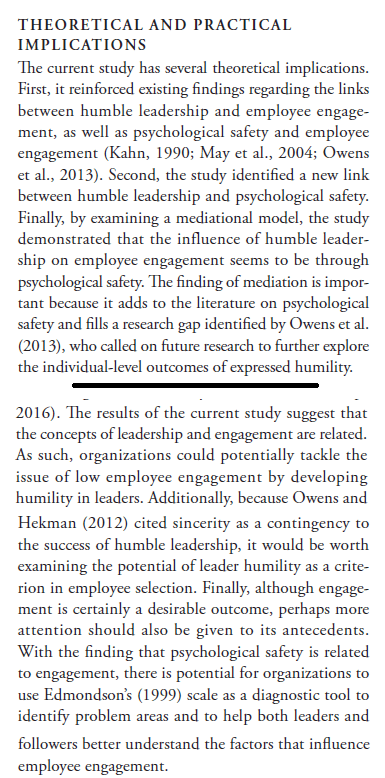
That is, psychological safety may serve as a key mechanism “by which leader-expressed humility fosters employee engagement in followers”.
When leaders express humility they are creating the conditions where followers can feel psychologically safe and engaged.
Authors: Walters & Diab (2016). Journal of Leadership Studies, 10(2).
Study link: https://doi.org/10.1002/jls.21434

 SafetyInsights.org
One thought on “Links between leader humility, psychological safety and follower/employee engagement”