A really interesting study that quantified the energy magnitude and intensities of various fatal and non-fatal accidents; energy estimates which then can be used to predict the severity of incidents.
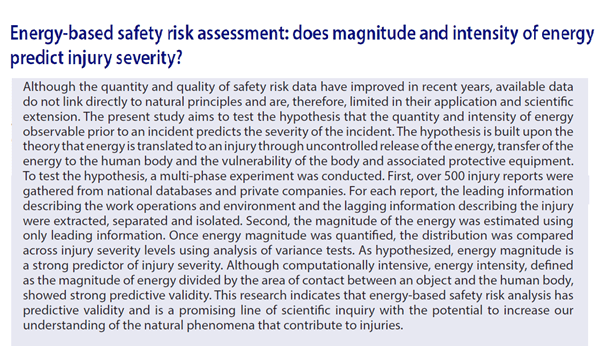
>500 injury reports were analysed.
There’s way too much conceptual background and discussion in this paper for me to cover (e.g. entire sections discussing energy magnitude, energy intensity, the equations and physics involved), so I recommend you check out the full paper.
Providing background:
· Many definitions of risk exist. In safety, a common [but often inadequate] conceptualisation is the product of likelihood and severity
· Most prior research has focused on quantifying likelihood, particularly based on observable attributes of the workplace
· Efforts to predict severity have not been as successful as likelihood, with some work finding that severity estimates “do not predict the severity of an injury better than random”
· They provide background on Haddon’s pioneering work on injury aetiology via energy transfer, e.g. injury occurs when the release and exchange of energy exceeds the bodies vulnerability (threshold)
· Other work exploring the use of hazard energy in hazard perception has found energy thinking can improve hazard recognition skills of workers by up to 30%
· These authors propose that based on energy release theory, the severity of a potential injury can be determined by the ratio of energy intensity and the vulnerability of the human body part that is exposed
· They next cover the theoretical and mathematical background on calculating energy magnitude and intensity; I’ve skipped most of this
· However in short, a range of energy sources exist in workplaces, eg gravitational, kinetic, radiation, chemical etc., hence different means are needed to calculate energy magnitudes
· Greater energy is predicted to result from a greater transfer of energy per unit time, and/or during situations where a smaller energy transfer occurs but over a smaller unit of area (pressure, gravity, motion), and the vulnerability of the body area that the energy exchange takes place (e.g. the head)
· Hence, a falling tape measure would likely not have been fatal had it struck a worker in the shoulder rather than their head; moreover, a sharp pointy object with equal kinetic energy is likely to be more hazardous than a blunt object with a larger surface area (resulting in greater pressure)
This study focused on only motion and gravitational energy, hence simple potential energy calculations could be undertaken for energy magnitude. Energy intensity was calculated via energy magnitude and energy transfer area.
Results
Overall:
· Energy magnitude is a strong predictor of injury severity
· Energy intensity, although more computationally intensive to calculate, showed strong predictive validity and was a better predictor than magnitude
· Statistically significant differences were found between the energies involved in different injury severities, with estimations possible to demarcate fatal versus non-fatal accidents
· Based on their estimations, a rule of thumb of fatal events having an energy magnitude of 2000 j and energy intensity of 2.56 joules/cm2
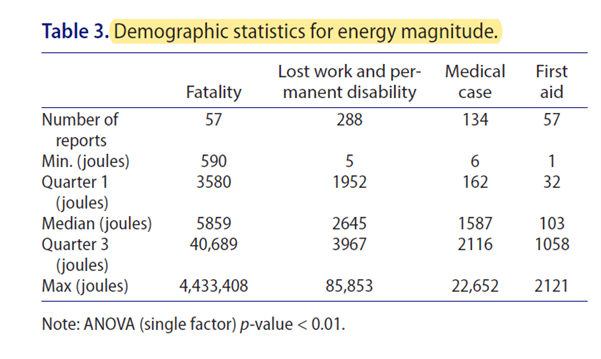
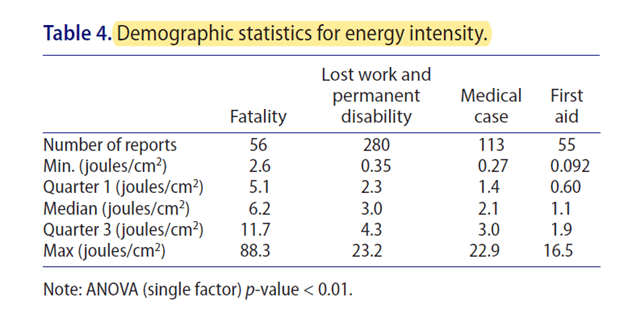
Expanding on the findings, statistical differences were found across all severity levels (data not reproduced here, you’ll need to check out the paper). That is, as expected, more severe and fatal injuries tended to involve greater quantities of energy.
Energy intensity showed significantly less variability among the severity groups compared to energy magnitude, that is, less overlap between different severities. Hence, including contact area in the calculation (energy intensity) improved the predictive validity compared to simply using energy magnitude.
They found, again as expected, that concepts like impact area (sharpness and the like), and vulnerability of the body part, also explained injury severity. They provide an example of a worker who fell 0.7m on his back on a flat surface, versus a worker who was struck on the head by a panel. Both incidents involved ~600 j of energy (energy magnitude), but the worker who fell on his back only a first aid injury versus the latter who was killed.
Hence, energy transfer area improves the predictive ability, although there is still overlap between injury severities to a modest extent.
Next they attempted to set a practical “high energy” threshold. There were some methodological challenges with establishing robust and objective high energy thresholds, but consideration all of the strengths and limitations, they settled on the 2000 j / 2.56 joules/cm2. While 2k joules doesn’t include all of the fatal injuries in their dataset, it “provides a more practical and useful threshold”.
Note that this study only explored motion and gravity, and the incorporation of other energy sources like chemical, electrical, radiation and biological energy may require different approaches.
Moreover, energy intensity couldn’t necessary accurately account for mechanical energy sources (such as from saws, grinders etc.); these energy sources tended to result in higher injury severity than the energy calculations would predict. This inconsistency is explained largely via body vulnerability.
Nevertheless, these types of assessments may be useful heuristics for differentiating SIF potential interactions, and the authors have continued this line of research elsewhere in energy thinking approaches, e.g. the HECA (High-Energy Control Assessments, which proposed 1500 j as a delineation between high vs low energy).
Authors: Matthew R. Hallowell, Dillon Alexander & John A. Gambatese (2017). Construction Management and Economics, 35:1-2, 64-77
Study link: https://doi.org/10.1080/01446193.2016.1274418
Linked to the LinkedIn post: https://www.linkedin.com/pulse/energy-based-safety-risk-assessment-does-magnitude-ben-hutchinson-gsjwc

 SafetyInsights.org
One thought on “Energy-based safety risk assessment: does magnitude and intensity of energy predict injury severity?”