Can safety checklists become ritualistic performances disconnected from their core goal, thereby increasing risk? A new study to be posted soon explored this question. Cliff’s notes: Possibly yes.
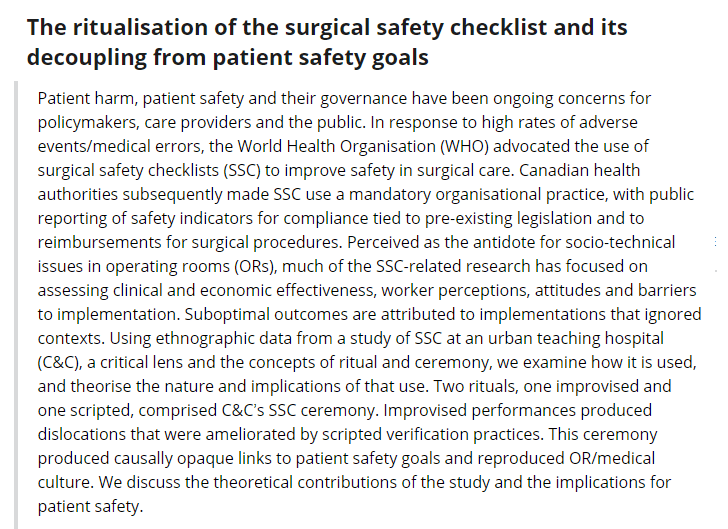
Surgical Safety Checklist (SSC) practices in a Canadian hospital Operating Room were observed via an ethnographic approach, combined with interviews, surveys and document analysis.
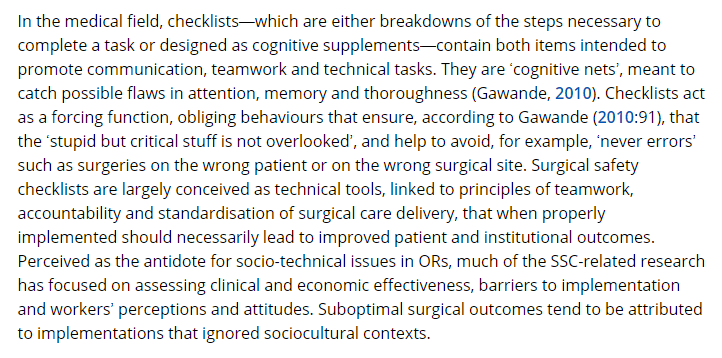
Overall they found:
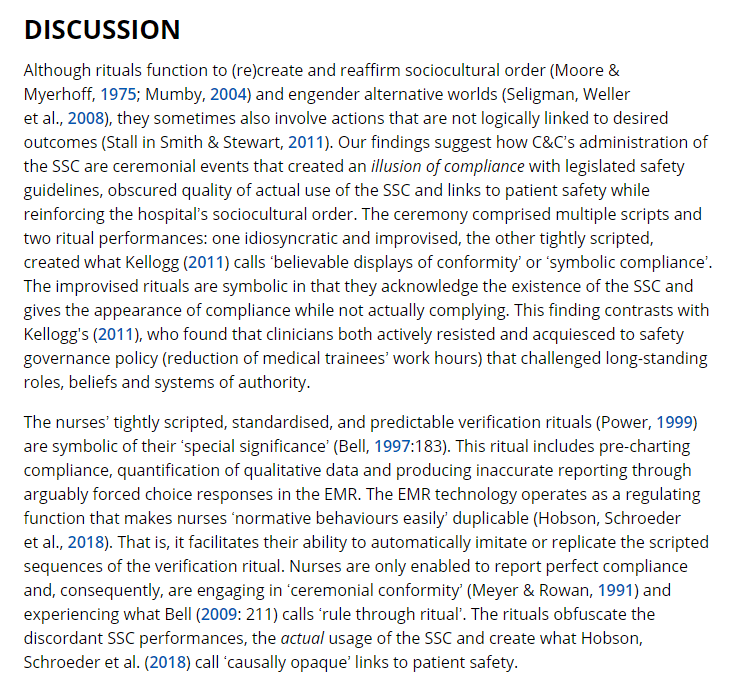
- The use of the SSC was found to function as a ceremonial event that “created an illusion of compliance with legislated safety guidelines, obscured quality of actual use of the SSC and links to patient safety while reinforcing the hospital’s sociocultural order”
- The ceremonial function involved multiple scripts and two ritual performances: one said to be idiosyncratic and improved, and the other ritual was tightly scripted creating “believable displays of conformity or ‘symbolic compliance’
- The “improvised rituals are symbolic in that they acknowledge the existence of the SSC and gives the appearance of compliance while not actually complying”
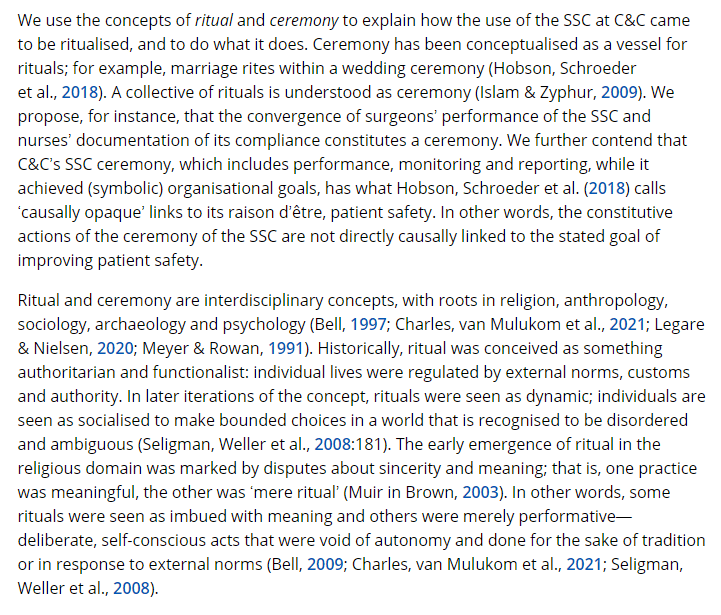
The ritual/ceremony of the SSC “results in the illusion of doing something versus actually doing something. It has symbolic and material value in that it helps [the hospital to] conform to safety governance mandates, avoids disruption of the status quo, and gives the appearance that duties, responsibilities and goals are being met”.
Drawing on Michael Power’s work, they highlight how audits can also have unintended consequences of false assurance and can also act of rituals of verification that are decoupled from their underlying goals.
Our work on the symbolic elements of safety audits also supports these contentions.
Authors: Facey, M., Baxter, N., Hammond Mobilio, M., Moulton, C. A., & Paradis, E. (2024). Sociology of Health & Illness.
Study link: https://onlinelibrary.wiley.com/doi/pdf/10.1111/1467-9566.13746

 SafetyInsights.org
One thought on “Surgical Checklists behaving badly…new study suggests they can result in ritualistic practices decoupled from their core goals”