What are the links between risk avoidance and locus of control in workers experiencing near misses? A study to be posted soon explored these links from >1.3k US miners.
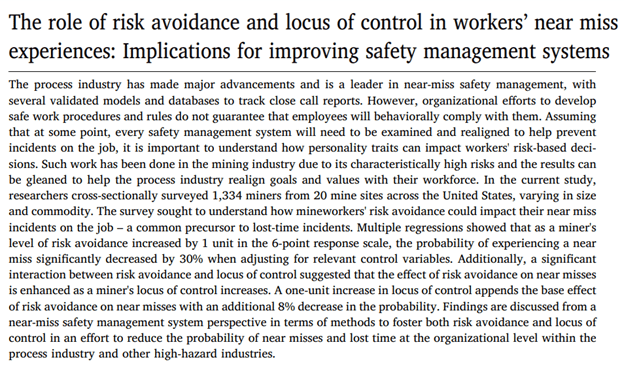
First, risk tolerance/avoidance/propensity is an individual’s tendency to take or avoid risks, and risk avoidance is an “emergent trait that can change”. Locus of control is a personality trait that represents the extent that people believe that the rewards they receive, or losses, are based on their own control or actions.
Key findings:
· As a miner’s level of risk avoidance increased by 1 unit (in the 6-point response scale), their probability of experiencing a near miss significantly decreased by 30%
· The effect of risk avoidance on near misses is enhanced as a miner’s locus of control increases – a significant 14% decrease in near miss probability was found for each unit increase in a worker’s locus of control
· A 1 unit increase in locus of control enhances the base effect of risk avoidance on near misses with an additional 8% reduction in near miss probability
· Education was the only control variable found to significantly influence the likelihood of experiencing a near miss, where workers with an education below high school being at a greater risk of experiencing a near miss compared to miner’s with a bachelor or higher
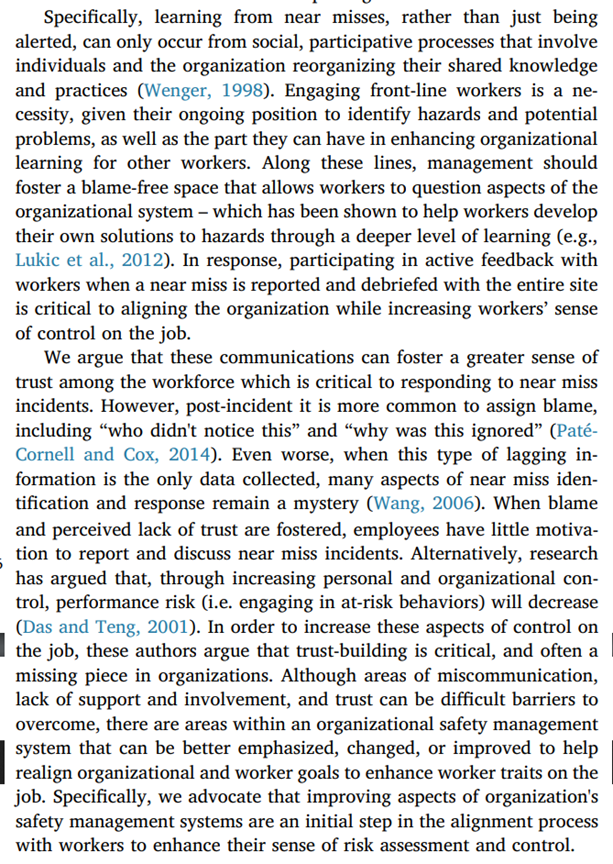
They direct some criticism towards process and chemical industries, for instance, around their hindered learning mechanisms. These findings suggest that “workers’ individual factors need to be considered and addressed when deciding how to disseminate aspects of safety management”.
While this study focused on individual factors, these individual factors “can still be influenced by organizational characteristics such as decision making authority bestowed onto an individual, opportunities provided to use knowledge and skills, and the option and ability to participate in discussions”.
Hence, interventions and levers should be targeted across the hierarchical levels.
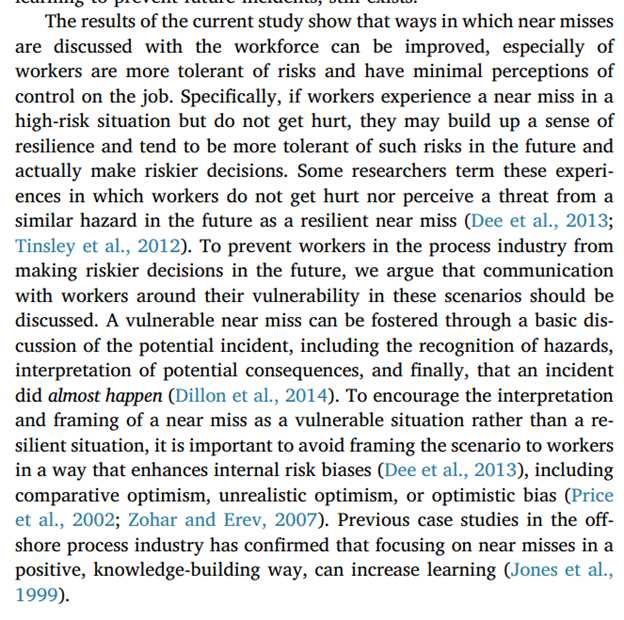
Finally, near misses aren’t a single monolithic construct. That is, you can have resilient near misses and vulnerable near misses. Resilient near misses are ‘it narrowly went right’, hence, success is emphasised. These types of near misses can desensitise people to danger.
Efforts need to be directed towards vulnerable near misses – the ‘it narrowly went wrong’, emphasising how close to danger we were.
Authors: Haas, E. J., & Yorio, P. L. (2019). Journal of loss prevention in the process industries, 59, 91-99.
Study link: https://doi.org/10.1016%2Fj.jlp.2019.03.005

 SafetyInsights.org
One thought on “Links between locus of control, risk avoidance and near misses in mining”