This study explored the relationships between leader humility, psychological safety and employee engagement.
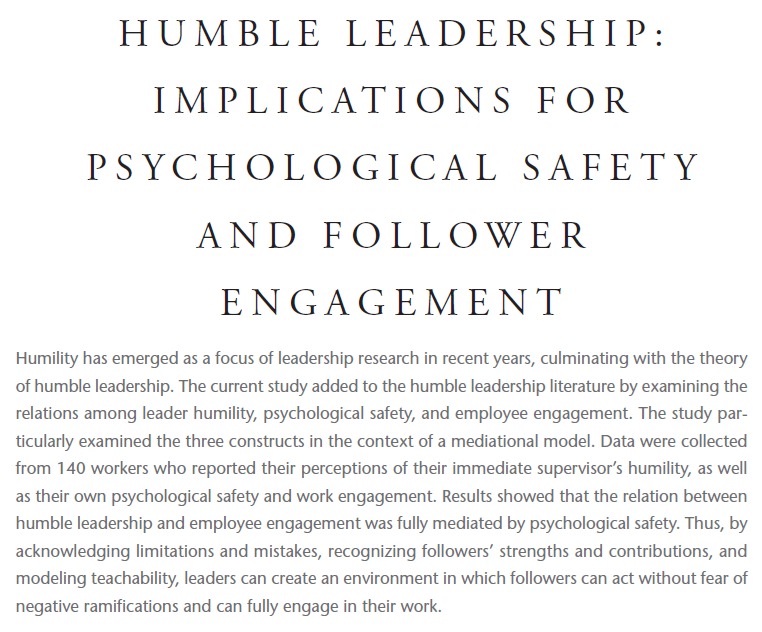
Data came from 140 workers via an online survey platform.
Providing background:
· Since the 1930s, >65 classification systems have been developed to describe the dimensions of leader behaviour
· Two outcomes have commonly being used to frame effective leadership: followers’ psychological safety and level of engagement
· Humble leadership has been asserted to allow executives to avoid problems associated with self-complacency and overconfidence, and to facilitate organisational learning and resilience
· One model of leader humility defined expressed humility as “an interpersonal characteristic that emerges in social contexts that connotes (a) a manifested willingness to view oneself accurately, (b) a displayed appreciation of others’ strengths and contributions, and (c) teachability”
· Three categories of humble leader behaviours were expressed in one study as acknowledging limitations and mistakes – being a willingness to view oneself accurately, admitting mistakes, acknowledging limitations in experience and knowledge or taking responsibility for failures. The effectiveness of these behaviours were seen to be contingent on the leaders’ competence, where humility in incompetent leaders seen as a weakness
o recognising followers’ strengths and contributions- where leaders verbalise appreciation for followers’ contributions, acknowledge their strengths and refer to the team when talking about successes. Hence, “humble leaders made sure to communicate the value added to the team by each individual follower”. This behaviour was contingent on perceptions of leader sincerity, with false humility fostering suspicion and contempt in followers
o modelling teachability – this has been said to be the most important aspect of humble leadership, and involves a demonstration toward learning, modelling tasks for followers, seeking feedback, listening and considering alternative perspectives. This behaviour wasn’t seen as effective by followers when situations involved time pressure or threat, when organisational cultures weren’t conducive to humility, or when hierarchical adherence was high
· Humble leadership has been associated with four outcomes: 1) fluidity of organising, 2) continuous small change, 3) follower engagement, and 4) psychological freedom
· Units headed by humble leaders were found in one study to function in a bottom-up manner, but easily able to adapt when the situation called for a more top-down structure
· Units headed by more humble leaders were also found to make constant evaluations and adjustments, leading to frequent small changes
· Edmondson proposed five categories of antecedents to psychological safety: 1) trusting and respectful interpersonal relationships with coworkers, 2) opportunity to practice new strategies in a non-evaluative setting, 3) supportive organisational contexts, 4) informal workplace dynamics, 5) leader behaviour
· Elsewhere, leaders who are coaching-orientated, open to feedback and discussion from followers, and model an attitude of openness are more likely to encourage psychological safety among their employees
Results
They found that:
· The relation between humble leadership and employee engagement was fully mediated by psychological safety in their model
· Hence, “by acknowledging limitations and mistakes, recognizing followers’ strengths and contributions, and modeling teachability, leaders can create an environment in which followers can act without fear of negative ramifications and can fully engage in their work”
· Humble leadership was significantly correlated with psychological safety
· Humble leadership and follower engagement were significantly correlated
· Significant correlations were found between humble leadership, psychological safety and follower engagement
Discussing the findings, psychological safety significantly predicted employee engagement in their analytical model. When humble leadership was added to the model, and controlling for psychological safety, the previously significant relationship between humble leadership and follower engagement became non-significant.
Hence, based on this specific dataset and model, psychological safety fully mediated the relationship between humble leadership and follower engagement (i.e. without sufficient psychological safety, humble leadership may not be effective for enhancing follower engagement).
That is, psychological safety may serve as a key mechanism “by which leader-expressed humility fosters employee engagement in followers”. When leaders express humility they are creating the conditions where followers can feel psychologically safe and engaged.
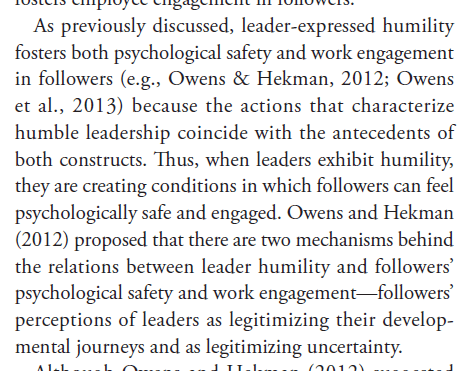
They observe that the more direct influence of humble leadership should be on psychological safety rather than employee engagement.
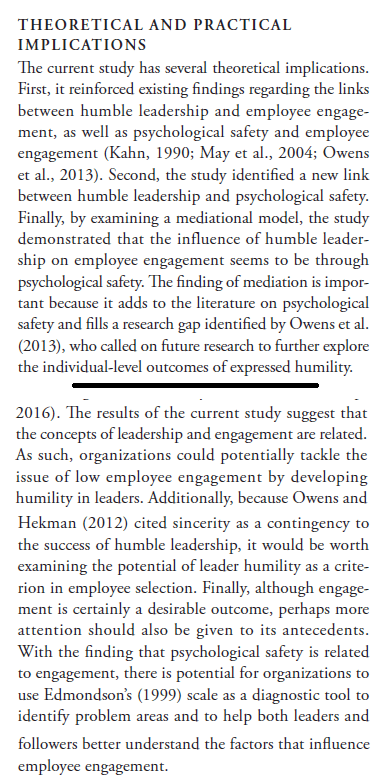
For practical implications, they argue that organisations could “potentially tackle the issue of low employee engagement by developing humility in leaders”, and here attention should be paid to the antecedents. Edmondson’s scale may be a useful diagnostic tool to identify problem areas and to help leaders an followers identify areas to help.
Like any study, this had limitations. For one, the data came from an online portal. They chose this sample because of greater limitations in using university students.
Authors: Walters & Diab (2016). Journal of Leadership Studies, 10(2).
Study link: https://doi.org/10.1002/jls.21434

 SafetyInsights.org
2 thoughts on “Humble Leadership: Implications for Psychological Safety and Follower Engagement”