This ethnographic study explored the ritualistic and ceremonial functions of a Surgical Safety Checklist (SSC) in an urban teaching hospital.
It’s a pretty interesting read that I can’t do justice.
Providing background:
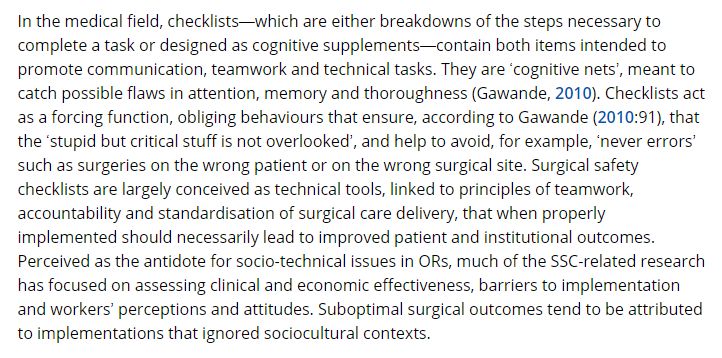
- In medicine, checklists are said to be either breakdowns of necessary task steps or designed as cognitive supplements
- Checklists are “cognitive nets’, meant to catch possible flaws in attention, memory and thoroughness” and act as forcing functions on behaviour
- Research on SSC compliance and effectiveness is mixed. Several studies have found benefits to SSC, like reduced 30-day morbidity and reduced mortality. Other work has highlighted little or no significant impact on mortality
- Checklists may be only partially effective in healthcare given that they are often implemented without fully appreciating the contextual factors that make them successful
- These authors argue that besides the more functional aspects of checklists, they also have symbolic and ritualistic functions
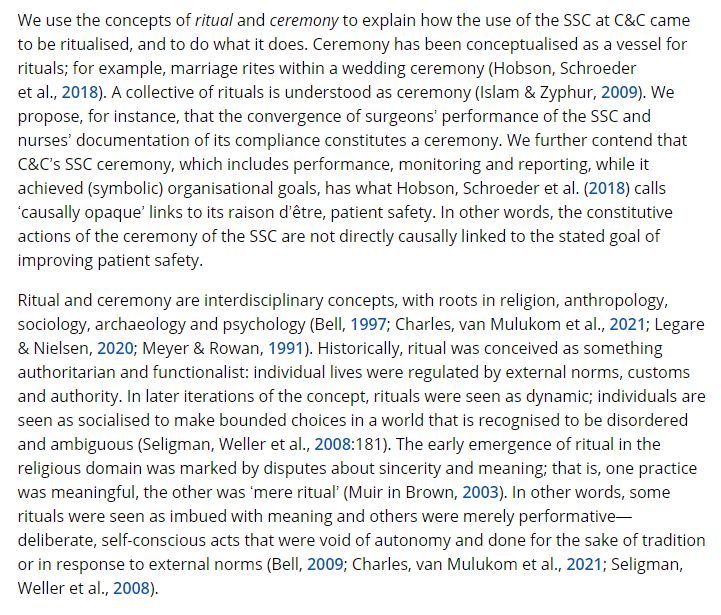
- Ceremony is a “vessel for rituals”, like marriage rites during a wedding. Surgeons’ usage of the SSC and nurses’ documentation of SSC compliance constitute a ceremony
- The ceremonial aspect of the SSC, including performance, monitoring and reporting, may result in a team achieving symbolic goals with only weak connections to its actual purpose on patient safety
- This decoupling between the symbolic effects and actual function has been termed ‘causally opaque’ links
- Rituals are an important artefact to study. They “not only transfer and reinforce norms and meanings, they also link individuals to broader sociocultural structures” and rituals can further “build group cohesiveness among unequal status groups and affirm social values and power relations”
- Rituals help to create, recreate and reaffirm sociocultural order, but can sometimes “involve actions that are not logically linked to desired outcomes”
- Rituals can be more static and uniform, like ticking boxes on compliance forms. Rituals can also be dynamic and informed by contexts, functions and groups
Results
Observing the use of the SSC in practice revealed:
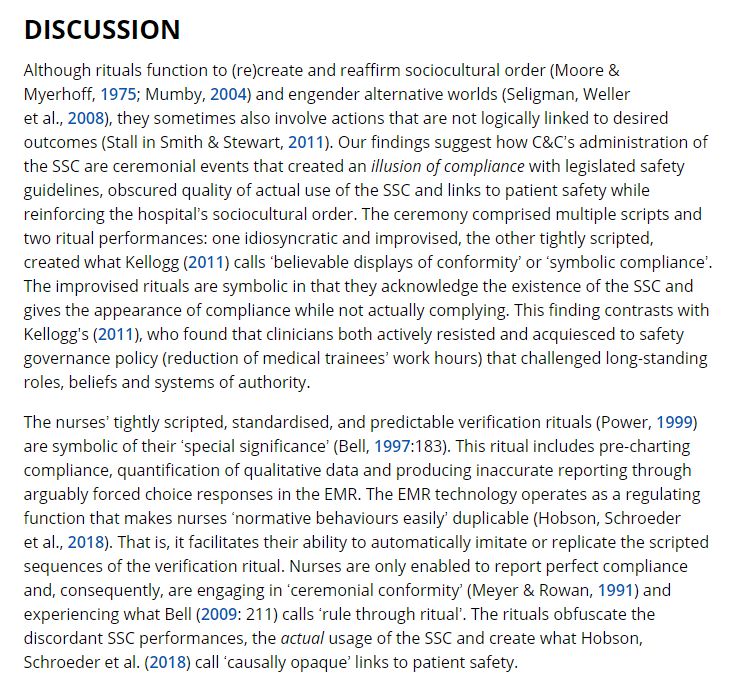
· The use of the SSC was found to function as a ceremonial event that “created an illusion of compliance with legislated safety guidelines, obscured quality of actual use of the SSC and links to patient safety while reinforcing the hospital’s sociocultural order”
· The ceremonial function involved multiple scripts and two ritual performances: one said to be idiosyncratic and improved, and the other ritual was tightly scripted creating “believable displays of conformity or ‘symbolic compliance’
· The “improvised rituals are symbolic in that they acknowledge the existence of the SSC and gives the appearance of compliance while not actually complying”
They cover the results in three parts.
1) SSC polices as ritual script
This script was said to include policy directives and other types of legislation and compliance reporting guidelines and governed via an internal accountability system. The SSC was “an unwieldy adaptation of the WHO’s SSC” and includes 64 tickboxes. The unwieldiness “invited” deviations and improvisations.
The circulating nurses have responsibility for documenting operating room compliance to the SSC (e.g. the surgeon’s use of the SSC), and verify that they have observed performance of each stage of the checklist.
Although the symbolic script of the SSC was predicated on compliance “, the form wasn’t necessarily completed as intended. For instance, surgeons “performed their own unscripted, idiosyncratic uses of the SSC. These included abbreviated, skipped or loosely structured briefings, time outs (omitted whole-team or joint attention and condoned absences) and debriefings; varied sequences/timing … and reliance on memory and experience rather than using the SSC”.
Delegation of the responsibility to perform the SSC to subordinates or trainees “added another dimension to improvisation”. In some cases surgeons would skip the SSC performance entirely or skipped whole sections. Sometimes the SSC only involved sharing the patient’s name and surgery type. Debriefs at the end of cases also happened infrequently or not at all.
With debriefs, a clinician suggested how interprofessional hierarchies and medical liability affect SSC performances. One clinician stated that “No surgeon is going to admit they could have done something better, or different. That would be tantamount to exposing themselves to potential legal trouble”. Moreover, discussing power imbalances, “no nurse or anaesthetist is going to point out in front of everyone how the surgeon could or should have done something better”.
Unscripted performances of enacting the SSC “not only deviated from the ritual script, they also called into question its purported belief in communication, teamwork and sense of shared purpose”.
2. Nurses’ scripted rituals of verification
Documenting the SSC compliance is a type of verification that it was performed during surgery. The verification activity was “marked by precise, repetitive actions and a restricted code of behaviour characterised by inflexible box-ticking”
That is, nurses were driven for 100% compliance rate of the SSC verification, with some nurse accounts stating “that performing [SSC] compliance was without meaning (‘[we’re] just ‘go[ing] through the motions’) because they had limited decision-making autonomy”.
Further, nurses were reluctant or feared auditing surgeon performances. And, “nurses completed the forms whether SSCs were performed or not to ensure their accountability, to avoid the extra work” and to avoid having the form returned as a ‘charting error’.
As one nurse said, whether or not the SSC activities were actually done “[You always check the SSC off as done] … otherwise you’ll get it back three weeks later as an error”.
Nurses had little autonomy regarding what to chart on the form, but had improvised autonomy when to chart. For instance, the official script was meant to be that the stages are observed in real time and then ticked after the activity is completed. However, they found “in some instances the boxes were all ticked ahead of surgical procedures, before nurses could ascertain whether the steps were completed”.
Discussing the findings, they highlight that the nurses’ “tightly scripted, standardised, and predictable verification rituals (Power, 1999) are symbolic of their ‘special significance”. Their own scripts allow them to “automatically imitate or replicate the scripted sequences of the verification ritual” of the SSC.
That is, nurses are “only enabled to report perfect compliance and, consequently, are engaging in ‘ceremonial conformity’”. Because incomplete SSC forms are returned to nurses, they mechanically tick every box, every time, irrespective of whether that task was done or done as expected.
Hence, these rituals “obfuscate the discordant SSC performances, the actual usage of the SSC and create what Hobson, Schroeder et al. (2018) call ‘causally opaque’ links to patient safety”.
The ceremony of SSC verification “results in the illusion of doing something versus actually doing something. It has symbolic and material value in that it helps [the hospital to] conform to safety governance mandates, avoids disruption of the status quo, and gives the appearance that duties, responsibilities and goals are being met”.
The ceremonies carry multiple and contrary messages, and highlight the tension between professional autonomy and accountability. It’s argued that it’s “inherent contradictory” to assign compliance documentation and activities to nurses, given the wide interprofessional hierarchies (power gradients) and absence of autonomy to question surgeons.
Likewise, the “idiosyncratic performances also reinforce surgeons’ perceived infallibility and are symbolic of their autonomy over their work”. These ceremonies obscure the contradictions or tensions faced by nurses by producing “pockets of order”.
Drawing on Michael Power’s work, they highlight how audits can also have unintended consequences of false assurance, and can also act of rituals of verification that are decoupled from their underlying goals.
Authors: Facey, M., Baxter, N., Hammond Mobilio, M., Moulton, C. A., & Paradis, E. (2024). Sociology of Health & Illness.
Study link: https://onlinelibrary.wiley.com/doi/pdf/10.1111/1467-9566.13746
LinkedIn post: https://www.linkedin.com/pulse/ritualisation-surgical-safety-checklist-its-from-goals-ben-hutchinson-2buyc

 SafetyInsights.org
One thought on “The ritualisation of the surgical safety checklist and its decoupling from patient safety goals”