An absolute banger of a paper will be posted soon – co-authored by one of my favourites: the late, great Bob Wears.
This paper talks about the corrupting, but understandable, factors that lead us to focus on constructing the past via hindsight and outcome bias in diagnostic failures (e.g. first stories over second stories).
Out of the gates, they observe that:
“Reviews of malpractice claims have a morbid attraction that is similar to gazing at crash scenes. Both provide the observer with a vicarious, cathartic experience”.
These stories of failure are popular because they “support a perception of control that has important psychological, social, and political benefits13 by making a complex, chaotic, and irreducibly uncertain world appear to be simpler and more linear”.
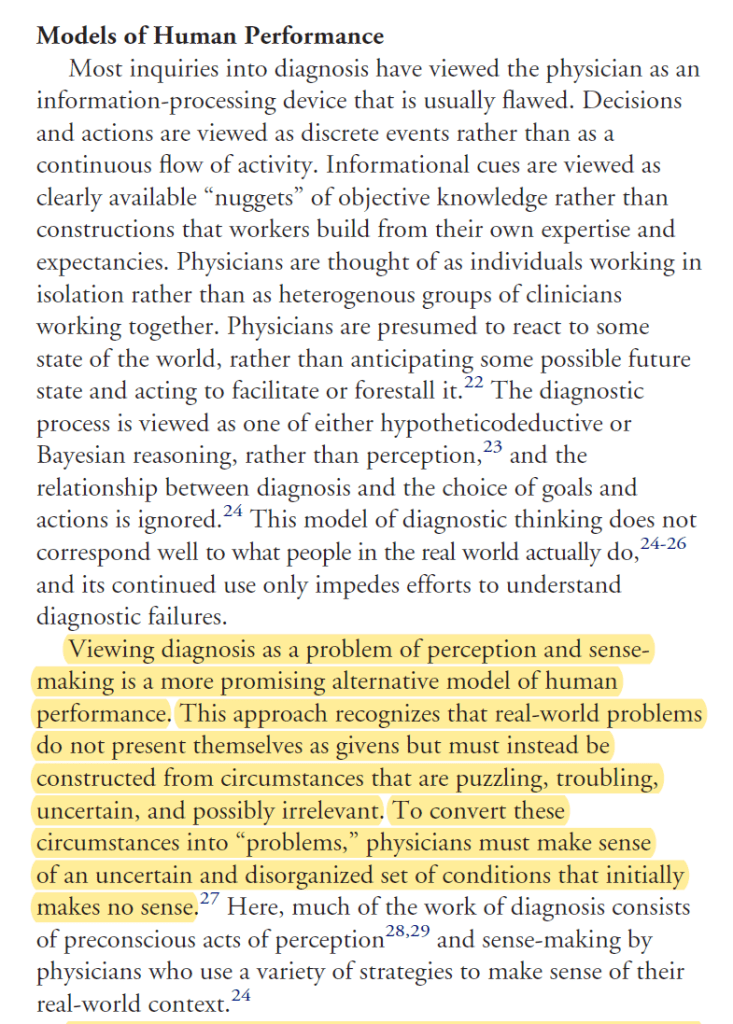
Physicians are presumed to react to some state of the world instead of “anticipating some possible future state and acting to facilitate or forestall it”, or operating with some “hypotheticodeductive or Bayesian reasoning, rather than perception”.
This model of diagnostic reasoning is not well-calibrated to what people in the real world actually do.
They argue that viewing diagnosis as a problem involving perception and sensemaking is more promising as a lens of understanding human performance, as it recognises that “real-world problems do not present themselves as givens but must instead be constructed from circumstances that are puzzling, troubling, uncertain, and possibly irrelevant”.
They discuss the role of hindsight and outcome biases; i.e. the power of “delusional clarity”. These effects are “powerful and insidious and make it hard for historical analyses (such as root cause analysis or closed claim review) to yield useful understandings of accidents or adverse events).
With the benefit of hindsight, those who know what happened after the fact “consistently overestimate what others who lacked that knowledge could have known”. Hindsight they say “converts the disjointed and disorganized array of disparate events that the participants faced into a coherent causal framework that the reviewer uses to “explain” what happened”.
Interestingly, they argue that hindsight bias is “so powerful and so pervasive” that some others contend that “it must be fundamentally adaptive, arguing that our minds evolved not to understand and explain the past but to quickly and efficiently adapt to the future”.
Finally, they discuss some ways forward (covered in the soon to be posted summary).
Ref: Wears, R. L., & Nemeth, C. P. (2007). Annals of emergency medicine, 49(2), 206-209.
Study link: https://doi.org/10.1016/j.annemergmed.2006.08.027

 SafetyInsights.org
One thought on “Replacing hindsight with insight and moving towards second stories of performance”