What are the links between risk perception, safety climate, safety leadership and rule departure/adaptation? An upcoming summary explored these links in a sample of 390 power grid construction workers.
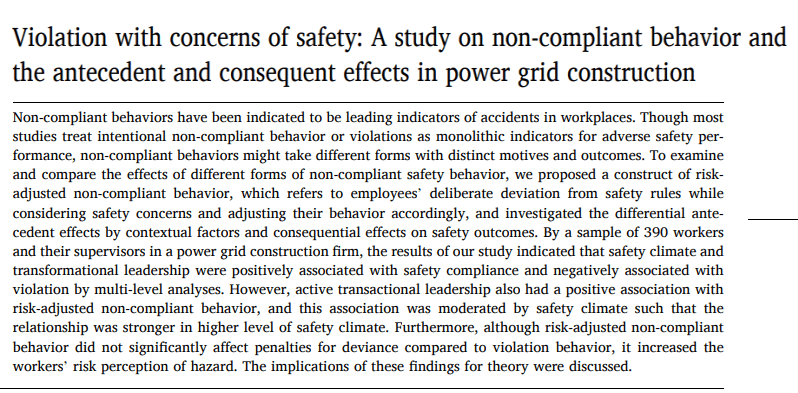
Note: While this study talks of compliance (and associating rule following as ‘correct’ or ‘compliant’) and violations (I’ve never liked ‘violation’ because it’s so loaded and judgemental), the paper is pretty progressive in its application and discussion of the findings.
Out of laziness I’ll stick with their wording, but don’t necessarily agree with it.
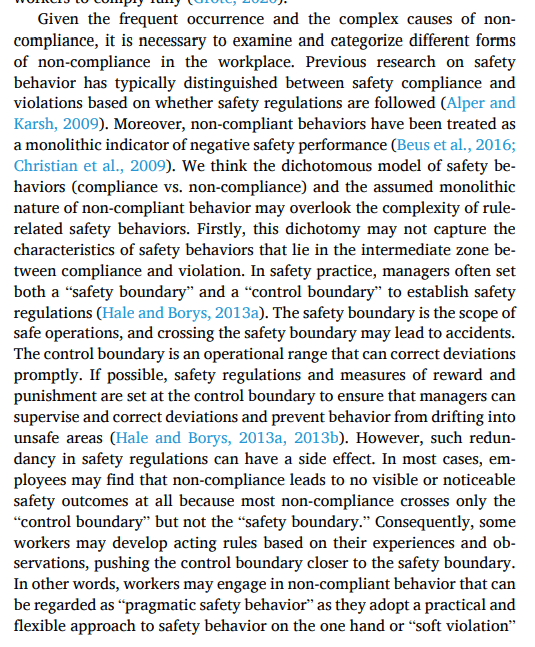
For one, they highlight that while research and industry has long focused on rule following and departure (e.g. “violations”), “the idea that violations are merely bad actions by “bad people” may overlook the possible multi-faceted nature of non-compliant behaviors”, e.g. good people performing workarounds with positive intentions.
Further, research has treated “non-compliant behaviors as a monolithic source of unsafety and a negative safety performance indicator”, but this doesn’t adequately separate intention and non-intentional, or reckless/malevolent versus non-reckless departures, nor departures that were not linked to a known and appreciated risk awareness
Some findings included:
· These findings “challenges the assumption that people violate safety rules in a uniform way” and that “non-compliant behavior pose a monolithic negative indicator of safety performance”
· Various factors influence rule departures, including how workers perceive risks and rationalise their decisions, and their adjusted non-compliant behaviour measure differentiated actions from violations
· Safety climate consistently promoted safety compliance and reduced risk-adjusted non-compliance behaviour and violation
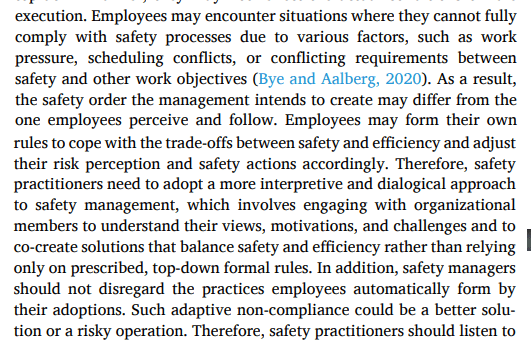
They argue that while safety rules are established in a top-down manner to standardise and constrain behaviour, “they may not reflect the actual conditions of rule execution”.
Hence, workers can encounter situations where they can’t fully comply with processes (e.g. due to scheduling, workload, conflicting requirements and more).
Hence workers then form their own rules to cope with trade-offs and local constraints and, importantly, “adjust their risk perception and safety actions accordingly”.
Authors: Zhou, F., Lu, H., & Jiang, C. (2024). Safety science, 170, 106353.
Study link: https://doi.org/10.1016/j.ssci.2023.106353

 SafetyInsights.org
One thought on “Risk perception, safety climate, leadership and rule departures”