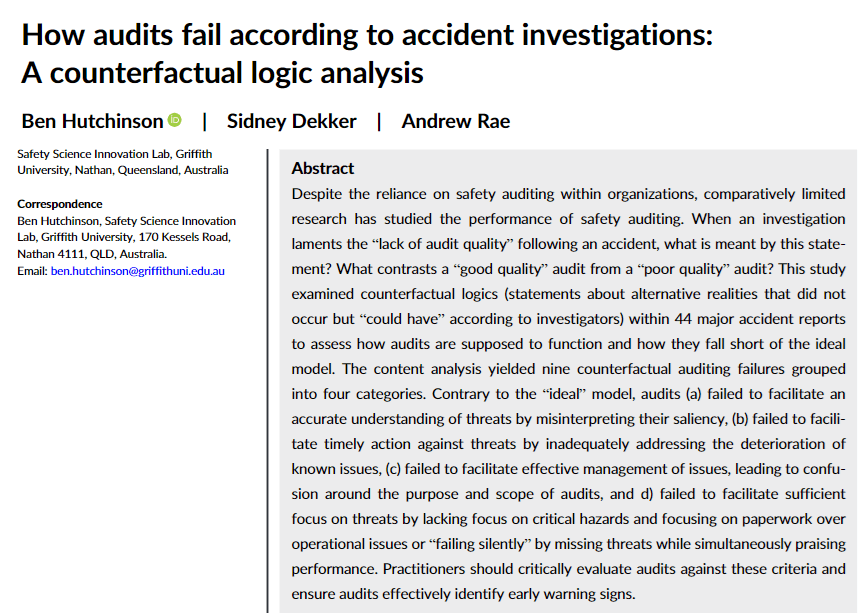
Our recent study of 44 major or fatal accident reports in the process, chemical, pipeline, mining, oil & gas industries explored how audits failed prior to the accident (according to the investigation).
In the first post (link below), I covered the first two categories of audit failures (1 Audits involve a failure to understand, 2 Audits involve a failure to act.)
The two remaining categories are:
· Audits involve a failure to manage
· Audits involve a failure to focus
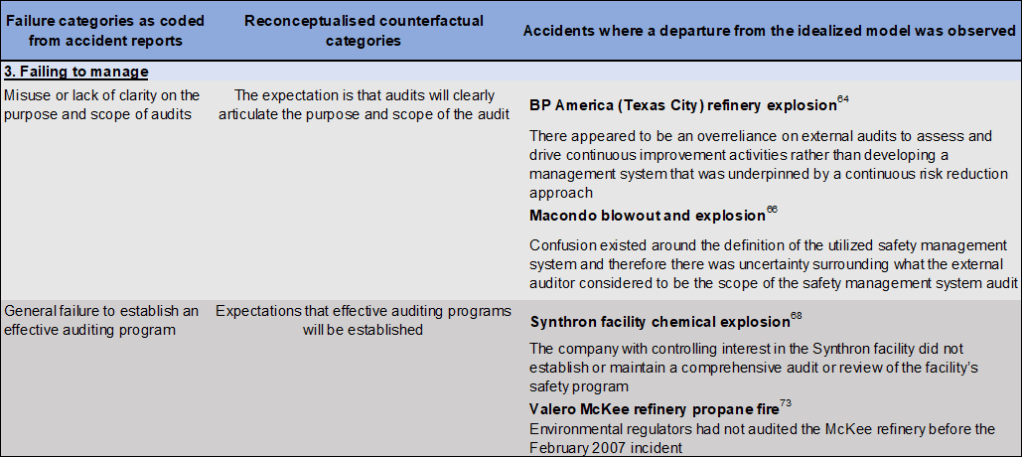
** Audits involve a failure to manage **
Here, audits were misused or lacked clarity on their purpose and scope. In some examples, there was uncertainty about what the audit regime was supposed to include or achieve, how it would achieve its goals in practice, and what parts of the systems should be evaluated in the audit.
Audits at Texas City were seen to have excessively relied on audits as the primary driver of continuous improvement, which impeded the development of a management system that prioritised continuous risk reduction.
In mining, a misguided use of systems were observed, such that executives perceived a “complex interlocking system of audits, reports, and rules” as fostering a safety-sensitive culture, despite their partial blindness to hazardous work.
** Audits involve a failure to focus **
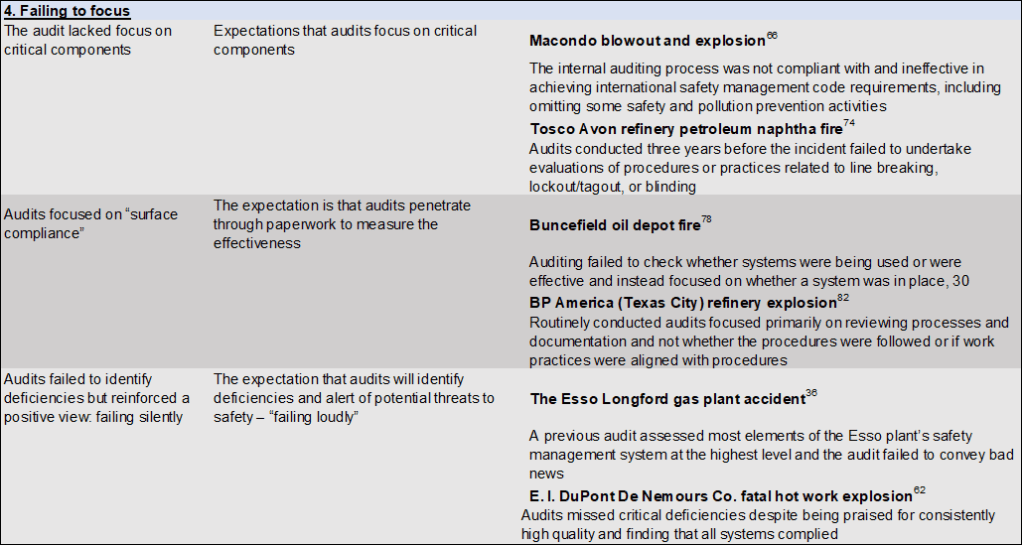
This category focused on audits that, in hindsight, did not focus on the necessary and critical elements of safety systems, risks, or practices.
In many cases, specific hazards or hazardous activities did not receive due attention during audits, for example, lockout/tagout procedures involved with the Tosco refinery fire.
Elsewhere, investigators described weaknesses in audits regarding rule compliance – e.g. in the Chevron refinery fire, audits focused too strictly on regulatory compliance over reducing risk.
Audits also focused on ‘surface compliance’, that is, a near militant focus on paperwork over evaluating actual system implementation or effectiveness.
And, most interesting in my view was that audits could “fail silently”.
That is, audits could fail to achieve their critical goals, but deliver little feedback that they were failing. At a more pathological level, some audits not only failed, but provided glowing praise of system performance despite critical issues existing.
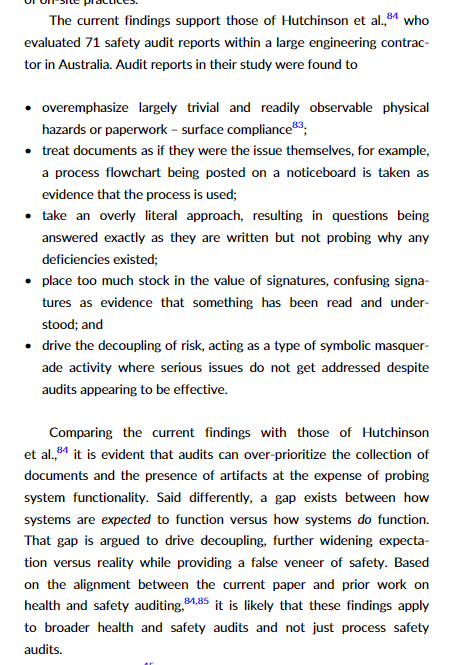
Overall, we argue that audits may not be acting as robust indicators of weak signals.
Indeed, paraphrasing Dixon-Woods et al., practitioners should ask whether their audits, in practice, work as tools of problem-solving or instead, the machinery of comfort-seeking.
Ref: Hutchinson, B., Dekker, S., & Rae, A. (2024). Process Safety Progress.
Links:
Study: https://doi.org/10.1002/prs.12579
Tabulated findings: https://aiche.onlinelibrary.wiley.com/action/downloadSupplement?doi=10.1002%2Fprs.12579&file=prs12579-sup-0001-TableS1.docx

 SafetyInsights.org
2 thoughts on “Major accident audit failures p.2: A failure to manage and a failure to focus”