An interesting read from Ivan Pupulidy describing the shift in the US Forestry Service’s approach to serious incident investigation from their prior method to that of a Learning Review.
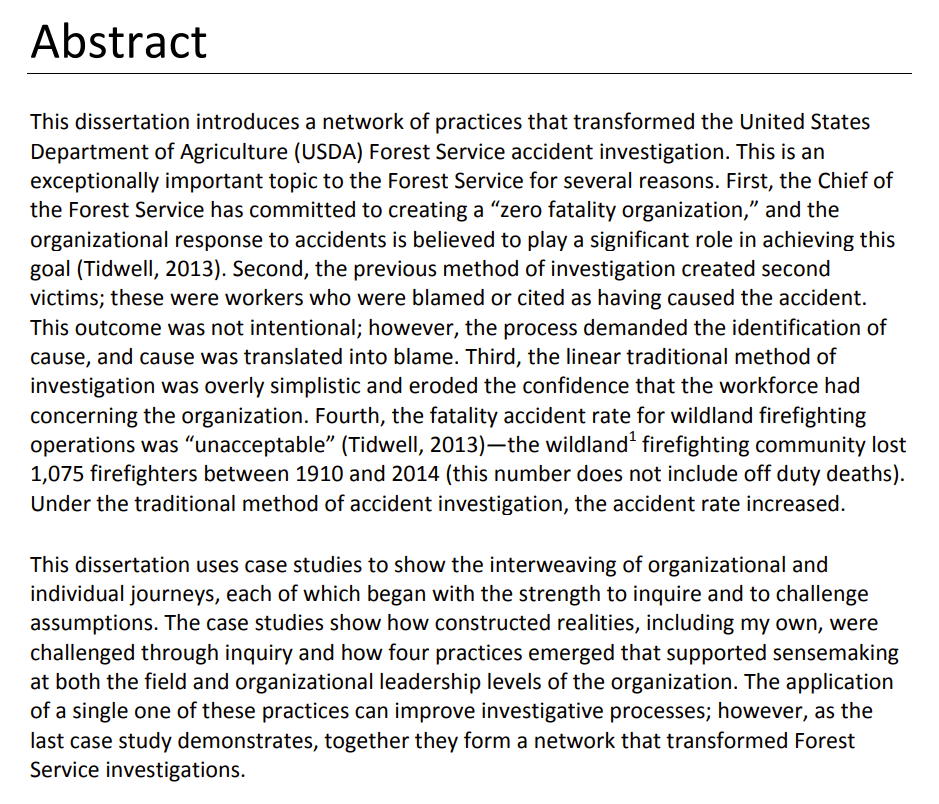
There’s a lot here (210 page dissertation), but the summary provides a useful collection of key assumptions that “bound” their thinking to less effective ways to learn and improve.
Bounding Assumptions:
1. The past is a key indicator for the future
2. Accidents can be universally represented as causal chains
3. The best way to improve safety is to control or eliminate error
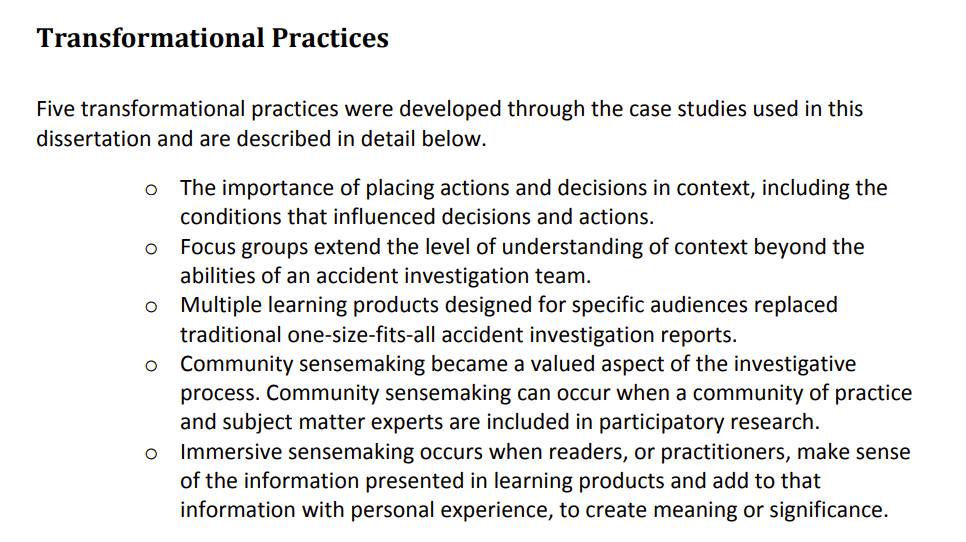
4. Correcting or fixing individual system components alone can improve safety
5. Complex systems behave in a linear, predictable manner

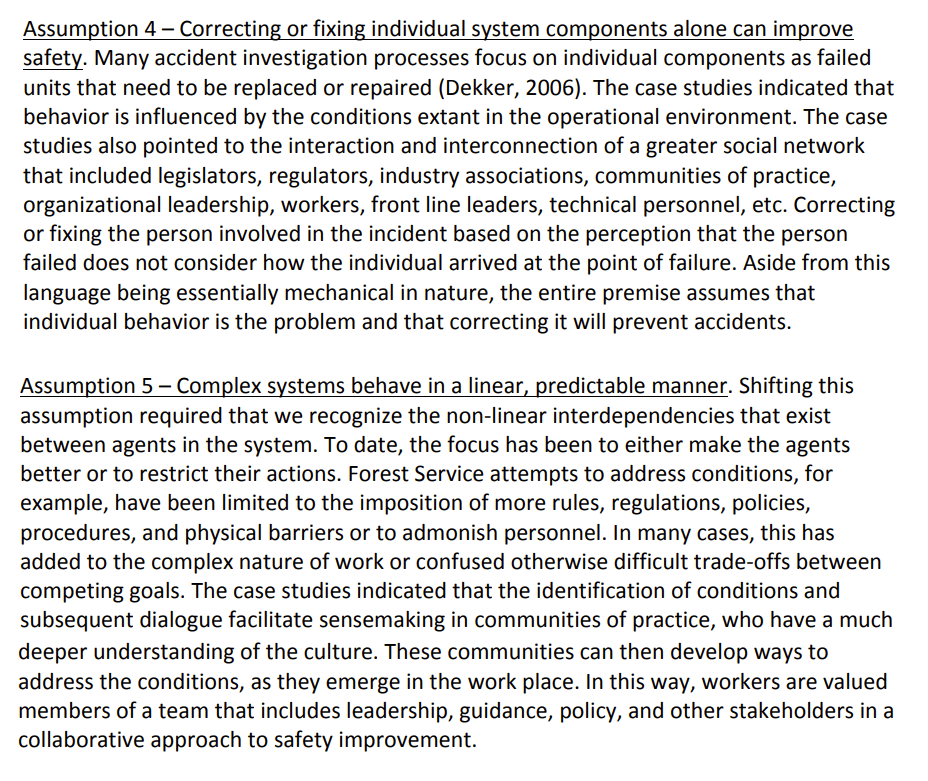
Ivan then provides an overview of key practices that took place in the US Forest Service’s practices.
Key practices:
1. The importance of placing actions and decisions in context: Indicating the criticality of considering environmental, organisational and cultural influences across the entire system.
2. The importance of focus groups to develop understanding: Small groups, like investigation teams, often have difficulty developing “an understanding that results in meaningful recommendations”.
There are often issues important to the community that are overlooked, and this feedback may “only air … after the report is released, which is commonly in the form of a critique of the investigative process”. Focus group interactions would capture a greater number of insights around the narratives.
3. Multiple Learning Products: Traditional investigations result in a single report, and hence once released “believed that these reports represented a definitive explanation of events and corrective actions that would restore the system to safe operation”.
The shift to multiple learning products was based on “the need to offer more to the community than an explanation of an event and corresponding corrective actions”. Here, “the idea is to leave the audience with questions rather than trying to resolve them”.
4. Community Sensemaking: The use of focus groups is enhanced here by the formation of impromptu communities that form after events, made up of people who have an interest in prevention. These people “were not trained in accident investigation, and at least in part, they were not constrained by models of investigation that could channel their inquiry”
5. Immersive Sensemaking: This involves “placing people in a position where they can develop their own understanding of the event and make sense of it from their perspectives”. Communities are presented with multiple narratives and info.
Learners are “encouraged to discuss, role-play, and bring in other information or expertise in an effort to organically explore why it may have made sense to those involved in the accident to do what they did”.
Ref: Pupulidy, I. (2015). [Doctoral Thesis, Tilburg University]. [s.n.].
Dissertation link: https://pure.uvt.nl/ws/portalfiles/portal/7737432/PupilidyTheTransformation01092015.pdf

 SafetyInsights.org
2 thoughts on “Shift from human-focused investigations to system focused learning and sensemaking in US Forestry”