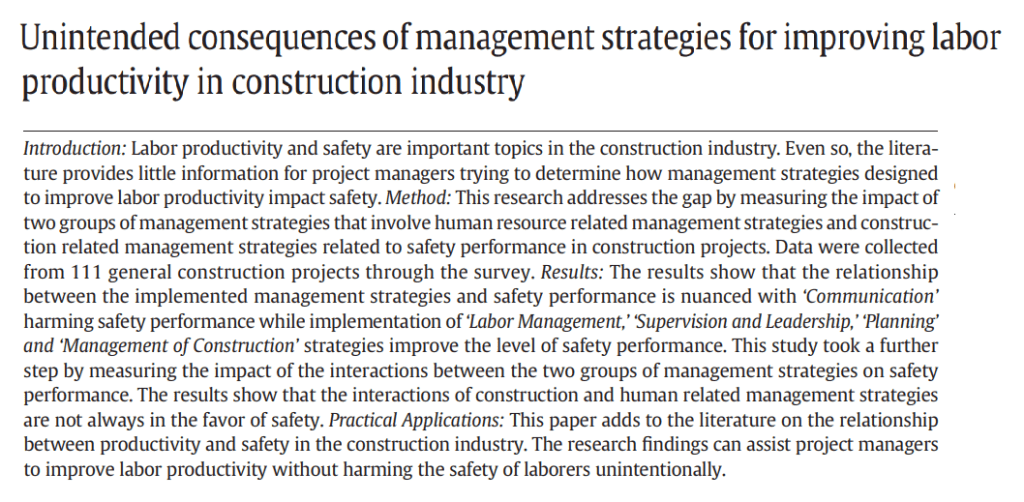
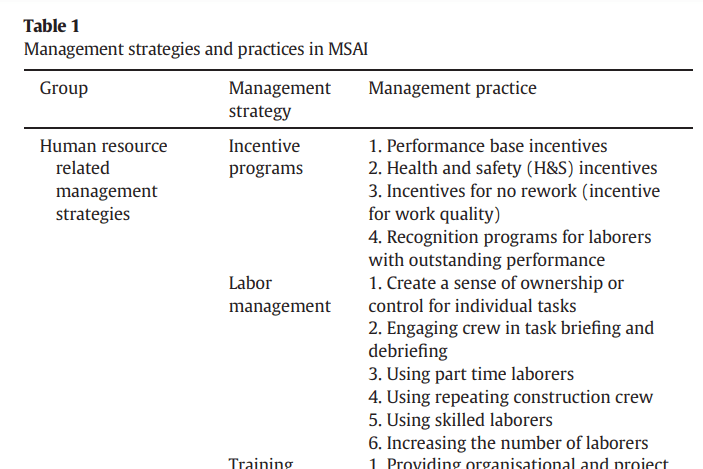
This studied the impact various management strategies to boost labour productivity have on safety. Strategies were human resource (HR) and construction management (CM) related and included a large number of strategies (48 practices; shown below).
Survey data was collected from 111 general construction projects.
The importance of this is that construction is not just one of the more hazardous industries but also one of the least productive. Given the constant push to optimise labour productivity (doing more and faster with less), various management strategies are utilised but these may impact safety more than productivity (as one study in manufacturing found).
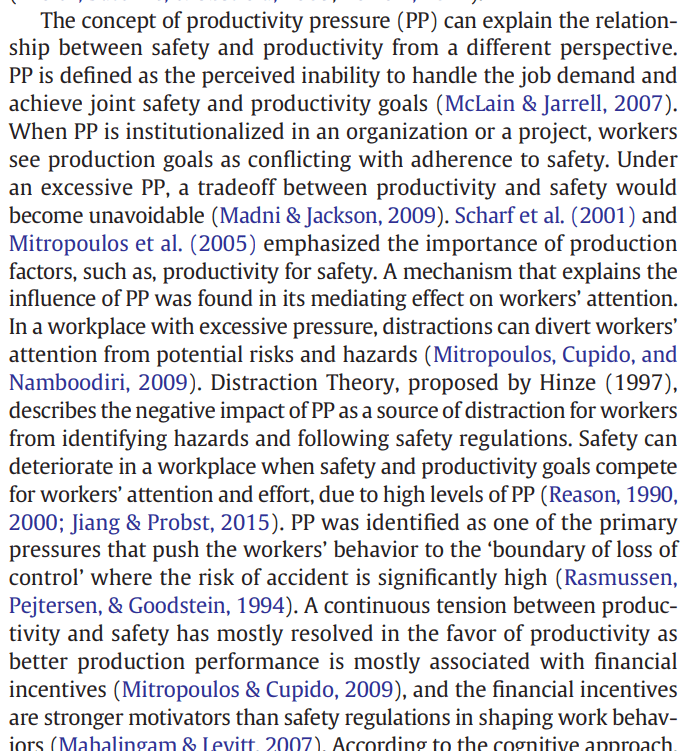
For example, Lean may help improve productivity but may also “indirectly endanger the safety of laborers by increasing the level of PP” (p108). PP is Productivity Pressure, being the perceived inability to handle job demands and achieve both safety & productivity goals.
Results
Overall, it was found that the relationship between safety and productivity is inconclusive and depends largely on the specific management strategies that are implemented.
Four management strategies were found to have largely positive effects on safety: Labour management; supervision & leadership; planning; management of construction. However, “the interactions of construction and human related management strategies were not always in favor of safety in construction projects” (p113).
For HR strategies, labour management had the greatest positive influence for safety, followed by supervision & leadership.
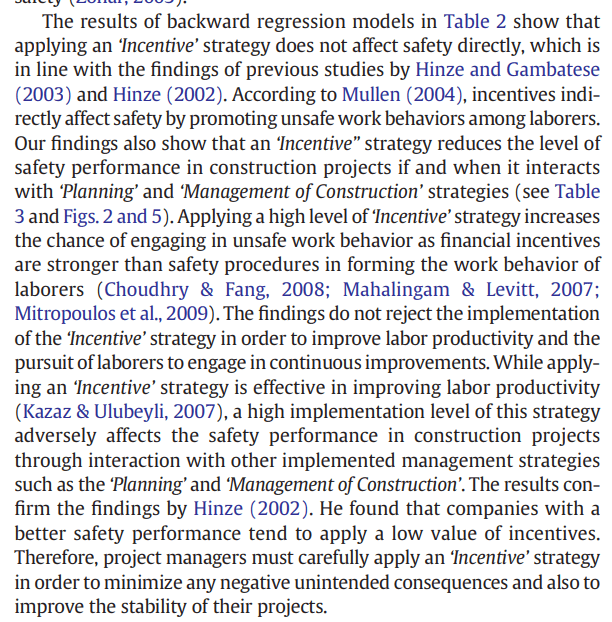
For CM, management of construction (including material, equipment, rework, safety & quality management) & incentive programs had a significant negative impact on safety. Further, the positive effects of planning strategy “may be eliminated by implementing a high level of ‘Incentive’ strategies” (p111). Safety performance was shown to be negatively affected in well-planned projects when a high level of incentive strategies to boost labour were present; with incentives also negatively impacting other management of construction strategies on safety.
Specifically from this study, incentives didn’t directly impact safety, but indirectly via interactions with planning and management of construction strategies.
The positive effects of planning strategies on safety is exacerbated by implementation of labour strategies, but the positive impact is reduced by a high-level implementation of communication strategies.
To quote the paper, “the positive impact of the ‘Planning’ strategy on safety performance is reduced by implementing a high level of ‘Communication’ strategy” (p112), which authors note reveals the complexity of the relationships between safety & productivity in construction [and perhaps in the way that they captured & interpreted the data].
However, notably, the communication strategies emphasised productivity, which may have impacted trade-offs towards productivity – which authors advise is a cautionary tale for project managers in implementing communication strategies.
Further, unintended consequences of prioritising productivity messaging is that workers may compromise their own safety as “they believe that the company retains the productive laborers rather than the safe ones” (p113).
Finally of interest is that the findings show it’s ill-advised to assume projects will remain safe because safety management systems are in place because “safety can be influenced by factors that are out of the scope of safety management systems” (p113).
Thus, and not surprisingly, “the implementation of the safety management systems is not sufficient to achieve a safe project. The safety needs to be integrated into operational decision-makings in order to be seen as a priority of the business” (p113-114).
Authors: Ghodrati, N., Yiu, T. W., & Wilkinson, S. (2018). Journal of safety research, 67, 107-116.
Study link: https://doi.org/10.1016/j.jsr.2018.09.001
LinkedIn post: https://www.linkedin.com/pulse/unintended-consequences-management-strategies-labor-ben-hutchinson-no7te

 SafetyInsights.org