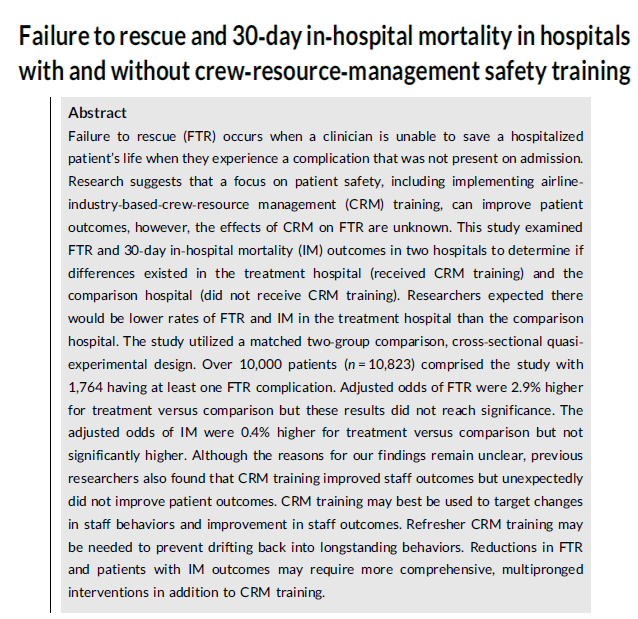
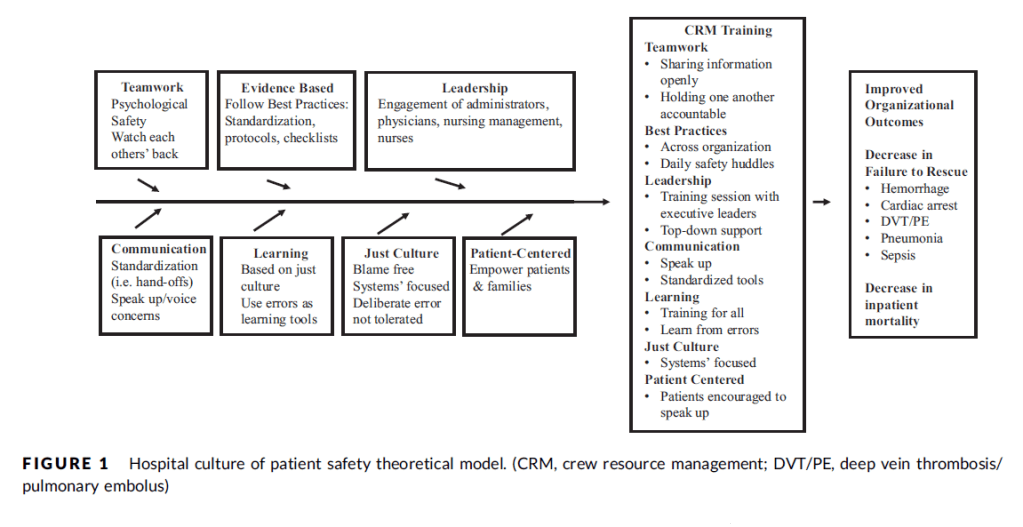
What impact does a comprehensive Crew Resource Management (CRM) training program, and subsequent practices, have on in-hospital patient mortality and failure to rescue? Not a lot, according to another upcoming study.
Two hospitals, one control and one intervention, were compared after 3 years. The CRM program in the intervention hospital consisted of a 4-hr comprehensive CRM program and included all surgical services employees (>1,600 people), and >10,000 patients.
Key findings were that:
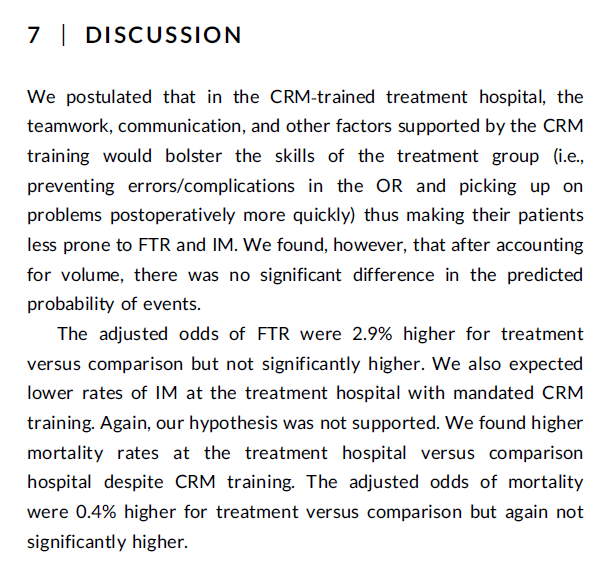
· No statistically significant differences were found between hospitals on the probability of failure to rescue or in-hospital patient mortality (after controlling for volume).
· They suggest several reasons why the intervention may not have been successful. For instance, perhaps these effects require more comprehensive, multipronged interventions in addition to the CRM training. There was also no refresher training over the time period.
It’s said that the implementation “of a comprehensive CRM training program in an organization is complicated”. This study was designed with the premise that 3 years post-implementation of the CRM program would be sufficient to pick up on improvements on FTR and mortality; hence, part of the “usual way of doing business”.
Nevertheless, they found no statistically significant differences.
They rightly observe that the implementation of a CRM program is “complicated” (if not complex).
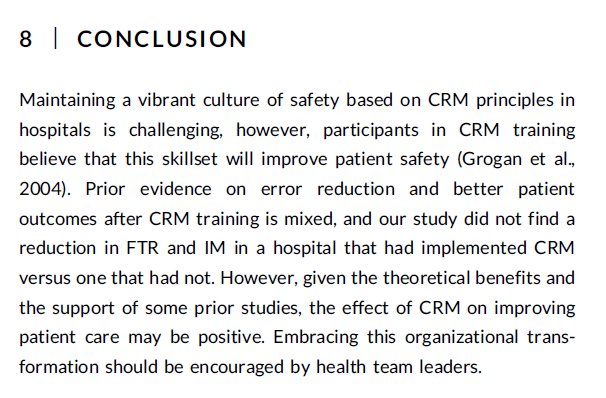
While this study found no differences in patient mortality, other theoretical benefits of CRM may still be worth it.
[*Note: Some may question whether we’d expect to find significant differences between something like a CRM program on rare outcome measures like patient mortality, especially in complex environments, but this wasn’t really discussed in the paper]
Authors: Bacon, C. T., McCoy, T. P., & Henshaw, D. S. (2020). Research in Nursing & Health, 43(2), 155-167.
Study link: https://doi.org/10.1002/nur.22007

 SafetyInsights.org
One thought on “Crew Resource Management training and patient mortality: no significant effects”