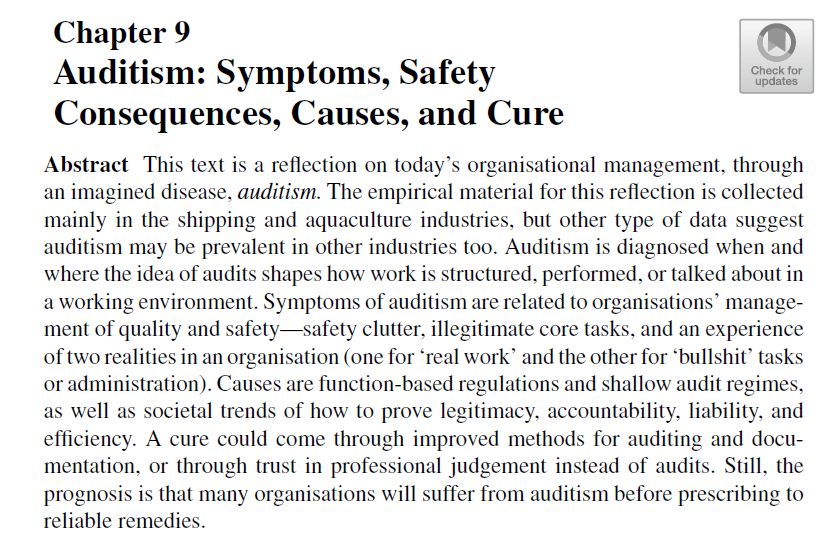
This chapter explores an organisational “imagined disease”, termed by the author as “auditism” [** I love this term].
I’ll be using a lot of direct quotes. I haven’t done a good job of this, so recommend you check out the chapter.
It’s noted that we’re surrounded by auditism and have been convinced that what we do at work must be documented, to “prove that we did what we should have done”.

Auditism is said to emerge “when and where the idea of audits shapes how work is structured, performed, or talked about in a working environment”, differing from the intention of auditing (e.g. ensuring the governing qualities of a system etc).
It’s said in order to be seen to be accountable, they audit, so tasks are documented and standardised to become auditable.
Symptoms of Auditism
Auditism is indicated by how organisations adapt to audits. Many examples are said to exist, but all relate to “the growing of two parallel lines of work, one concerned with real work and another with ‘bullshit’ tasks, to adopt a provocative term famously used by Graeber”.

“Effective” audits may be seen to require quantifiable tasks that are standardised and objectified. Here, “standard tasks”, said to resemble the core work that people do, are counted and measured “even though these tasks may not contribute to the operations, and only constitute another layer of mandatory tasks to be performed”.
When auditing gets a central place in organisations, it’s said to create knowledge, which then creates audit loops. These audit looks mutually shape interactions between auditors and auditees, meaning that the audits construct the environments they operate in to make the environments more auditable. This loop leads to more auditing in response to failures observed in audits. It’s said that “Auditism is demonstrated clearly when organisations implement systems that are auditable, even if the system is not meeting its goals or supporting the core work”.

In the safety management world, auditism may be seen in safety clutter and illegitimate core tasks. Across many industries, “safety management systems are seen as too extensive, bureaucratic, and focused on documentation, thus creating a risk rather than ensuring safety”. This “one-sided focus and overreliance” on safety management systems can suppress other functions in the company.
Moreover, “A symptom of auditism is to not recognise that ill-fitting management systems might work against the objective of the system”. Also, evaluating safe work (how core tasks are performed safely), is often difficult to audit; hence auditism results in more safety work via extra tasks in order to evaluate products of work.
Some people report that the safety systems are made for arse-covering purposes, and hence the auditable tasks (the safety work) “thus create a parallel trail of tasks, alongside the un-auditable core tasks”. That is, the core tasks “go on outside the managed part of the organisation, undocumented and often despite the safety management system”. This creates a gap between formal rules and informal practices, which audits may overlook.
Based on data from industries like aquaculture, safety systems have been described as “exaggerated, complicated, and featuring procedures that are excessively detailed”. Others in shipping have reported that the implementation of safety management systems are “only on paper”, and other companies “buy generic, standardised safety management systems that are guaranteed to satisfy auditors”.
Purchasing systems not fit for purpose results in an “unwieldy system that is designed to cover all even-tualities, and situations, but with several procedures that do not fit the situations on their vessels”.
Drivers for Auditism
Auditism is said to be a consequence of regulation and the expectation of organisations. For one, organisations seek systems that are meant to fit the companies specific activities, but must also be auditable and documented. These requirements are said to often be in conflict.
Effective auditing is said to necessitate measurable tasks (standardised, objectified, quantifiable), as this makes it easy for checking compliance. Yet audits aren’t typically equipped to verify that organisations are doing enough, since the regulations and standards rarely describe what ‘enough’ is. Thus, management “fears being blamed for insufficient procedures, so they show they do ‘all they can’ through all-embracing safety management systems” and auditing “can therefore require reels of red tape at the expense of trust, dialogue, and autonomy”.
Shallow auditing methods may also lead to auditism. Here the author argues that “ Paper trails are supposed to give auditors the ability to ensure that rules are being followed without examining the actual work”. Companies seek verification to demonstrate accountability and legitimacy, yet managers and operational personnel have been noted to see procedures mainly there for liability reasons and can in practice “be ignored”.
Treatment for Auditism
The author then proposes some ideas on how to address the disease of auditism. I think this is the weakest part of the chapter.
This includes regulation, use of technology to reduce the amount of safety clutter, documentation, reporting and other activities not seen as critical to the ‘core tasks’ of work.
Trust is proposed as an alternative to audits. It’s said that regulators must presently rely on industry giving correct, truthful information about its operations. Despite this, their systems are still audited. It’s said that “The audit requirements create a misunderstanding that trust is not there. Organisations implement impermeable rules and red tape, that potentially lead to auditism and cancel out existing trust”
Here, professional judgement is said to be the control mechanism, living in the “unaudited backstage”. Use of trust and judgements could “potentially inspire new systems not infested by auditism”.
Author: Størkersen, K. V. (2024). Auditism: Symptoms, Safety Consequences, Causes, and Cure. In The Regulator–Regulatee Relationship in High-Hazard Industry Sectors: New Actors and New Viewpoints in a Conservative Landscape
Study link: https://doi.org/10.1007/978-3-031-49570-0_9
LinkedIn post: https://www.linkedin.com/pulse/auditism-symptoms-safety-consequences-causes-cure-ben-hutchinson-0ttjc

 SafetyInsights.org
2 thoughts on “Auditism: Symptoms, Safety Consequences, Causes, and Cure”