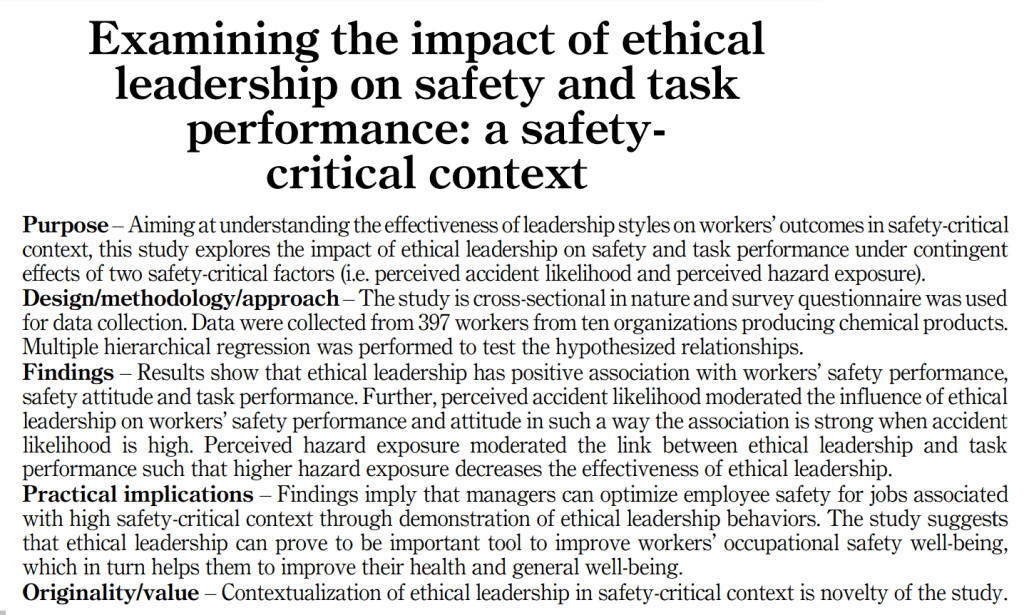
This studied the impact of ethical leadership on safety & task performance under the effects of two safety-critical factors:
1) perceived accident likelihood,
2) perceived hazard exposure.
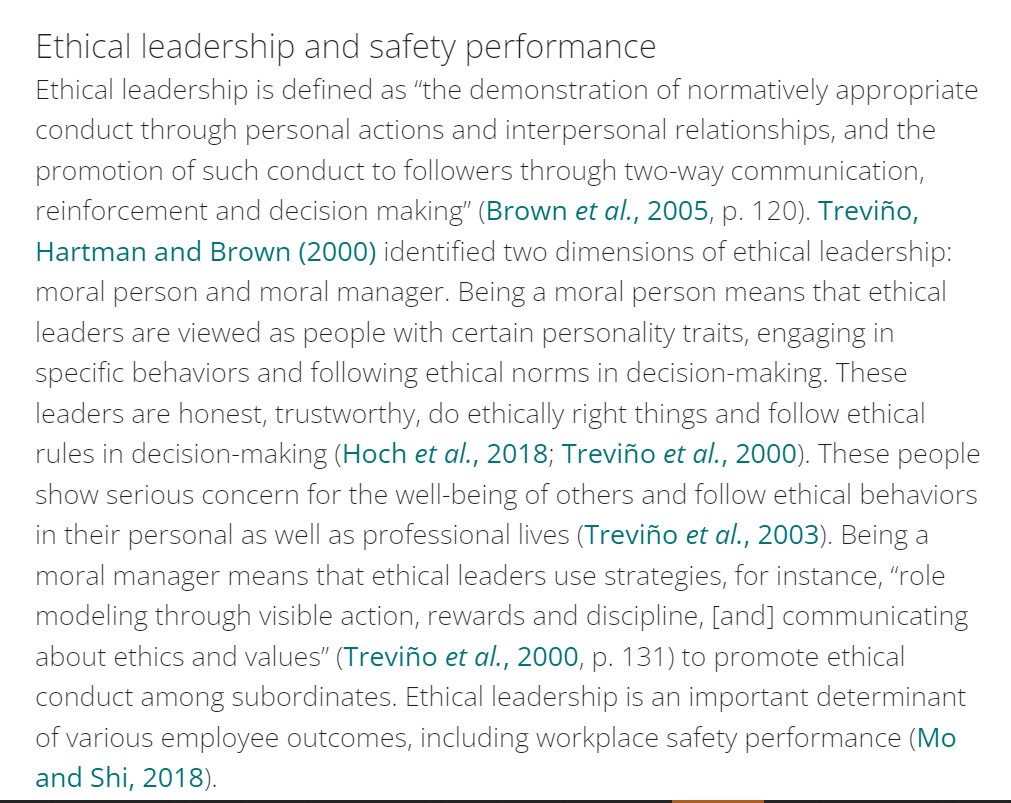
Ethical leadership is defined as “the demonstration of normatively appropriate conduct through personal actions and interpersonal relationships, and the promotion of such conduct to followers through two-way communication, reinforcement and decision making”.
A cross-sectional design was used collecting data from 397 workers.
Results
Findings indicated that there is a positive effect of supervisor ethical leadership, where “that workers who receive more ethical leadership produce higher safety performance and task performance than those who receives less or no ethical leadership”.
Specifically, supervisor ethical leadership had a positive correlation with safety participation, safety compliance & safety attitude; but only a relatively modest link with task performance.
Transformational leadership was positively correlated with ethical leadership & workers’ safety & task performance.
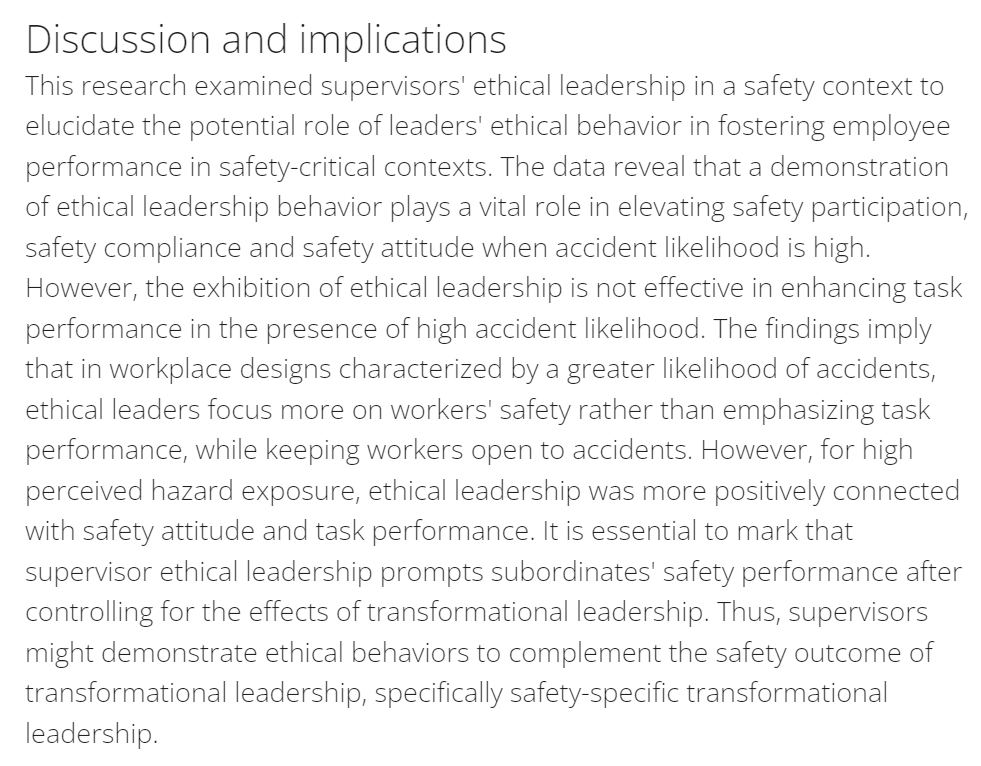
However, supervisor ethical leadership “did not moderate the ethical leadership–task performance linkage, which suggests that ethical leaders do not prioritize task performance (over safety performance) under high accident likelihood”. That is, the presence of ethical leadership isn’t effective in enhancing task performance under the presence of high perceived accident likelihood.
For high perceived hazard exposure, ethical leadership was more positively linked with safety attitude & task performance.
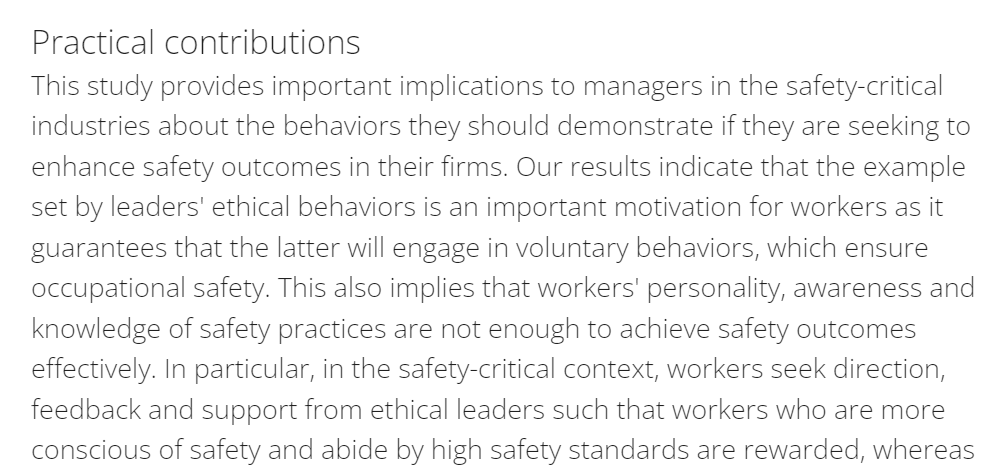
Practically speaking, the authors highlight the importance of leader behaviour on safety & task performance within firms. Further, focusing on “workers’ personality, awareness and knowledge of safety practices are not enough to achieve safety outcomes effectively”.
Specifically, in safety-critical environments workers seek direction, feedback & support from ethical leaders – such that ethical leaders can foster safety performance in environments of high perceived accident probability, and if job designs are less safety-critical, can also positively influence task performance.
Authors suggest that firms should promote ethical leadership behaviours among managers & supervisors.
Authors: Shafique, I., Kalyar, M. N., & Rani, T. (2020). Leadership & Organization Development Journal, 41(7), 909-926.
Study link: https://doi.org/10.1108/LODJ-07-2019-0335
LinkedIn post: https://www.linkedin.com/pulse/examining-impact-ethical-leadership-safety-task-ben-hutchinson-6igkc

 SafetyInsights.org