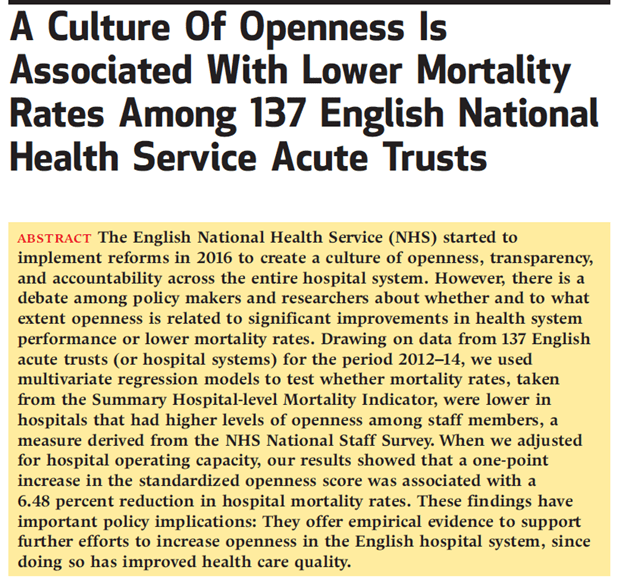
This study explored the role of a culture of openness on mortality rates among 137 English hospital systems between 2012-14.
Thanks to sidneydekker.com for flagging this paper during the recent Global Safety conference.
Providing background:
· It’s said that while many agree about the importance of openness, it has “proved difficult to define and operationalize empirically”
· Openness has been referred to as “environment in which communication among patients, staff members, and managers is open and transparent”
· Or as an environment where “staff freely speak up if they see something that may negatively affect a patient” and “feel free to question those with more authority”
· It’s said that openness appears to be a “vital component of organizational culture in health care”, with Amy Edmonson’s data suggesting that “a primary influence on detecting errors in health care provision was the staff’s willingness to discuss them openly”
· Openness has been linked to better patient safety and a better understanding of patients’ care goals, subsequently with lower mortality rates
· In US data, lack of openness has been linked with a “poorer” safety climate, where “organizations and systems that lack openness are less focused on improving the safety of health care and their standards of quality, with higher readmission rates for heart attack and heart failure, longer lengths-of-stay, and less improvement in postoperative outcomes”
· Despite the above, the effects of openness on mortality and morbidity isn’t clear
Results
Via multivariate regression models, they found that:
· Hospital-level mortality indicator data was lower in hospitals with higher levels of openness among staff
· When adjusted for hospital operating capacity, a one-point increase in the standardised openness score was associated with a 6.48% reduction in hospital mortality rates
· When they controlled for each single component in their model, error and disclosure explained the decrease in hospital mortality rates – a one-point increase in the standardised error component was associated with a 1.69% decrease in mortality
· A one-point increase in the disclosure component was associated with a 1.25% decrease in hospital mortality
· Their other two components – safety and report, weren’t statistically significant
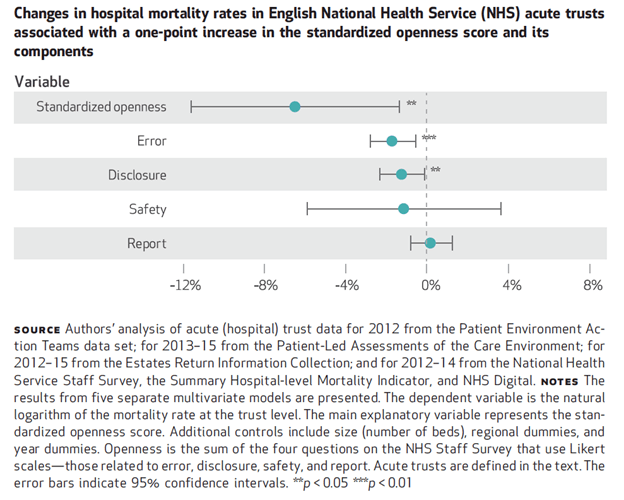
When accounting for the effectiveness of procedures for reporting errors and incidents, and staff experiencing harassment, bullying or abuse in the definition of openness, each one-point change in this revised openness score accounted for a 6.48% reduction in mortality.
In summary, they argue that:
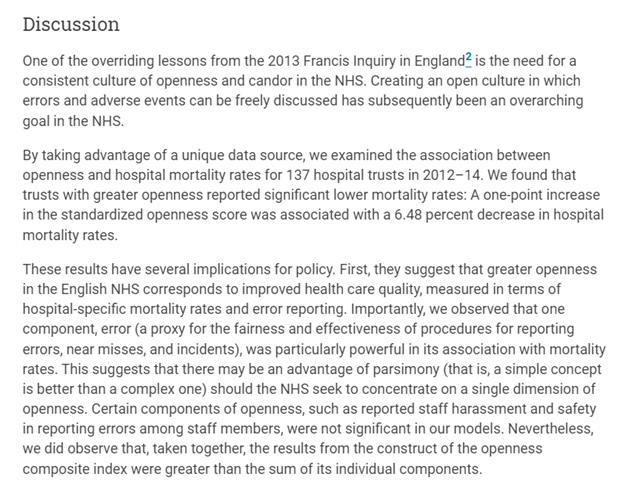
1) these findings suggest that greater openness corresponds to improved health care quality via hospital mortality and error reporting
2) error, said to be “a proxy for the fairness and effectiveness of procedures for reporting errors, near misses, and incidents”, was found to be particularly powerful in its association with mortality rates
3) the above suggests that “there may be an advantage of parsimony (that is, a simple concept is better than a complex one) should the NHS seek to concentrate on a single dimension of openness”
4) And further, other components of openness, like staff reporting harassment and safety in reporting errors among staff weren’t statistically significant in their models
5) Nevertheless, they did observe that “taken together, the results from the construct of the openness composite index were greater than the sum of each single component”
As usual, be mindful of limitations. For one, this study couldn’t establish causality as they couldn’t establish clear treatment vs control groups. Hence the findings are correlational. Openness may have been impacted by other factors that weren’t available for study. Moreover, other factors associated with mortality fell outside the scope of the study + other limitations.
Authors: Toffolutti, V., & Stuckler, D. (2019). Health Affairs, 38(5), 844-850.

Study link: https://doi.org/10.1377/hlthaff.2018.05303
Sidney’s site: https://sidneydekker.com/
LinkedIn post: https://www.linkedin.com/pulse/culture-openness-associated-lower-mortality-rates-among-hutchinson-0awqc

 SafetyInsights.org
2 thoughts on “A culture of openness is associated with lower mortality rates among 137 English National Health Service Acute Trusts”