I found this interesting – it studied the impacts of different workplace nudge interventions on particular worker behaviours around gas monitor compliance and handrail holding. The setting was a Belgian steel plant.
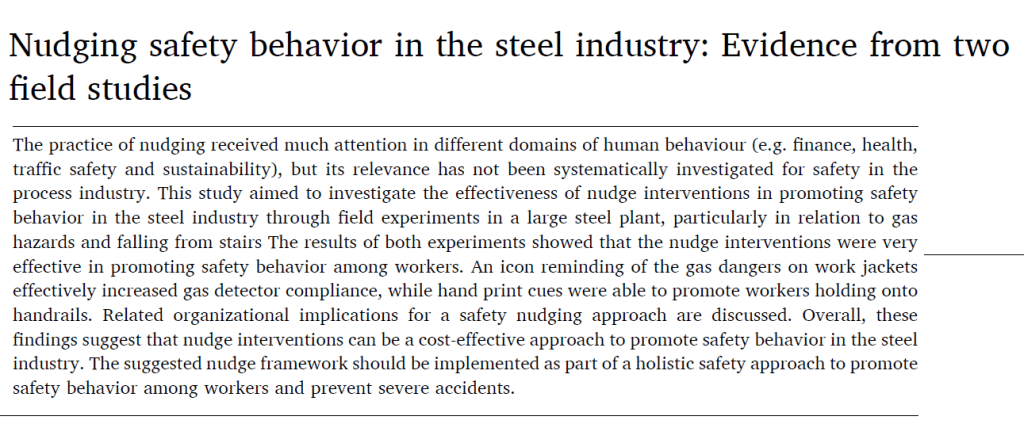
Not a summary – but if it interests you then check out the paper.
Nudge effectiveness has recently taken a bit of a beating following systematic reviews. Conversely, this study found nudges to be somewhat effective in the short to mid-term.
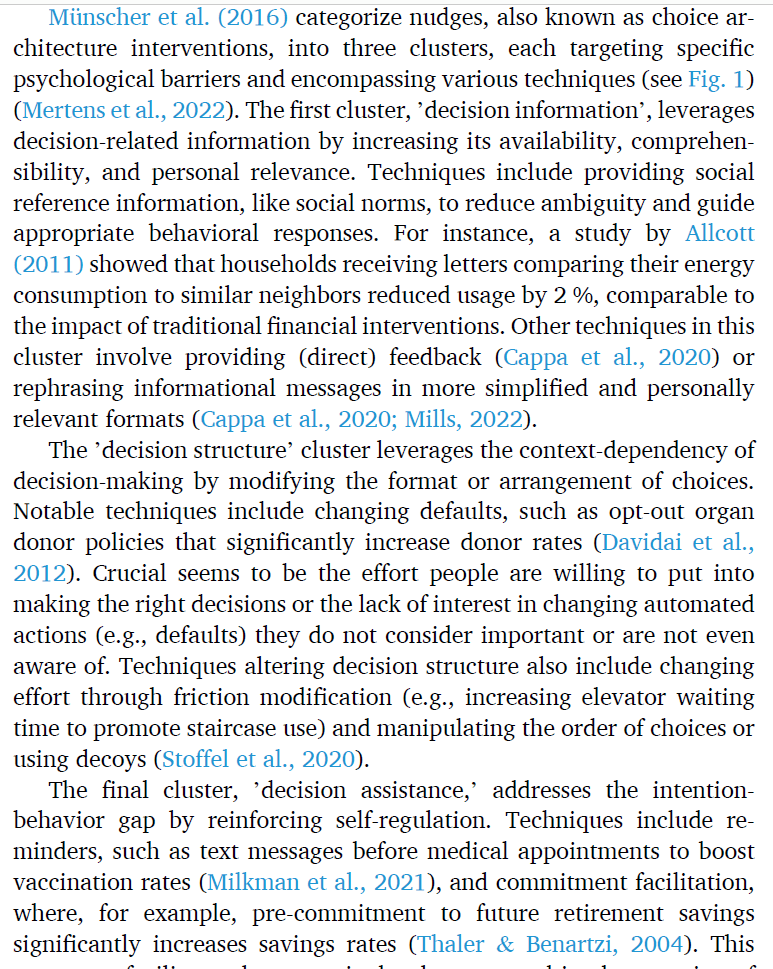
They studied the impact of various nudge interventions, including a computer screen confirmation for workers to confirm the correct gas monitor is in use, and an icon sewn onto their shirts (where the gas monitor should be placed).
For handrail compliance they tested the effects of handprints and symbols stickers in different colours on the handrail.
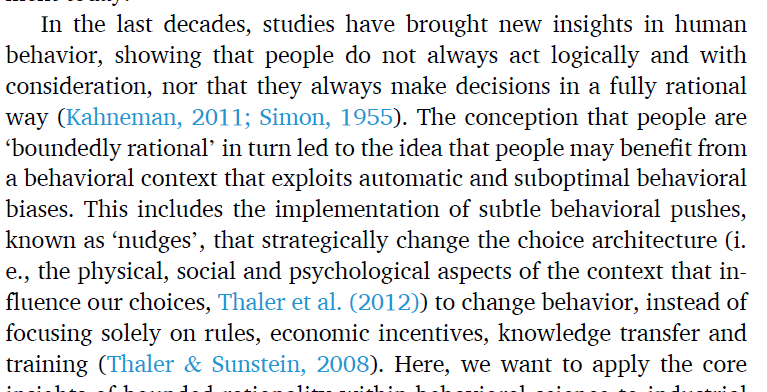
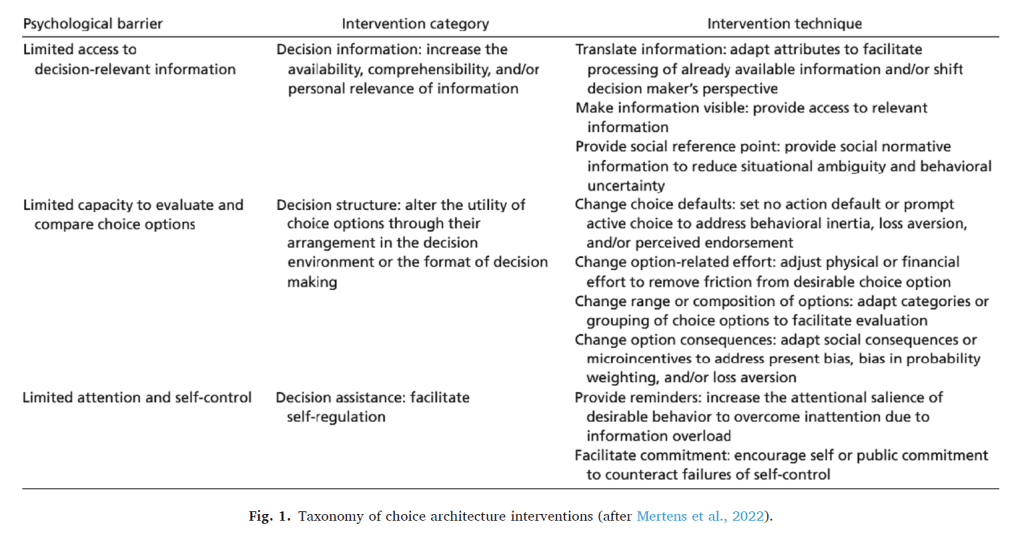
They drew on bounded /local rationality as a lens, and type 1 and 2 thinking [** more frequently referred to as system 1 and 2, but for various reasons this is less precise as these processes in the brain aren’t really distinct ‘systems’]
In both interventions, small to medium but statistically significant effects were observed.
They argue that these findings are promising, and nudges can be a cost effective means as part of a wholistic approach to risk management.
Of course, they kept the interventions pretty simple – handrails (meh), and gas monitor usage (which is important), but there’s a lot more potential here with safety-critical activities, and upstream with leadership (nudging production/safety trade-offs, second-order decision making etc.).
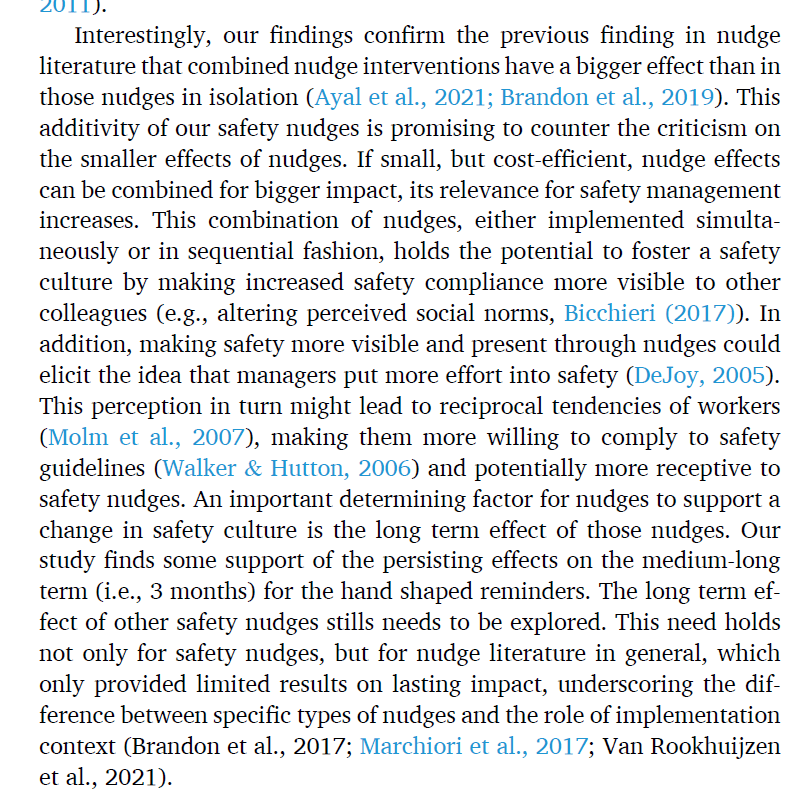
Authors: Costa, S., Duyck, W., Van Wouwe, E., & Dirix, N. (2024). Nudging safety behavior in the steel industry: Evidence from two field studies. Safety Science, 173, 106444.
Study link: https://biblio.ugent.be/publication/01HQ5D47KQZRBD8AQYTVMT9TKC/file/01HQ5D6JNFSZDE7Y4B7EKN3XDP

 SafetyInsights.org
One thought on “Nudging safety behavior in the steel industry: Evidence from two field studies”