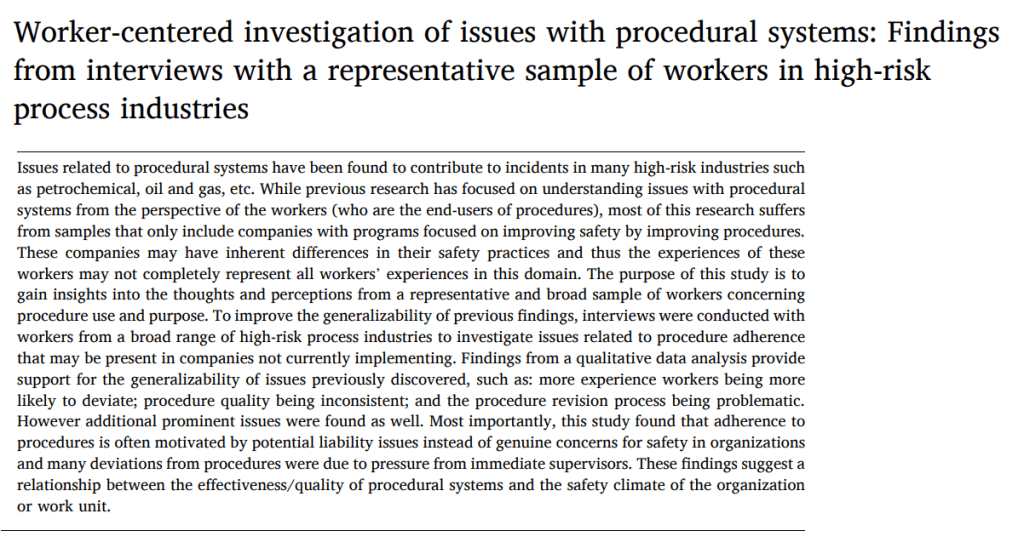
This explored the thoughts & perceptions of workers concerning procedure use & purpose via interviews. 20 workers from the process industries (refining, chemical plants etc.) were included.
Results
For changing procedures, most workers indicated going to their supervisor to start the change process. However, some workers had a negative view of the change process, citing:
1) procedure change starting but not being completed,
2) taking too long,
3) workers not finding the process necessary for themselves or others,
4) the firm culture not approving of the process change.
Some evidence suggested that a procedure change could vary between weeks to 6 months. Significant lapses could affect workers’ propensity to use procedures, or if it took too long then have them believe that their input isn’t valued. Authors cite a study suggesting that workers’ perceived procedure quality was predictive of whether they used the procedure.
For perceptions on the utility of procedures, some workers indicated that using procedures was about “helping to mitigate potential liability issues” (p12). Authors argue that if workers are expected to blindly follow procedures then they are less likely to be critically thinking where it may be dangerous or inefficient to perform the task as per the procedure (e.g. “malicious procedural compliance”).
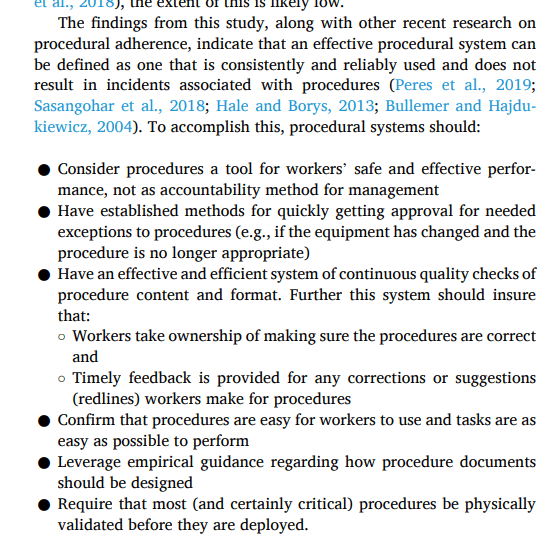
It’s noted that when procedural systems are designed for blind compliance and workers have this attitude towards them, “it indicates that the workers experience procedures as a tool for management as opposed to a tool to support their performance and safety” (p12). This is supported by other research.
For procedure use, over half of workers indicated that they depart from procedures by either not following the steps exactly or by not using the procedure at all. These departures were usually due to equipment malfunction or contextual changes in tasks. From one worker’s perspective, “I mean, you don’t deviate to the point where it’s dangerous. You just kind of… you operate. You know, you’re an operator—you operate the equipment.” (p13).
For the reasons why, reducing time was a major factor and this was regularly reported to be linked with pressure from immediate supervisors. Other frequently reported reasons included worker experience & when a task if physically impossible to complete due to equipment malfunction, where procedural departure is seen as the only practicable action to take.
Some workers indicated that their firm had processes for requesting an emergency procedural deviation that they would regularly use.
Rule departure in this study was similar with other research, where “workers deviate when procedures are deemed to be inaccurate, outdated, or contain unnecessary information” (p15). Rule use also decreased over time for some workers due to familiarity with the task.
For some workers, an attitude of disinterest or professional pride guided their perception of procedures. For example if the task was seen to be mundane or they were too experienced, then they were less likely to use a procedure. Quoting the authors, “This may suggest that experienced workers may develop procedures that are perceived as more “efficient” or “adequate” experientially” (p15).
A trade-off here may be replacing “knowledge in the world” with “knowledge in the head” and may increase the chance of forgetting key steps for safety-critical work.
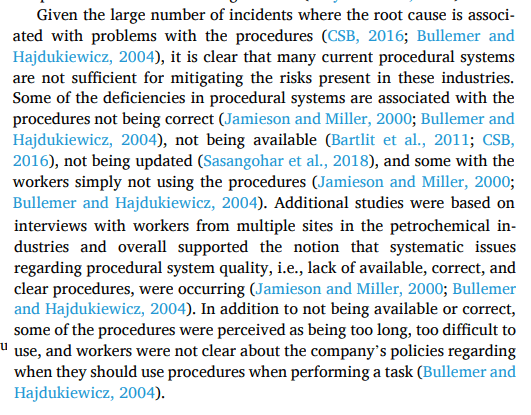
Findings indicate that the management & implementation of procedures is a complex issue, becoming even more difficult in larger firms. And implementing an effective procedural system requires more than the content of the procedures & procedure training because it may fail to address critical elements like:
1) pressure from supervisors
2) attitudes that procedures are more a protection from liability
3) long turnaround times for revising procedures
That is, procedures & training are “necessary but not sufficient for an effective procedural system” (p18). Thus, “understanding behaviors pertaining to procedures requires a holistic understanding of the inextricable link between the procedural systems, their implementation, and the Safety Climate … of the organization”, which we could extend beyond safety climate to understanding the entire sociotechnical system.
Finally, authors argue that even if a firm could produce practically perfect procedures & trained workers, if the overarching business prioritises production [and in my view this isn’t always obvious trade-offs but often many subtle and locally optimal but pervasive practices & decisions], then “workers will likely be put in a position where they are asked to violate procedures to save time and increase productivity” (p18).
Authors: Peres, S. C., Smith, A., & Sasangohar, F. (2020). Journal of Loss Prevention in the Process Industries, 67, 104264.
Study link: https://doi.org/10.1016/j.jlp.2020.104264
LinkedIn post: https://www.linkedin.com/pulse/worker-centered-investigation-issues-procedural-from-ben-hutchinson-cmdbc

 SafetyInsights.org
2 thoughts on “Worker-centered investigation of issues with procedural systems: Findings from interviews with a representative sample of workers in high-risk process industries”